
Guppy Fish Care Guide: Tank Setup, Diet, Breeding & Lifespan

Guppies need a cycled 10-gallon or larger tank, a filter, stable warm water, and small meals. Aim for 74-80°F (23-27°C), pH 7.0-8.0, and 0 ppm ammonia and nitrite. Before buying any fish, choose your group: males only if you don’t want fry, females only with the warning that they may already be pregnant, or one male per two or three females if you’re ready for babies.
That choice prevents two common guppy problems: nonstop chasing and surprise overcrowding. A quiet little group can turn into a family reunion faster than most new keepers expect.
Guppies are friendly beginner fish, but they aren’t meant for an uncycled bowl. When they suddenly hide, gasp, or die, check the water before reaching for medicine. Poor water quality, too much food, and illnesses carried by new fish cause many early losses.
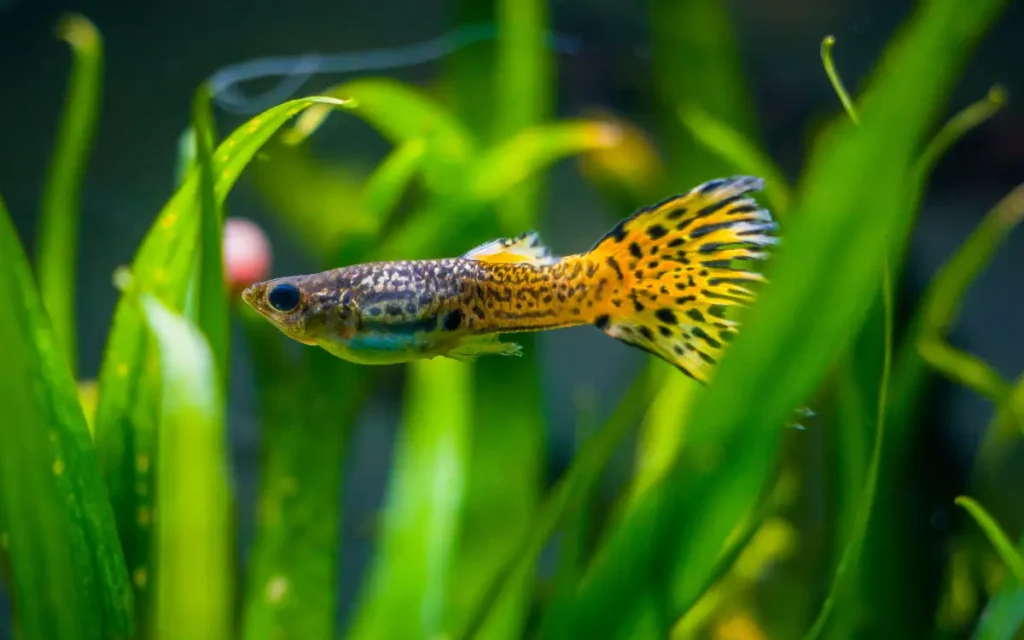
Guppy Care at a Glance
| Care need | Recommended starting point |
| Scientific name | Poecilia reticulata |
| Adult size | Males: about 1.5-2 inches; females: about 2-2.5 inches |
| Usual lifespan | About 2-3 years |
| Tank size | 10 gallons for a small group; 15-20 gallons is easier for a mixed or community tank |
| Temperature | 74-80°F (23-27°C) |
| pH | 7.0-8.0 |
| Water hardness | Moderate to hard water, roughly 9-19 dGH |
| Ammonia and nitrite | 0 ppm |
| Diet | Omnivore |
| Temperament | Peaceful and active, with frequent chasing among guppies |
| Tank level | Mostly upper and middle water |
What Is a Guppy Fish?
A guppy is a small freshwater livebearer, which means the female gives birth to free-swimming fry instead of laying eggs around the tank. Guppies are native to northern South America and nearby Caribbean islands, though people have introduced them to warm waters in many other parts of the world.
Domestic guppies come in a wide mix of tail shapes, colors, and patterns. Males are usually smaller and more colorful, with a narrow anal fin called a gonopodium. Females are usually larger, rounder, and less flashy. The difference is easier to spot once the fish mature.
See the visual traits in the male vs. female guppy guide, or compare common colors and tail shapes in this guide to the types of guppies.
Are Guppies Easy to Care For?
Yes, guppies are a good first fish once the aquarium is cycled. They eat readily, stay small, and adjust to a reasonable range of conditions. Their weak point is sudden change.
A guppy can look fine in the morning and clamp its fins by evening if ammonia rises, the heater fails, or a new fish brings in disease. “Hardy” means a guppy can handle ordinary variation. It doesn’t mean the fish can live in dirty water.
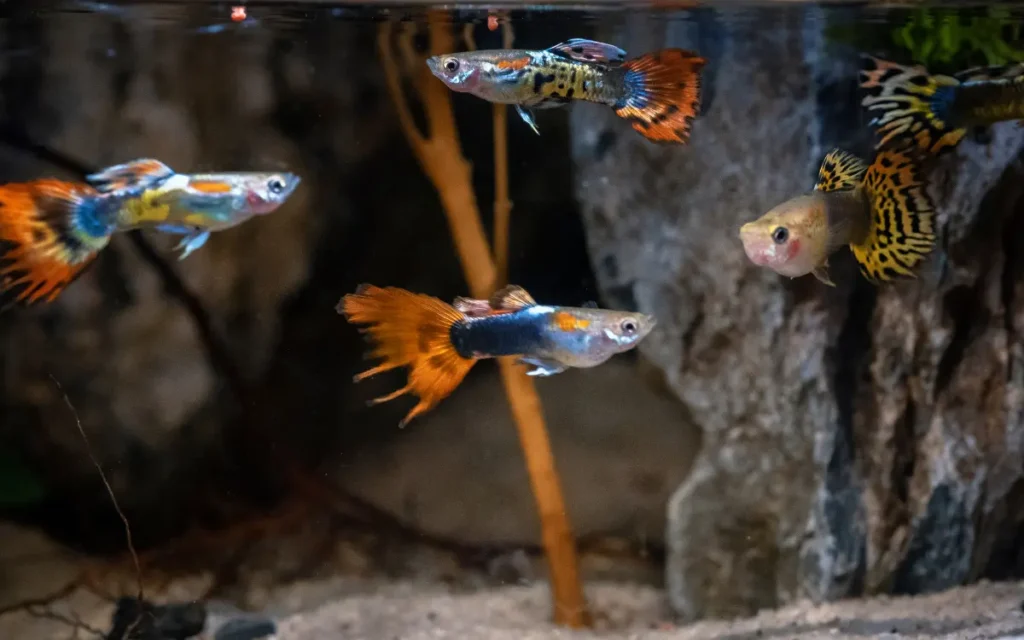
Choose Your Guppy Group Before You Buy the Tank
This is the decision many care guides leave until the breeding section, when it is already too late.
| Group | Best for | What to watch for |
| Males only | Bright color without pregnancies | Males still chase and display. Plants and enough swimming room help spread attention. |
| Females only | A quieter-looking group | Adult females may arrive pregnant and can store sperm, so fry are still possible after purchase. |
| Males and females | Keepers who want to breed | Keep about one male for every two or three females. Plan space or homes for the fry before mixing sexes. |
Avoid buying one male and one female. The female receives all of the male’s attention, which can leave her stressed and exhausted. Also avoid keeping only two males in a bare tank, where one fish may take the full force of the other’s chasing.
If you choose a mixed group, start with a larger, planted tank. Read the full guppy breeding guide before bringing the fish home.
What Tank Size Do Guppies Need?
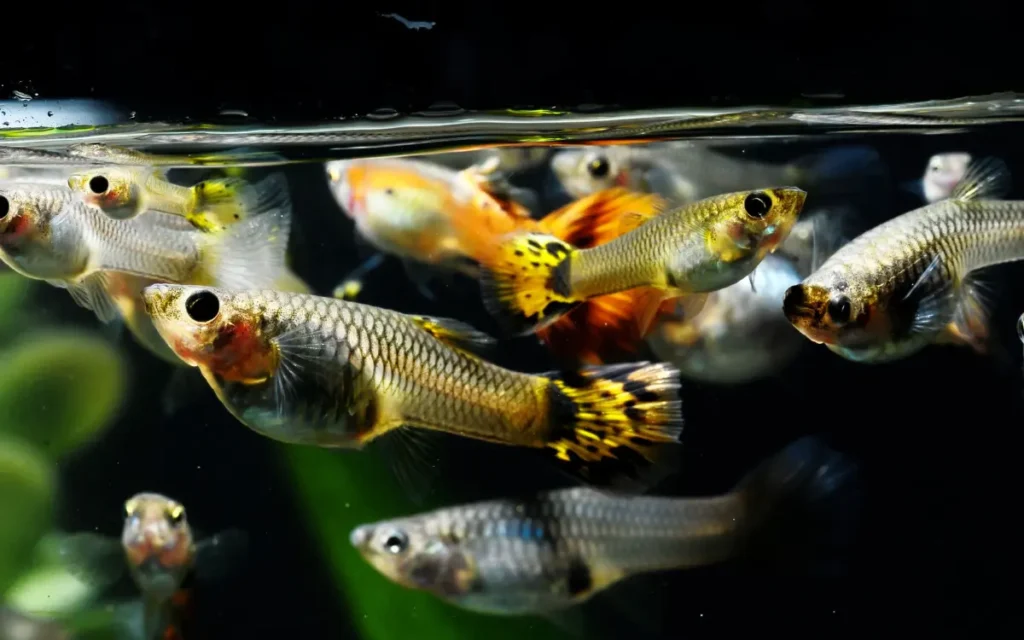
A 10-gallon tank is a sensible starting point for a small group of guppies. A 15- or 20-gallon tank gives beginners more room for mistakes, more swimming space, and slower swings in water quality.
Five gallons can hold a very small number of guppies under close care, but it leaves little room for waste, chasing, tank mates, or unexpected fry. That makes it a poor first setup for most people. A long tank is more useful than a tall tank with the same volume because guppies swim across the upper half.
Stocking isn’t a simple “one inch per gallon” calculation. Adult size, sex, filter capacity, plants, tank mates, and maintenance all matter.
Basic equipment for a guppy tank
- A 10-gallon or larger aquarium with a lid
- An adjustable heater and separate thermometer
- A sponge filter or gentle power filter
- Water conditioner that treats chlorine or chloramine
- A liquid test kit for ammonia, nitrite, nitrate, and pH
- A gravel vacuum and aquarium-only bucket
- Plants or cover, with open space left for swimming
A lid matters. Guppies usually stay in the tank, right up until one decides it has an appointment on the floor.
How to Set Up a Guppy Tank Step by Step
1. Put the tank on a level, steady surface
Keep it away from direct sun, cold drafts, and heating vents. Sunlight can overheat the water and turn a small algae patch into a green-wall project.
2. Add rinsed substrate and safe decor
Gravel or sand both work. Check ornaments for sharp edges that can catch long guppy tails. Add plants along the back and sides while leaving the front or center open for swimming.
3. Install the filter, heater, and thermometer
Set the filter for gentle movement across the surface. If the intake is strong, cover it with a pre-filter sponge so fins and future fry cannot be pulled in.
4. Fill the tank and treat the tap water
Use a conditioner that handles whatever your water supplier uses. Match replacement water reasonably closely to the tank temperature.
5. Complete the nitrogen cycle before adding guppies
The filter needs bacteria that turn toxic ammonia into nitrite, then nitrite into nitrate. This process is called the nitrogen cycle. A bottle of bacteria may help start it, but the calendar cannot tell you when the tank is ready. Your test results can.
Before adding fish, a properly completed fishless cycle should process its planned waste source and return to 0 ppm ammonia and 0 ppm nitrite. Nitrate may be present, though fast-growing plants can use some of it. If cycling is new to you, follow the fish tank cycling guide rather than adding fish after the water has simply sat for a few days.
6. Add fish slowly and test often
Don’t fully stock a new tank in one trip. Add a small group, feed lightly, and test the water each day during the first week. If ammonia or nitrite appears, stop feeding for the moment, change part of the water, and keep testing.
For the rest of the setup, use the freshwater aquarium setup guide.
Best Water Parameters for Guppies
Guppies generally do best in mineral-rich water that is neutral to mildly alkaline. Their broad tolerance is useful, but fast changes are still stressful.
| Parameter | Practical target | What matters most |
| Temperature | 74-80°F (23-27°C) | Keep daily swings small |
| pH | 7.0-8.0 | Don’t force a fast change with pH chemicals |
| GH | About 9-19 dGH | Guppies tend to do poorly long term in very soft water |
| Ammonia | 0 ppm | Any reading needs action |
| Nitrite | 0 ppm | Any reading needs action |
| Nitrate | Keep it low and controlled | Use test trends to adjust water changes and stocking |
If your tap water is very soft or acidic, test its GH and KH before adding mineral products. Ask the breeder or store about the water the fish came from. Slow, measured changes beat guesswork.
Do guppies need a heater?
Most guppy tanks need a heater. You may not need one if the room keeps the tank inside the target range day and night, but room temperature often drops more than people notice. Check the water with a thermometer instead of judging it by how the room feels.
Do guppies need a filter?
Yes. The filter moves water, supports oxygen exchange, traps debris, and houses much of the bacteria that process fish waste. A filter does not replace water changes.
A Simple Guppy Maintenance Routine
Every day
Check that the fish are swimming normally, their fins are open, and all fish come to eat. Confirm the filter is flowing and glance at the thermometer. Remove any dead fish or uneaten chunks of food at once.
Every week
Test ammonia, nitrite, nitrate, and pH. Change about 20-30% of the water as a starting routine, then adjust the amount or frequency to your test results and stocking level. Vacuum waste from exposed areas of the substrate and clean the front glass with an aquarium-safe algae scraper.
When filter flow slows
Rinse sponges or reusable filter media gently in the bucket of removed tank water. Don’t replace all filter media at once, and don’t scrub every tank surface on the same day. That can remove too much of the bacterial colony your fish depend on.
What Do Guppies Eat?
Guppies are omnivores. Feed a quality flake or micro pellet made for small tropical fish, then rotate in small portions of foods such as daphnia, brine shrimp, or a suitable frozen mix.
Feed adult guppies once or twice a day. Give only a small pinch they finish in roughly one minute. Add a little at a time so food does not sink behind the decor and become tomorrow’s ammonia reading.
Use flakes small enough to fit their mouths. Thaw frozen food before feeding, and don’t treat rich foods as the whole diet. Variety is useful; a buffet at every meal is not.
For food size, ingredient choices, and a sample schedule, see the guppy fish food guide.
Best Plants for Guppies
Plants give females a break from chasing and give newborn fry somewhere to disappear. Fine-leaved plants such as Java moss, guppy grass, and water sprite offer especially useful cover. Anubias and Java fern are easy choices for structure, while floating plants dim harsh light and create roots for fry to hide among.
Leave some open water for swimming. Plants can take up some nutrients, but they don’t cancel the need for a filter, tests, or water changes. Compare low-fuss options in the plants for guppies guide.
Guppy Tank Mates
The best guppy tank mate is peaceful, too large to swallow a guppy, unlikely to nip long fins, and comfortable in the same warm, harder water. Check all four points. The word “peaceful” by itself isn’t enough.
Possible choices include some other livebearers, snails, and carefully selected small community fish. Space needs can change quickly once another species is added, so research the exact species rather than buying a general “community fish.” Endlers can breed with guppies, which matters if you want to keep either line pure.
Avoid goldfish because their temperature, waste, and space needs don’t match. Bettas are unpredictable with bright, flowing male guppies. Large fish and known fin nippers are also poor choices.
Use the full guppy tank mates list to compare species before buying. If you’re planning an invertebrate tank, read the separate guide to keeping guppies with shrimp. Adult shrimp may coexist with guppies, but tiny shrimplets can become snacks.
Guppy Breeding and Pregnancy
Guppies breed without much encouragement. A mature female may give birth roughly every three to four weeks, though timing varies with age, temperature, health, and stress. She can also store sperm and produce more than one brood after mating.
Common pregnancy signs include a darkening gravid spot, a growing abdomen, and a belly that looks more squared near birth. Hiding or refusing food can happen close to delivery, but those signs can also point to stress or illness. Look at the whole fish and test the water before assuming she is ready to give birth.
A brood may contain a handful of fry or several dozen. Twenty to fifty is common in many adult guppies, but age, size, and condition can shift that number. Adults may eat fry, including their own.
If you want fry to survive, use dense plants or move the fry to a cycled grow-out tank. Don’t leave a female packed into a tiny breeder box for days. That can add stress at exactly the wrong time.
Read the step-by-step guppy breeding guide for pairing and pregnancy care. Once the babies arrive, switch to the guppy fry care guide for feeding frequency, water changes, and grow-out space.
How Long Do Guppies Live?
Guppies commonly live about two to three years, though genetics and early care make the exact number hard to promise. Warm water speeds metabolism, and poor breeding lines can bring inherited weakness. Clean water cannot rewrite genetics, but it removes one major source of preventable stress.
To give guppies their best chance, keep the temperature steady, avoid crowding, feed small varied meals, and quarantine new fish when possible.
Common Guppy Problems and What to Do First
If several guppies act sick at the same time, suspect the environment before assuming each fish caught a different disease.
- Check the temperature and confirm the filter is running.
- Test ammonia and nitrite right away.
- If either is above 0 ppm, make a partial water change with conditioned, temperature-matched water and test again.
- Increase surface movement or aeration if fish are gasping.
- Isolate an affected fish when practical, especially if you see spots, sores, or rapid decline.
- Identify the likely cause before adding medication. Mixing treatments “just in case” can make the problem harder to solve.
| What you see | Possible causes | First check |
| Gasping at the surface | Low oxygen, ammonia, nitrite, heat, gill trouble | Temperature, filter flow, ammonia, and nitrite |
| Clamped fins and hiding | Stress, poor water, bullying, early illness | Full water test and tank behavior |
| White spots and rubbing | Possible external parasite | Quarantine, temperature, and a clear diagnosis |
| Torn or shrinking fins | Nipping, sharp decor, poor water, infection | Tank mates, decor, and water quality |
| Thin body or stringy waste | Poor intake, internal disease, parasites | Feeding response, quarantine history, and other symptoms |
| Swelling, raised scales, or loss of balance | Serious internal illness or organ trouble | Isolate promptly and seek qualified aquatic veterinary help |
The guppy diseases guide can help you compare symptoms. For a severe problem, a rapid decline, or repeated losses without a clear cause, contact a veterinarian who treats fish. The Merck Veterinary Manual’s aquarium fish overview is also a useful veterinary reference.
How to Choose Healthy Guppies
Watch the whole store tank before choosing a color. Healthy guppies should swim upright, hold their fins open, breathe without struggling, and react when food or people approach.
Skip a tank if several fish have white spots, fuzzy growth, pinched bellies, bent spines, clamped fins, or rapid breathing. One beautiful fish is not worth carrying a tank-wide problem home.
When possible, quarantine new guppies in a separate, cycled tank for two to four weeks. Use separate nets and siphons, and observe before treating. Follow the seller’s acclimation instructions because local pickup and shipped fish may need different handling.
Guppy Care Checklist
- Choose the sex mix before buying fish.
- Start with a cycled 10-gallon or larger tank.
- Keep ammonia and nitrite at 0 ppm.
- Hold a stable temperature around 74-80°F (23-27°C).
- Feed small portions once or twice daily.
- Test the water and change part of it each week.
- Add plants and open swimming space.
- Quarantine new fish when possible.
- Make a fry plan before keeping males with females.
FAQs
Can a guppy live alone?
A guppy may survive alone, but these active social fish are usually better kept with other compatible guppies. Choose the group size and sexes to fit your tank and breeding plans.
How many guppies can live in a 10-gallon tank?
A small group of about five or six adult guppies can be a reasonable starting point in a filtered, cycled 10-gallon tank with no other fish. Use fewer if you add tank mates, and expect a mixed-sex group to outgrow the tank as fry arrive. Test results and behavior matter more than a fixed stocking formula.
Can guppies live in tap water?
Yes, if the tap water is treated for chlorine or chloramine and its temperature and mineral content suit guppies. Test pH, GH, ammonia, nitrite, and nitrate rather than assuming clear water is safe.
Do guppies need an air pump?
Not always. A filter that moves the surface may provide enough gas exchange. Add an air stone if the surface is still, the tank runs warm, the fish gasp, or you need more oxygen during treatment.
Why are my guppies dying suddenly?
Test ammonia, nitrite, and temperature first. Also check for a stalled filter, recent overfeeding, untreated tap water, crowding, or disease introduced by a new fish. Multiple fish declining together often points to a shared water or oxygen problem.
How can I stop guppies from breeding?
Keep only males. A female-only group may still produce fry if the females mated before you bought them because they can store sperm.
Can guppies live with shrimp?
Adult shrimp can sometimes live with guppies when their water needs match and the tank has plenty of cover. Guppies may eat baby shrimp, so this pairing is not a safe choice if every shrimplet must survive.
