
Best Fish for a 20 Gallon Aquarium

A 20 gallon tank is one of the best “real” aquarium sizes you can buy. It’s big enough to keep water more stable, give fish room to act naturally, and let you build a proper community without feeling cramped. It’s also small enough that weekly care doesn’t turn into a huge job.
If you started with something tiny and felt like everything was harder than it should be, that’s normal. Small tanks swing fast. A little extra food, a missed water change, or a new fish can tip things over quickly. That’s why I usually tell beginners: if you have the space, 20 gallons is a smarter starting point than most nano setups. And if you’re currently keeping fish in a smaller tank, you’ll notice the difference right away compared with setups like a 3 gallon guide (here’s our list of fish for a 3 gallon tank) or a 5 gallon option (see fish for a 5 gallon tank).
This guide is built to help you stock a 20 gallon tank the right way: fewer mistakes, better compatibility, and fish choices that make sense long term.
Read also: Aquarium Fish by Tank Size (3 to 75 Gallons Guide)
Why a 20 Gallon Tank Is the Sweet Spot for Most Hobbyists
A 20 gallon tank sits in a nice middle zone. It’s forgiving enough for beginners, but flexible enough for hobbyists who want something more interesting than a single fish tank.
Here’s what changes at 20 gallons:
- More stable water quality. Waste is diluted in more water, so changes happen slower.
- Bigger schooling groups. Many fish look and behave better in groups of 8–12, which is hard in small tanks.
- More “zones.” You can build a community with top, middle, and bottom swimmers.
- Better behavior. Fish have enough space to avoid each other, claim spots, and reduce stress.
- More aquascape options. Plants, driftwood, and rocks can be added without stealing all the swimming room.
My honest take: for most people, a 20 gallon tank is easier to keep stable than a 10 gallon tank, even though it’s larger. The water just gives you breathing room.
20 Gallon Standard vs 20 Gallon Long: Pick the Right Shape First
This is one of the biggest reasons people get disappointed with a 20 gallon tank: they buy the wrong shape.
20 Gallon Standard (taller)
A standard 20 is usually taller with less length. It can work well for:
- Fish that use vertical space
- Tanks with taller plants and wood
- Species that aren’t constant fast swimmers
It can also make stocking trickier for active schooling fish because they often want horizontal room.
20 Gallon Long (more horizontal space)
A 20 gallon long is a favorite for community tanks because it gives more swimming length. It’s often better for:
- Tetras, rasboras, danios
- Larger schools
- Bottom dwellers like corydoras that cruise the floor
- A layout with open swim lanes
If you’re building a community tank, I lean toward 20 gallon long almost every time.
How Many Fish Can You Keep in a 20 Gallon Tank?
Skip the “1 inch per gallon” rule. It’s too simple to be dependable.
Instead, think in three buckets:
- Bioload (waste output): messy fish fill the tank faster than slim, light-feeding fish.
- Swimming space: fast fish need more room than slow fish.
- Temperament: mild fish can share; pushy fish need more space or fewer tank mates.
A practical 20 gallon stocking pattern looks like this:
- 1 centerpiece fish or a calm pair
- 8–12 schooling fish
- 5–8 bottom dwellers (depending on species)
You don’t need to max out the tank to have a beautiful aquarium. In fact, a slightly understocked 20 gallon usually looks cleaner, has fewer algae issues, and gives fish better behavior.
A quick reference table
This isn’t a strict rule, but it’s a useful planning guide.
Fish TypeTypical Count in 20 GallonsNotesCenterpiece fish1 (or a calm pair)Depends heavily on speciesSmall schooling fish8–12Bigger groups look betterCorydoras/loaches5–8Keep social species in groupsPleco/algae eater0–1Only choose species that fit 20g
Best Centerpiece Fish for a 20 Gallon Tank
A centerpiece fish is the “main character.” It doesn’t need to be large. It needs to be noticeable and compatible.
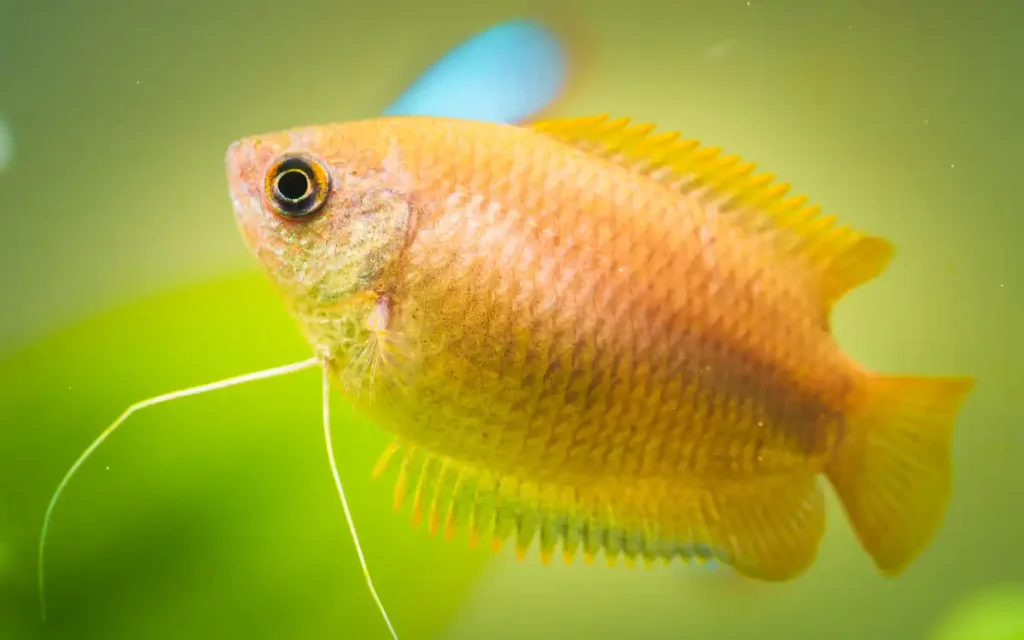
Honey Gourami
A honey gourami is one of my favorite centerpiece choices for 20 gallons. It’s peaceful, doesn’t usually bully tank mates, and fits well in a planted community.
Good with: peaceful tetras, rasboras, corydoras Avoid pairing with: aggressive fin nippers or very boisterous fish
Dwarf Gourami
Dwarf gouramis are common and colorful, but they can be more hit-or-miss with temperament than honey gouramis. In a 20 gallon, keep one unless you really know what you’re doing.
Good with: calm community fish Watch for: chasing, stress, or hiding behavior
Bolivian Ram
Bolivian rams are a great “step up” fish for a 20 gallon because they bring personality without constant aggression. They’re generally calmer than many other dwarf cichlids.
Best setup: warm, clean water; peaceful tank mates; sand or fine gravel
Apistogramma (dwarf cichlid)
Apistos can work in 20 gallons, especially a long tank with plants and hiding places. Pick one species and plan the layout around them.
Tip: more hiding spots equals fewer problems.
Betta (single)
Yes, a betta can be a centerpiece in a 20 gallon, and in many ways it’s easier than keeping a betta in a 5 gallon because you can build a calmer, more natural setup. But the tank mates must be chosen carefully (no fin nippers).
If you want a smaller-tank betta approach, it helps to compare your options with our fish for a 5 gallon tank list, then treat the 20 gallon as an upgrade in space and stability.
Best Schooling Fish for a 20 Gallon Community
This is where a 20 gallon tank shines: you can keep a school that actually looks like a school.
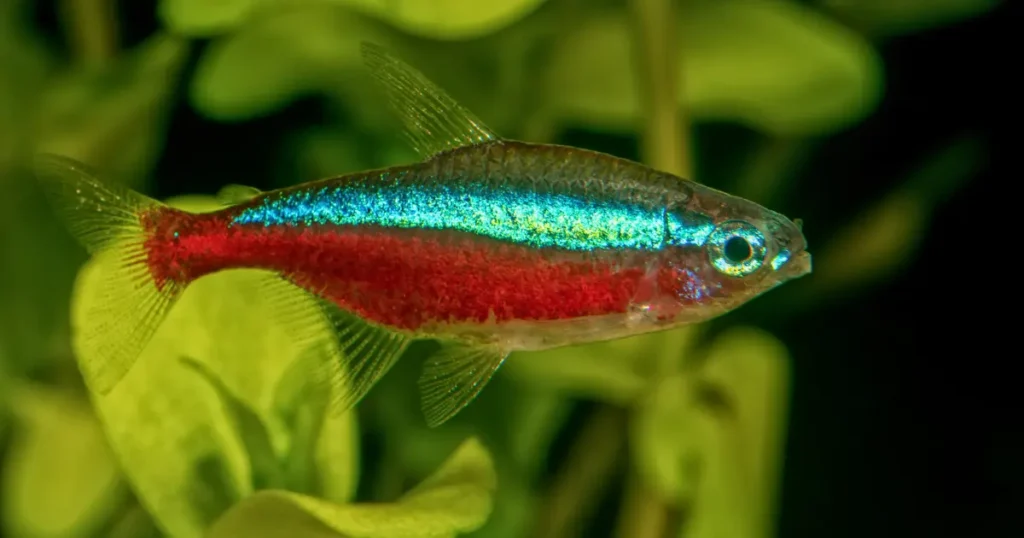
Neon Tetra or Cardinal Tetra
Both can work, but cardinals often prefer warmer, stable tanks. Either way, don’t buy three and call it a day. In 20 gallons, aim for 10–12 if they are your main schooling fish.
Ember Tetra
Small, orange, and calm. They look best in a planted tank with dark substrate. A group of 10–12 in a 20 gallon can look amazing.
Rummy Nose Tetra
Rummy noses look their best in a solid school, and they reward good water quality. They’re not the fish I’d pick for a brand-new tank, but they’re great once your tank is stable.
Harlequin Rasbora
Hardy, friendly, and active without being chaotic. A group of 8–10 works well.
Zebra Danio
Danios are tough and fun, but they’re energetic. In a 20 gallon long, they can work well. In a standard 20, they can feel too “busy” for calmer fish.
Bottom Dwellers That Fit a 20 Gallon Tank
Bottom fish add movement and help the tank feel full without crowding the mid-water.
Corydoras (choose the right type)
A 20 gallon tank is a great home for many cory species, but pick one type and keep them in a group.
- Group size: 6+ is usually where they look comfortable.
- Substrate: sand or smooth fine gravel is best.
Kuhli Loaches
Kuhli loaches are shy, weird in the best way, and mostly active at dusk or night. They need hiding spots, a soft substrate, and a peaceful tank.
Group size: 5–8 Best in: planted tanks with caves/wood
Otocinclus
Otocinclus are small algae grazers, but they’re not a “new tank fix.” Add them only when the tank is mature and you have some natural algae growth.
Group size: 4–6 Watch for: skinny bellies at the store (avoid those)
Bristlenose Pleco
A bristlenose pleco can work in 20 gallons, especially a long tank, but it’s still a lot of bioload compared to otos. If you choose one, keep the rest of your stocking reasonable and don’t expect it to solve algae problems by itself.
Semi-Aggressive Fish That Can Work in 20 Gallons (If You Plan It Right)
A 20 gallon tank can handle a bit more personality, but this is where people get into trouble by mixing the wrong fish.
Kribensis (Krib)
Kribs can be fine in a 20 gallon long with the right layout, but they can become territorial, especially if they pair off or breed.
Best approach:
- Keep one (or a proven pair)
- Provide caves and sight breaks
- Avoid mixing with other bottom-territory fish
Tiger Barbs (group only)
Tiger barbs are famous fin nippers. They behave better in a proper group, but they’re still not a calm community fish. In a 20 gallon, you can do a barb-focused tank, but mixing them with slow, long-finned fish is asking for stress.
If you want a peaceful community, skip tiger barbs.
My opinion: semi-aggressive setups are fun, but for ranking and helping beginners, your main focus should still be peaceful communities.
Fish to Avoid in a 20 Gallon Tank
These are the common “store mistakes.”
- Common goldfish: too much waste and they outgrow the tank.
- Angelfish: they can fit when small, then quickly become cramped and aggressive.
- Oscar and large cichlids: they need large tanks, period.
- Plecos that aren’t bristlenose: many common plecos get huge.
- Most rainbow sharks and aggressive sharks: not enough territory space.
If a fish is sold at 2 inches but grows to 6–10 inches, 20 gallons is usually not the right long-term home.
Sample 20 Gallon Stocking Plans That Make Sense
These are realistic, stable combinations.
Stocking Plan 1: Calm planted community
- 1 Honey Gourami
- 10 Ember Tetras
- 6 Corydoras (one species)
Why it works: calm fish, clear zones, good group sizes.
Stocking Plan 2: Classic tetra school with bottom activity
- 12 Neon Tetras (or 10 Cardinals)
- 6 Corydoras
- 4 Otocinclus (added after tank matures)
Why it works: strong school, gentle bottom team, low drama.
Stocking Plan 3: “Personality” community without chaos
- 1 Bolivian Ram (or a calm pair, if your tank is stable)
- 10 Harlequin Rasboras
- 6 Corydoras
Why it works: one standout fish plus peaceful schooling.
Stocking Plan 4: Danio energy tank (20 long recommended)
- 10 Zebra Danios
- 6 Corydoras
- 1 Bristlenose Pleco (optional)
Why it works: active top/middle with a stable bottom group, but it’s a busier vibe.
Important: whichever plan you choose, stock slowly. Add your school first, then bottom dwellers, then centerpiece last. That order usually keeps stress lower.
Planted 20 Gallon Tank Tips That Improve Fish Behavior
A planted 20 gallon tank isn’t just for looks. It makes stocking easier because plants create sight breaks, reduce stress, and give fish places to retreat.
A simple layout that works for many communities:
- Taller plants in the back corners
- A piece of driftwood or rock structure in the center
- Open swimming lane through the front/middle
- A few low plants or moss near the bottom for cover
Even if you’re not doing a heavy planted setup, adding a few hardy plants often makes the tank easier to manage.
Filtration and Equipment for a 20 Gallon Tank
You don’t need fancy gear, but you do need the basics to be sized correctly.
- Filter: a quality hang-on-back or sponge filter can work. If you stock heavier, choose stronger filtration.
- Heater: for tropical fish, use a reliable heater sized for 20 gallons.
- Lid: prevents jumping and reduces evaporation.
- Light: match it to your goal. Fish-only needs less light; planted tanks need better lighting.
My opinion: don’t undersize the filter just to save money. A slightly stronger filter makes the tank easier to keep clean.
Maintenance Routine That Keeps a 20 Gallon Healthy
A 20 gallon can look great with simple consistency:
- Weekly 25–35% water change
- Gravel vac lightly (especially in open areas)
- Don’t replace filter media constantly; rinse it gently in old tank water
- Feed small amounts and watch leftovers
- Test water if fish act off (don’t wait for a crash)
Most “mystery fish deaths” are really water quality or stocking problems.
Frequently Asked Questions
Is a 20 gallon tank good for beginners?
Yes. In my opinion it’s one of the best beginner sizes because the water is more stable than smaller tanks, and stocking options are much better.
Is a 20 gallon long better than a standard 20?
For most community tanks, yes. More horizontal room helps schooling fish and reduces stress.
Can I keep angelfish in a 20 gallon tank?
Not long term. They outgrow it and often become territorial. It’s a common mistake.
How many tetras should I keep in 20 gallons?
Usually 10–12 for small tetras, depending on what else is in the tank. Bigger groups look better and behave better.
Can I keep two gouramis in a 20 gallon tank?
Sometimes, but it depends on the species and individual temperament. One gourami is the safer play for beginners.
Do I need algae eaters in a 20 gallon aquarium?
Not necessarily. Good feeding habits and regular maintenance prevent most algae problems. If you do add them, otocinclus are great once the tank is mature.
What’s the easiest “safe” stocking plan for a first 20 gallon tank?
A peaceful school (like 10–12 ember tetras) plus a bottom group (6 corydoras) and one gentle centerpiece (honey gourami) is hard to mess up if the tank is cycled properly.
