
Blood Parrot Cichlid 101 Care Guide

A Blood Parrot Cichlid needs a 55-gallon or larger aquarium, warm clean water, open swimming room, and several secure hiding places. Keep the temperature between 76 and 80°F and offer small sinking pellets that fit its unusual mouth.
These fish can grow to around 7 or 8 inches and may live for 10 years or longer. They are usually less aggressive than many Central American cichlids, but they can still become territorial, especially around caves, food, or spawning sites.
I would not call the Blood Parrot a perfect beginner fish. It is fairly hardy, but its mouth and body shape can create feeding and swimming problems. Choosing a healthy fish and setting up the tank correctly makes a big difference.
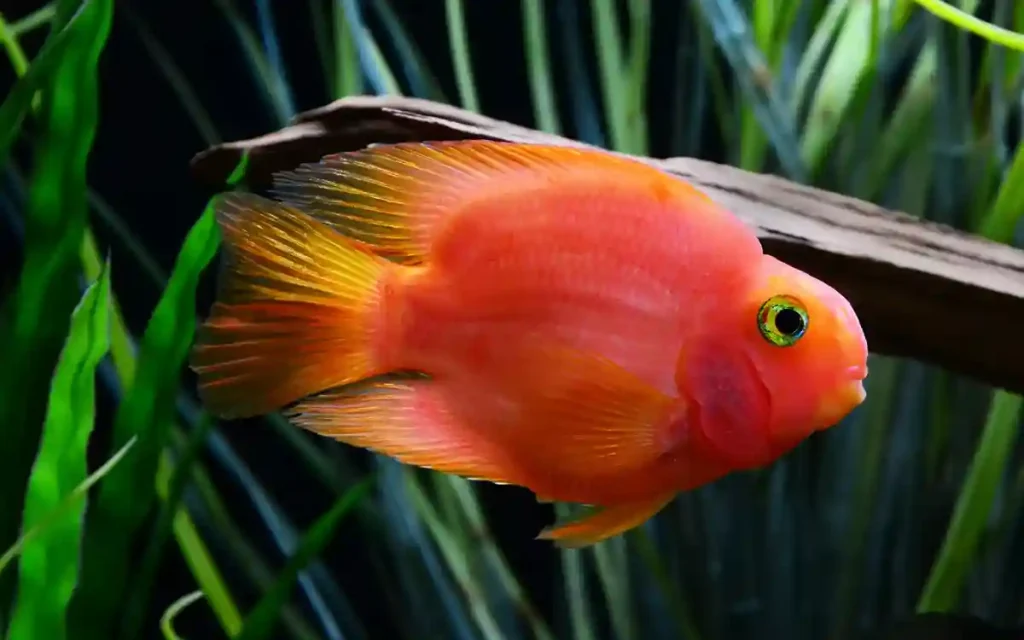
Blood Parrot Cichlid Care Overview
| Care requirement | Recommended range |
| Common name | Blood Parrot Cichlid |
| Origin | Captive-bred hybrid |
| Adult size | Usually 7–8 inches |
| Minimum tank size | 55 gallons for one |
| Temperature | 76–80°F |
| pH | 6.5–8.0 |
| Water hardness | 6–18 dGH |
| Temperament | Semi-aggressive |
| Diet | Omnivore |
| Swimming level | Middle and lower areas |
| Lifespan | Around 10–15 years |
| Care level | Intermediate |
| Breeding | Difficult; many males are infertile |
What Is a Blood Parrot Cichlid?
The Blood Parrot Cichlid is a human-made hybrid rather than a naturally occurring fish species. It was first developed for the aquarium trade in Taiwan during the 1980s.
Its exact parentage was not officially recorded, and you may find different claims about it. Most sources connect the fish to Central American cichlids, with the Midas cichlid and redhead cichlid often named as likely parents.
A typical Blood Parrot has a round body, large eyes, a small beak-shaped mouth, and a bright orange or reddish color. Some are yellow, pale orange, gray, or patterned.
The small mouth cannot always close normally. Some fish also have curved spines, compressed bodies, or unusual swim bladders. These features come from the way the hybrid was developed.
Blood Parrots can still eat, swim, and live long lives, but individual fish vary. I recommend watching a fish carefully before buying it. Choose one that swims steadily, finds food without struggling, and has clear eyes and healthy fins.
Are Dyed Blood Parrots Safe to Buy?
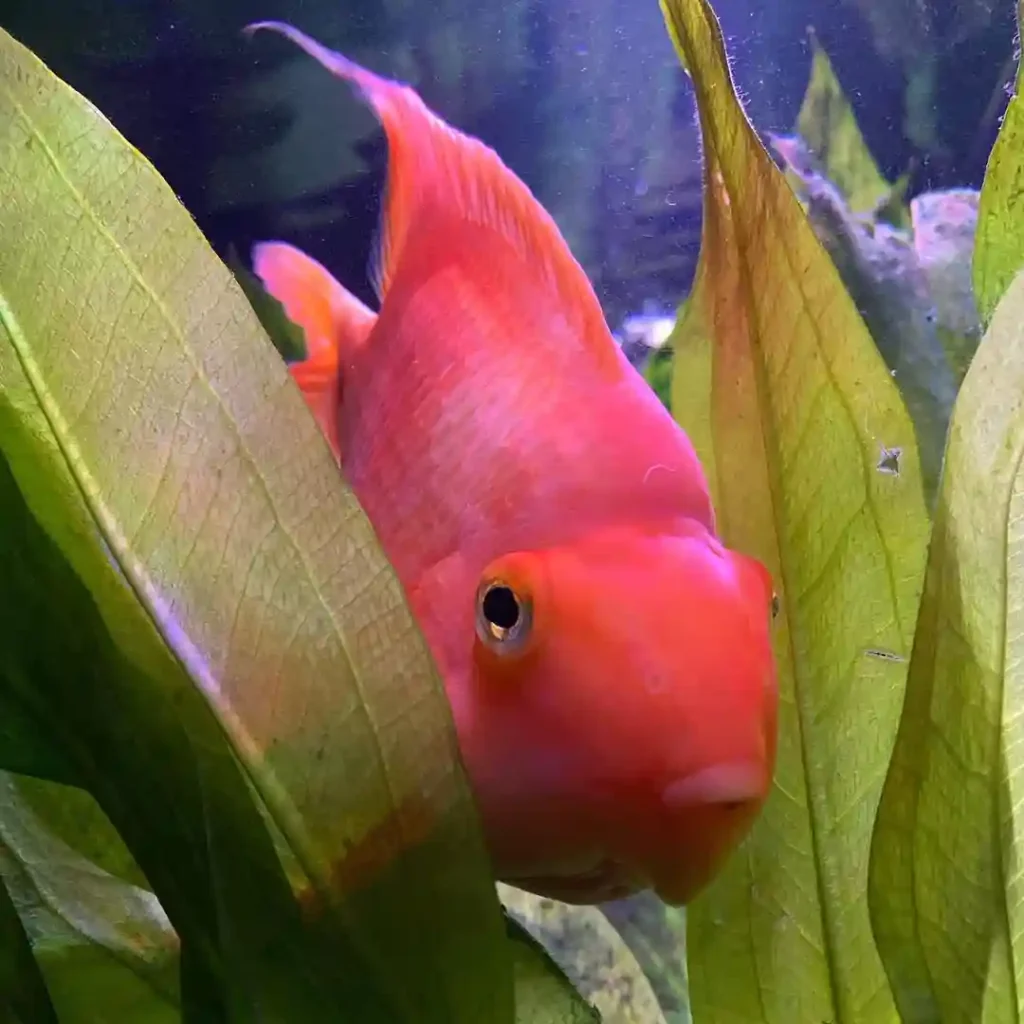
Blood Parrots naturally appear in shades of orange, red, yellow, and gray. Bright purple, blue, green, or unusually intense multicolored fish may have been artificially dyed.
Some sellers inject dye or use other coloring methods. These practices can damage the fish’s protective slime coat, increase stress, and leave it more open to infection.
I would avoid any fish sold under names such as jellybean parrot if its colors look artificial. Choose a naturally colored Blood Parrot from a seller who can explain where the fish came from.
You may also see heart-shaped parrots without normal tail fins. Their tails may have been removed when they were young. I do not recommend supporting this practice.
How Big Do Blood Parrot Cichlids Get?
Most Blood Parrot Cichlids grow to around 7 or 8 inches. Some varieties remain smaller, while larger forms such as King Kong parrots may grow beyond 8 inches.
Juveniles sold in stores can look small enough for a 20-gallon aquarium. That size is misleading. Their bodies become deep and heavy as they mature, and they produce much more waste than small community fish.
Growth depends on genetics, food, water quality, temperature, and available space. Many Blood Parrots grow quickly during their first year and then slow down as they approach adult size.
Do not try to keep one small by placing it in a cramped tank. Restricted space and poor water will not create a healthy miniature fish.
Blood Parrot Cichlid Lifespan
A well-cared-for Blood Parrot can live for around 10 to 15 years. Some fish may have shorter lives because of serious body deformities or poor early care.
Buying one is a long commitment. The small orange fish at the store may eventually need a large aquarium, strong filtration, and years of regular maintenance.
Stable water, a varied diet, low stress, and careful tank-mate selection give it the best chance of reaching an older age.
Minimum Tank Size
I recommend at least a 55-gallon aquarium for one adult Blood Parrot Cichlid. A 75-gallon tank is better if you want to keep a pair or add medium-sized tank mates.
Two or three Blood Parrots need more than simply doubling the minimum volume. Each fish needs swimming room and a place to retreat. A 75- to 100-gallon aquarium is much easier to arrange for a small group.
Tank shape matters too. Choose a long aquarium with a wide base instead of a short, tall model. Blood Parrots need horizontal swimming space and room to move around decorations.
A 30-gallon tank may hold a young fish temporarily, but I would not use it as a permanent home for a full-grown adult.
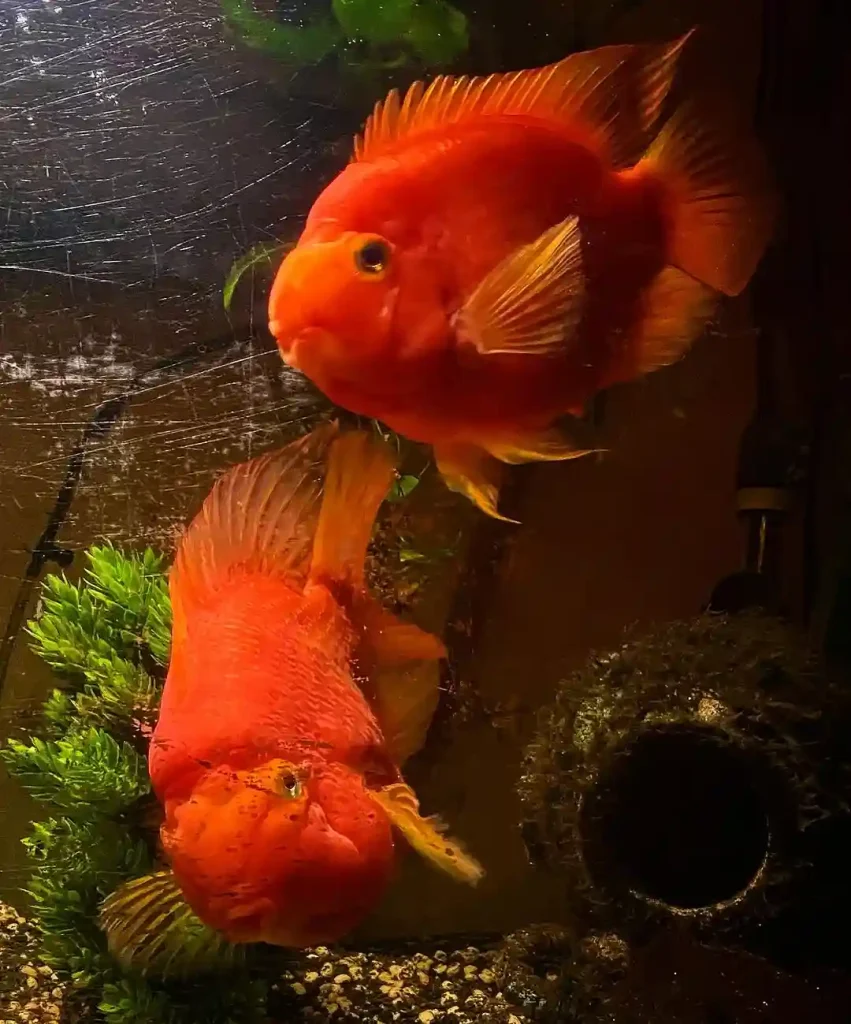
Setting Up the Aquarium
Blood Parrots can be shy when first introduced. A completely bare tank often makes them feel exposed, but too many decorations can make swimming difficult.
I like to place caves, driftwood, and smooth rocks near the back and sides. This leaves the middle open while giving each fish a sheltered area.
Choose caves with wide entrances. A round-bodied Blood Parrot may have trouble turning inside narrow ornaments. Avoid decorations with small holes where the fish could become trapped.
Use sand or smooth, fine gravel for the substrate. Blood Parrots may dig, move gravel, or pick food from the bottom. Sharp stones can scratch their mouths and bodies.
Artificial plants are easy to use, but choose soft ones without stiff plastic points. Sturdy live plants such as Anubias and Java fern can work when attached to wood or rocks.
Expect some rearranging. A Blood Parrot may push gravel, uproot weak plants, or move small decorations while creating a preferred resting area.
For a complete setup plan, read my step-by-step cichlid tank setup guide.
Water Parameters
Blood Parrot Cichlids tolerate a fairly wide range of water conditions, but sudden changes can still stress them.
Keep the temperature between 76 and 80°F. A stable temperature near 78°F works well in many aquariums.
Aim for a pH between 6.5 and 8.0. I would keep it close to neutral unless the water from your tap is naturally a little harder or more alkaline.
Water hardness between 6 and 18 dGH is usually suitable. Stable water is more useful than repeatedly adding chemicals to reach a single number.
Ammonia and nitrite must stay at 0 ppm. Keep nitrate below 20 to 30 ppm when possible.
Test the water every week. If a fish suddenly hides, loses color, breathes quickly, or refuses food, check the water before assuming it has a disease.
Filtration and Water Changes
Blood Parrots are large cichlids that eat well and create a fair amount of waste. Weak filtration can allow nitrate and organic waste to rise quickly.
Use a canister filter or a properly sized hang-on-back filter. The filter should circulate the full aquarium without creating a current that pushes the fish around.
Some Blood Parrots have awkward swimming movements because of their body shape. Give them areas of gentler flow where they can rest and feed comfortably.
Change about 25 to 30 percent of the water every week. Vacuum waste from open parts of the substrate and around caves where uneaten food collects.
Do not replace every piece of filter media at once. Rinse reusable media in removed aquarium water to protect the bacteria that process fish waste.
What Do Blood Parrot Cichlids Eat?
Blood Parrot Cichlids are omnivores. They need a mix of quality prepared food, plant ingredients, and occasional protein-rich treats.
Their small mouths make food size important. Large hard pellets may be difficult to grab or swallow.
I prefer small sinking or slow-sinking cichlid pellets as the main food. Pellets that soften slightly in water are often easier for them to eat.
You can add frozen brine shrimp, daphnia, mysis shrimp, or bloodworms a few times per week. Small pieces are better than large chunks.
Spirulina pellets, shelled peas, and small pieces of blanched zucchini can add plant matter and fiber.
Avoid using feeder fish. They are unnecessary, can carry parasites, and do not provide a balanced diet.
How Often Should You Feed Them?
Feed adult Blood Parrots once or twice daily. Give a small amount they can finish within two or three minutes.
Young fish may benefit from two or three smaller meals while growing. Keep each meal controlled because uneaten food quickly affects water quality.
Blood Parrots can be enthusiastic around feeding time, but that does not mean they are always hungry. Overfeeding can lead to excess weight, digestive trouble, and high nitrate.
Watch each fish eat. One fish may struggle to pick up food because its mouth is more deformed than another’s. Try smaller or softer sinking pellets if food repeatedly falls out.
Why Does My Blood Parrot Spit Out Food?
Blood Parrots sometimes pick up food, crush it, and spit out pieces before swallowing. This can be normal.
Their visible mouth may not close properly, but they can crush food using structures farther back in the throat. Some particles may escape while they eat.
Food that is too large or hard makes the problem worse. Try smaller sinking pellets and allow them a few seconds to soften.
Spitting becomes concerning when the fish cannot keep any food down, begins losing weight, or shows swelling, white waste, or other signs of illness.
Blood Parrot Cichlid Behavior
Blood Parrots are often curious once they feel safe. Many learn to recognize the person who feeds them and swim to the front when someone approaches.
New fish can behave very differently. They may hide behind a filter, sit inside a cave, or rush away whenever the room becomes active.
Give a new Blood Parrot time to settle. Keep the lights low at first and avoid constantly moving decorations or reaching into the tank.
Although they are usually calmer than aggressive Central American cichlids, they are still cichlids. They may defend caves, chase tank mates, dig into the substrate, and become more territorial when forming a pair.
Short chases are not always dangerous. Step in when one fish is followed constantly, stopped from eating, trapped near the surface, or left with damaged fins.
Can Blood Parrots Live Alone?
Yes, a Blood Parrot Cichlid can live alone. It does not need a group of its own kind to remain healthy.
A single fish often bonds with its keeper and becomes an active centerpiece fish. Keeping one also makes aggression and feeding easier to manage.
Blood Parrots can also live in pairs or small groups when the aquarium is large enough. You will need more caves and visual barriers so a dominant fish cannot control the full tank.
Adding two fish does not guarantee that they will form a peaceful pair. Watch their behavior closely and have a backup plan if one is bullied.
Best Blood Parrot Tank Mates
Good tank mates should be too large to swallow, active enough to move away, and calm enough not to attack the Blood Parrot.
Possible choices include severums, blue acaras, larger peaceful barbs, silver dollars, larger rainbowfish, some medium-sized catfish, and bristlenose plecos.
Compatibility depends on the fish’s personality and the available space. One Blood Parrot may ignore its companions, while another may guard a large part of the aquarium.
Avoid adding every suggested species to the same 55-gallon tank. Choose a small number of compatible fish based on their adult sizes and waste levels.
Introduce tank mates carefully and watch feeding time. Blood Parrots may be slower at collecting food than active barbs or rainbowfish.
For more options, see my complete list of Blood Parrot Cichlid tank mates.
Fish to Avoid
Avoid very small fish such as neon tetras, chili rasboras, Endlers, and small guppies. A Blood Parrot may eat any fish it can catch and fit into its mouth.
Highly aggressive cichlids are also poor choices. Oscars, Flowerhorns, Red Devils, Jaguars, and large Green Terrors may badly injure a Blood Parrot.
Fin-nipping fish can cause stress, especially if kept in groups that are too small. Long-finned, delicate fish may also struggle in a cichlid aquarium.
Shrimp are likely to become food. Snails may be picked at or knocked around, depending on the individual fish.
African rift-lake cichlids are not my first choice because their water needs, social behavior, and aggression can differ from those of Blood Parrots.
Introducing a Blood Parrot to the Tank
Cycle the aquarium fully before adding the fish. Ammonia and nitrite should both read 0 ppm.
Add caves and visual barriers before bringing it home. Make sure every opening is large enough for its body.
Acclimate the fish gradually to avoid sudden temperature and water changes. Keep the lights low for the rest of the day.
Do not worry if it hides and refuses food at first. Some Blood Parrots settle within a few days, while shy individuals may need a couple of weeks.
Offer a small amount of familiar food and remove anything left behind. Continue checking the water and watch for rapid breathing, white spots, or damaged fins.
Why Is My Blood Parrot Hiding?
Hiding is common after a Blood Parrot enters a new aquarium. It has not yet learned that the tank and the people nearby are safe.
A bare tank can make hiding worse. Caves and shaded areas give the fish enough security to start exploring.
Strong lighting, loud movement, aggressive tank mates, and unstable water can also keep it hidden. Test the water and observe whether another fish is blocking it from food.
Do not remove all the shelters to force the fish out. A fish normally becomes bolder when it knows that a safe retreat is available.
Why Is My Blood Parrot Turning Black?
Temporary black spots or patches can appear when a Blood Parrot is stressed. A recent move, poor water, bullying, or sudden changes may trigger darker markings.
Juvenile coloration can also change as the fish matures. Some young fish naturally lose darker areas as their orange or red color develops.
Test ammonia, nitrite, nitrate, temperature, and pH if the change appears suddenly. Look for other symptoms such as clamped fins, rapid breathing, rubbing, or loss of appetite.
Correct the cause rather than trying to treat the color itself. Stress markings often fade after conditions improve.
Why Is My Blood Parrot Turning White?
Color can fade because of stress, poor water, an unsuitable diet, illness, or weak genetics. Store lighting and color-enhancing foods can also make a fish look brighter before purchase than it does at home.
Check whether the fading affects the entire body or appears as separate patches. White spots, fuzzy areas, sores, and damaged scales may point to disease rather than normal color change.
A quality diet containing natural carotenoids can support red and orange coloration. It will not permanently change a naturally pale fish into a deep red one.
Common Health Problems
Blood Parrot Cichlids can develop ich, fin rot, fungal infections, digestive trouble, and swim bladder problems.
Ich appears as small white spots and may cause rubbing or fast breathing. Fin rot creates ragged or discolored fin edges, often after poor water or biting.
Some Blood Parrots naturally swim awkwardly because of their compressed bodies. A sudden loss of balance is different and may be linked to constipation, infection, injury, or poor water.
Their small mouths can also make it harder to compete for food. Check the body from above and from the side. A fish that becomes thin despite eating may need closer examination.
Quarantine new fish when possible. This gives you time to watch for illness before adding them to the main aquarium.
Male vs. Female Blood Parrot Cichlid
Sexing Blood Parrot Cichlids by appearance is difficult. Mature females are often smaller and rounder, while males may become larger and develop a more pointed shape around the head.
These differences are not reliable enough for choosing a pair at the store.
Breeding tubes provide a better clue when fish prepare to spawn. A female’s tube is usually wider and rounder, while a male’s is narrower and more pointed.
Behavior alone does not confirm sex. Two fish may guard a cave or clean a flat surface without producing fertile eggs.
Breeding Blood Parrot Cichlids
Blood Parrots may pair up, clean a rock, dig a pit, and lay eggs. This surprises owners who have heard that the fish cannot breed.
Many male Blood Parrots are infertile, so the eggs often turn white and develop fungus. The parents may then eat or remove them.
Some females can produce offspring when paired with a fertile male from another compatible cichlid line. However, this creates another hybrid cross rather than a simple natural species breeding project.
A spawning pair can become much more territorial. They may chase every other fish away from the nest, even when the eggs are infertile.
Unless you are prepared to separate fish and care for possible fry, I would not encourage breeding behavior in a crowded community tank.
Ethical Concerns About Blood Parrot Cichlids
Blood Parrots are controversial because their body shape and mouth were created through selective hybrid breeding. Some fish have more serious deformities than others.
I do not think this issue should be ignored in a care guide. A fish that cannot eat, swim, or breathe normally should not be treated as a harmless novelty.
If you decide to keep one, buy from a responsible seller. Avoid dyed fish, tail-altered heart parrots, and individuals that cannot swim or feed properly.
Once the fish is in your care, it deserves a suitable tank and proper treatment regardless of how it was produced.
Is a Blood Parrot Cichlid Right for You?
A Blood Parrot may suit you if you have a mature 55-gallon or larger aquarium and want an interactive centerpiece fish.
It is a poor choice for a small peaceful community, shrimp tank, or aquarium filled with tiny fish. It may also be unsuitable if you are uncomfortable supporting intentionally bred hybrid fish with unusual body shapes.
I would choose one only after watching it eat and swim. A healthy Blood Parrot should be alert, balanced, interested in its surroundings, and able to collect food.
With enough space and steady care, it can become a long-lived fish that recognizes feeding routines and spends plenty of time at the front of the aquarium.
Frequently Asked Questions
Can a Blood Parrot live in a 30-gallon tank?
A small juvenile may fit temporarily, but a 30-gallon tank is too cramped for most adults. I recommend at least 55 gallons for one.
How many Blood Parrots can live together?
One can live alone. A pair or small group may work in a 75- to 100-gallon or larger aquarium with several shelters and careful monitoring.
Are Blood Parrot Cichlids aggressive?
They are semi-aggressive. Most are calmer than Red Devils or Flowerhorns, but they may defend caves, chase smaller fish, and become territorial during spawning.
Do Blood Parrot Cichlids have teeth?
They have tooth structures farther back in the throat that help crush food. Their small visible mouths usually make them less capable of biting than many other cichlids.
Why does my Blood Parrot stay at the bottom?
A new or frightened fish may rest near the bottom. Poor water, illness, strong current, bullying, or a swim bladder problem can also cause this behavior.
Can Blood Parrots live with angelfish?
The combination is possible in a large aquarium, but it carries some risk. Angelfish have long fins and may be stressed by an active or territorial Blood Parrot.
Can Blood Parrots live with Oscars?
I do not recommend it in most home aquariums. Oscars grow much larger and can seriously injure a Blood Parrot during a fight.
Do Blood Parrots eat plants?
They may nibble soft leaves, dig around roots, or uproot plants while moving the substrate. Sturdy plants attached to wood or rocks are safer.
Why are my Blood Parrot’s eggs turning white?
White eggs are usually infertile or have developed fungus. Many male Blood Parrots are infertile, so unsuccessful spawning is common.
Do Blood Parrots recognize their owners?
Many learn to connect people with feeding and will swim toward the front when their keeper approaches. Their response is based on routine, movement, and learned recognition.
