
Bronze Cory Care Guide

Bronze corydoras are peaceful freshwater catfish that do best in groups of at least six in a 20-gallon-long aquarium or larger. They need clean water, smooth substrate for searching out food, and a varied diet that reaches the bottom of the tank.
A well-kept group spends much of its time moving across the substrate, investigating plants and driftwood, and occasionally swimming to the surface for a quick gulp of air.
Bronze corys are good beginner fish, but their reputation for being hardy can lead to mistakes. They aren’t suitable for tiny tanks, shouldn’t be kept alone, and cannot survive on leftover food indefinitely.
The biggest thing to remember is that bottom space and group size matter more than the fish’s small appearance.
Here’s how to set up a suitable aquarium, choose compatible tank mates, and keep bronze corydoras healthy.
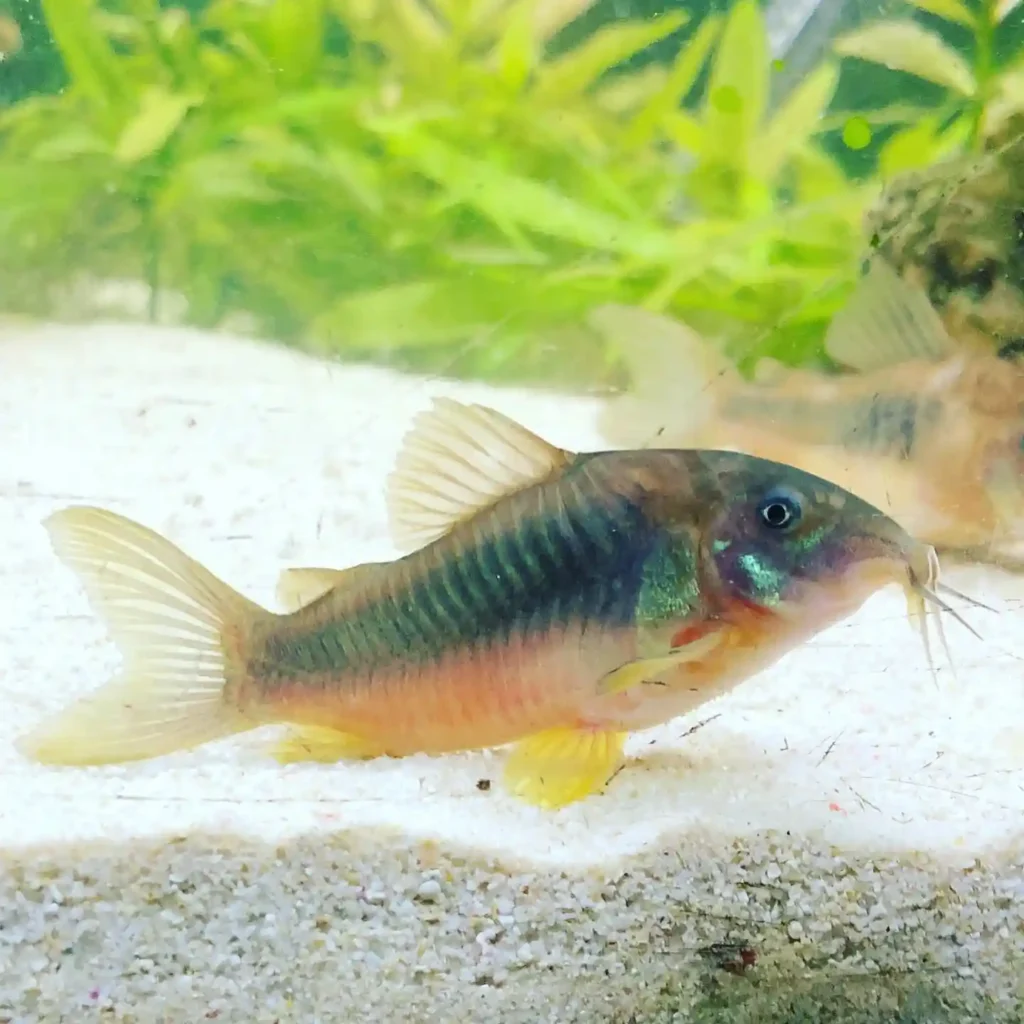
Bronze Cory Care at a Glance
| Characteristic | Details |
| Common name | Bronze Cory, Bronze Corydoras, Green Cory |
| Scientific name | Osteogaster aenea |
| Former scientific name | Corydoras aeneus |
| Family | Callichthyidae |
| Adult size | Around 2.5–3 inches |
| Lifespan | Commonly 5–8 years; sometimes longer |
| Recommended tank size | 20 gallons long or larger |
| Minimum group | 6, preferably 8 or more when space allows |
| Temperature | 72–79°F (22–26°C) |
| pH | Approximately 6.0–8.0 |
| Hardness | Approximately 2–15 dGH |
| Diet | Omnivore |
| Temperament | Peaceful |
| Swimming level | Mainly bottom |
| Care level | Beginner-friendly |
These are practical aquarium-care recommendations. Bronze corys can tolerate a somewhat wider temperature range, but stable conditions within a suitable range are preferable to frequent adjustments.
What Is a Bronze Cory?
The bronze cory is a small armored catfish that naturally spends much of its time close to the bottom of freshwater habitats.
Its body is covered with overlapping bony plates rather than the typical scales seen on many aquarium fish.
Bronze corys are known for their rounded heads, short barbels near the mouth, and metallic coloration. Their bodies may appear bronze, olive-brown, or greenish depending on the individual and lighting.
They were widely known as Corydoras aeneus for many years.
Following a scientific revision published in 2024, the accepted scientific name became Osteogaster aenea. Both names are still encountered in aquarium information and fish stores.
Bronze corys are popular partly because of their social behavior. Instead of defending a territory like some bottom-dwelling fish, they usually move peacefully around one another.
They often gather near food, investigate the same areas, and rest together.
Their harmless appearance doesn’t mean they are completely defenseless. Corydoras have stiff fin spines that help protect them from predators, so they should be handled carefully during transfers.
Where Do Bronze Corydoras Come From?
Bronze corydoras were originally described from Trinidad and occur naturally in parts of northern South America.
Older aquarium references sometimes describe an extremely wide distribution across South America. However, scientific revisions have shown that fish previously grouped under the same name may represent several closely related species or forms.
For everyday aquarium care, the important detail is the environment these fish are adapted to.
Bronze corys naturally search along the bottom for small food items. Their barbels help them detect food among soft substrate and plant material.
They need access to the aquarium floor, areas of shelter, and enough space to move as a group.
You don’t need to recreate a muddy riverbed in your aquarium. Fine sand, driftwood, suitable plants, and clean flowing water can provide a practical environment without sacrificing visibility or ease of maintenance.
Bronze Cory Size and Lifespan
Adult bronze corydoras generally reach around 2.5–3 inches (6–7.5 cm).
Females often grow larger and broader than males, especially once they reach breeding age.
Young bronze corys sold in aquarium stores may be considerably smaller.
Don’t plan your aquarium around their size at purchase. A group of six or eight adults needs enough space to move and feed without crowding.
With good care, bronze corys commonly live around five to eight years, and some may live longer.
Their lifespan depends on several things, including water quality, suitable feeding, genetics, and how well the aquarium meets their needs.
A fish that survives for years in unsuitable conditions isn’t necessarily receiving good care.
Look for natural behavior, healthy body condition, intact barbels, and regular feeding rather than judging success only by lifespan.
What Tank Size Do Bronze Corydoras Need?
A 20-gallon-long aquarium is a practical starting point for a group of six bronze corydoras.
An aquarium around 31–32 inches (80 cm) long and 12 inches (30 cm) wide offers a useful bottom area for a small group.
Larger tanks provide more flexibility, particularly when you want to keep eight or more corys alongside other community fish.
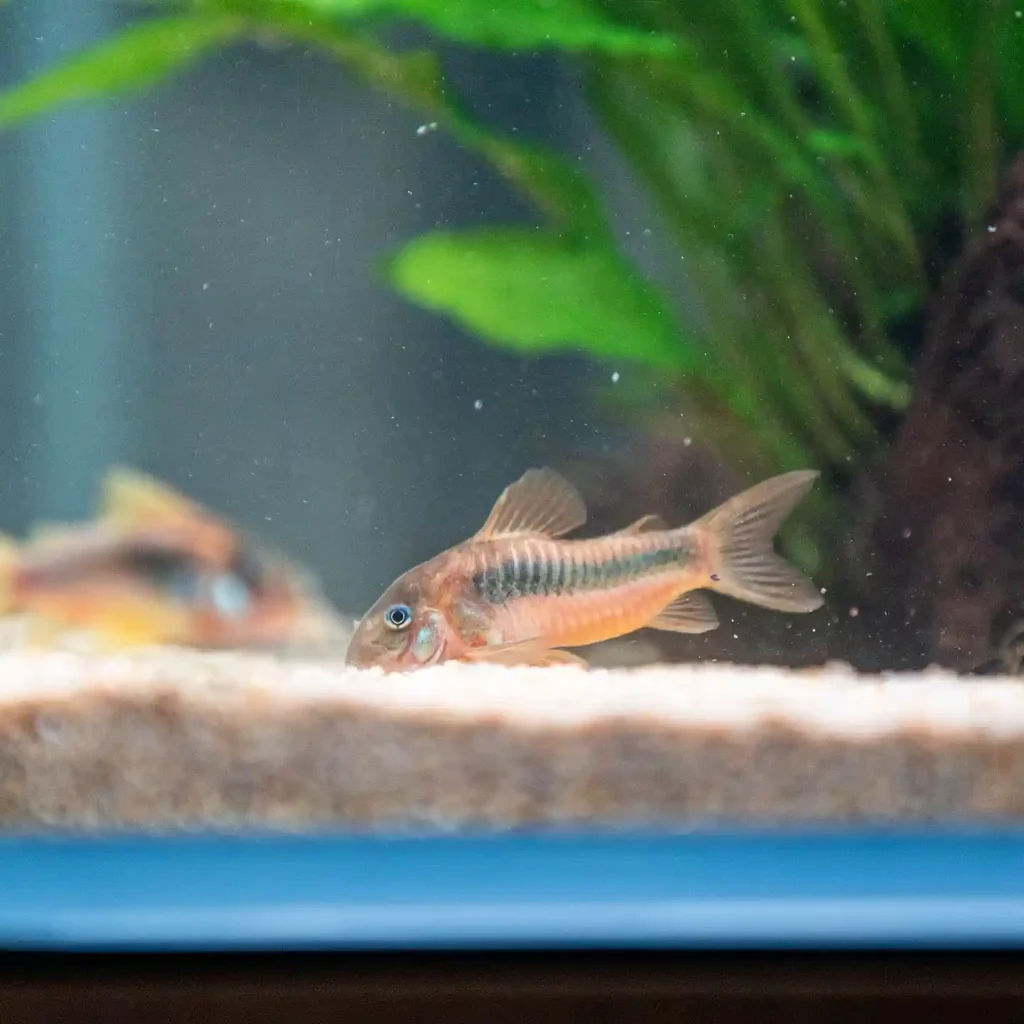
Why tank dimensions matter
Bronze corys spend much of their time searching for food near the bottom.
A tall aquarium may hold plenty of water but provide limited usable floor space.
A longer aquarium allows the group to move naturally while leaving room for plants, driftwood, and open feeding areas.
For this reason, I would choose a 20-gallon-long tank over a tall aquarium with a noticeably smaller footprint.
Can bronze corydoras live in a 10-gallon tank?
A 10-gallon aquarium is not my recommendation for a permanent group of adult bronze corys.
Although the fish are relatively small, keeping a proper social group in a limited footprint leaves less room for natural movement.
A 20-gallon-long aquarium is a better long-term choice.
If you only have a 10-gallon tank, consider smaller corydoras species with appropriate care requirements rather than reducing the bronze cory group to two or three fish.
How many bronze corys should you keep?
Keep at least six bronze corys together.
If the aquarium has enough room and filtration, eight or more can be even better.
In larger groups, bronze corys often appear more confident and spend more time foraging in the open.
Keeping only one or two may lead to less natural social behavior.
The important point is to choose a tank that accommodates the group rather than shrinking the group to fit an unsuitable tank.
How to Set Up a Bronze Cory Aquarium
Bronze corys don’t require complicated decorations, but the layout should give them room to search the substrate safely.
A suitable tank has open bottom areas, shelter, stable filtration, and enough plants or decorations to break up exposed spaces.
Choose fine sand or smooth gravel
Fine sand is one of the best substrate choices for bronze corydoras.
Their barbels help them investigate the substrate, and sand allows them to sift through small particles naturally.
Smooth, rounded gravel can also work, provided it is clean and doesn’t have sharp edges.
Avoid rough gravel that could injure their mouths or barbels.
It is also worth remembering that barbel damage isn’t always caused by the substrate itself. Waste buildup and bacterial problems may contribute.
Cleanliness matters regardless of whether you choose sand or gravel.
You can compare different substrate options in our Aquarium Substrate Guide.
Add plants without covering the entire bottom
Bronze corys appreciate a planted environment, especially when the plants create areas of shade and shelter.
Anubias, Java Fern, Cryptocoryne, and suitable background plants can all work well.
You don’t need to create a dense carpet across the entire bottom.
Leave open sand where the corys can search for food.
A practical layout could have taller plants along the rear glass, driftwood toward one side, and a clear feeding area near the front.
The fish can then move between sheltered and open areas without being forced into one corner.
Our Aquarium Plants Guide can help you choose species that match your lighting and tank setup.
Use driftwood and hiding places
A few pieces of smooth driftwood can provide shelter and create natural boundaries inside the aquarium.
Avoid decorations with narrow openings that could trap the fish.
Bronze corys are not usually territorial, so they don’t need individual caves for every fish.
Instead, give the group several comfortable places to rest.
Don’t overcrowd the bottom with large decorations. Too much hardscape can reduce the available foraging area.
Keep the water well filtered
Bronze corys need a reliable aquarium filter and stable water conditions.
A sponge filter or a properly sized hang-on-back or canister filter can work, depending on the aquarium.
The exact filter type matters less than its ability to support biological filtration and provide suitable water movement.
Avoid directing a very strong current into an area where the fish are trying to rest.
Provide gentle or moderate circulation and ensure that the water surface has adequate movement for gas exchange.
Bronze Cory Water Parameters
Bronze corydoras are adaptable fish, but they still need stable, suitable water.
For a home aquarium, aim for the following conditions:
| Parameter | Recommended condition |
| Temperature | 72–79°F (22–26°C) |
| pH | Approximately 6.0–8.0 |
| GH | Approximately 2–15 dGH |
| Ammonia | 0 ppm |
| Nitrite | 0 ppm |
| Nitrate | Keep controlled through maintenance |
There is no need to chase an exact pH number if your aquarium already has stable water within an appropriate range.
Repeated chemical adjustments may create more problems than they solve.
Check water quality regularly
Ammonia and nitrite can harm fish even when the water appears completely clear.
Both should remain at 0 ppm in an established, properly cycled aquarium.
Nitrate can build up over time, particularly when the tank is heavily stocked or food is left uneaten.
Regular water changes, appropriate feeding, and a functioning biological filter help keep water conditions suitable.
Before adding bronze corys to a new aquarium, make sure the nitrogen cycle is established.
Our Fish Tank Cycling Guide explains how beneficial bacteria process fish waste and how to check when a tank is ready.
Bronze Cory Behavior and Schooling
Bronze corydoras are social fish that behave differently from solitary bottom dwellers.
They spend much of their time moving across the substrate, often gathering in loose groups while searching for food.
You may notice two or three corys investigating the same area while the others rest nearby.
They don’t need to swim in a perfectly coordinated school all day.
Their social behavior is more flexible, and they may spread out before coming back together.
Why group size matters
A properly sized group helps bronze corys express more natural behavior.
Fish kept alone or in very small groups may be more cautious and spend more time hiding.
A larger group also gives them more opportunities for normal social interactions.
If your corys remain hidden most of the day, check the group size, tank mates, shelter, and water conditions before assuming they are simply shy.
Why do bronze corys swim to the surface?
Bronze corys sometimes swim quickly to the surface, gulp air, and return to the bottom.
This can be completely normal.
They have the ability to use swallowed air as an additional oxygen source, which is a natural feature of their biology.
fishbase.se
However, frequent frantic trips to the surface should not automatically be dismissed.
If several fish are breathing rapidly, staying near the surface, or behaving unusually, test the water and check filtration and oxygenation.
Normal air gulping is different from visible distress.
Do bronze corys clean the aquarium?
Bronze corys search for edible food particles, but they do not replace aquarium cleaning.
They produce waste just like other fish.
They also need their own food and should not be expected to survive on scraps left by tank mates.
A clean aquarium comes from suitable filtration, careful feeding, and regular maintenance, not from adding more bottom-dwelling fish.
What Do Bronze Corydoras Eat?
Bronze corydoras are omnivores that feed primarily along the bottom.
In nature, they search for small aquatic animals and other edible material within the substrate.
In a home aquarium, a good-quality sinking food should form the main part of their diet.
Small live or frozen foods such as daphnia, bloodworms, and brine shrimp can provide variety.
How often should you feed bronze corys?
Most healthy adult bronze corys can be fed once or twice daily in portions appropriate for the group.
There is no reliable universal number of pellets because foods vary in size and nutritional content.
Start with a small portion and observe whether all the fish can eat.
Avoid leaving large amounts of food to decay between water changes.
Make sure food reaches every fish
In a busy community aquarium, fish swimming near the surface may eat most of the food before it sinks.
Bronze corys can gradually become underfed even when the aquarium appears to receive plenty of food.
Use sinking pellets or wafers and watch the group during feeding.
If the larger fish dominate one area, divide the food between two suitable locations.
The goal is to make sure every cory gets access to food without adding so much that the substrate becomes dirty.
Can bronze corys eat algae wafers?
They may eat algae wafers, but these shouldn’t automatically be their only food.
Bronze corys need an omnivorous diet that includes suitable protein sources.
A varied sinking diet is more appropriate than relying on a product intended mainly for algae-grazing fish.
Best Tank Mates for Bronze Corydoras
Bronze corys are usually suitable for peaceful freshwater community aquariums.
However, compatibility is about more than aggression.
The tank mates should also have compatible temperature requirements, appropriate adult sizes, and enough swimming space.
| Tank mate | Compatibility | What to consider |
| Harlequin Rasboras | Generally good | Peaceful fish with compatible temperature needs |
| Many small Tetras | Generally good | Choose peaceful species suited to the water conditions |
| Guppies | Possible | Check water hardness compatibility and stocking |
| Bettas | Depends on individual | Aggressive bettas may chase or disturb corys |
| Adult Cherry Shrimp | Usually possible | Very small shrimplets may be vulnerable |
| Large aggressive Cichlids | Poor | Bullying and injury risks |
| Goldfish | Not recommended | Different feeding, waste, space, and often temperature needs |
Can bronze corys live with bettas?
Sometimes, but the betta’s temperament matters.
A calm betta may ignore bronze corys, particularly in a planted aquarium with enough space.
An aggressive betta may repeatedly chase them or prevent them from feeding comfortably.
There is no guarantee that a particular betta will accept bottom-dwelling tank mates.
If you want to try this combination, plan enough space for a proper cory group and be prepared to separate the fish if aggression develops.
Our Betta Fish Tank Mates Guide covers the broader compatibility questions.
Can bronze corys live with shrimp?
Bronze corys can usually coexist with healthy adult cherry shrimp in a peaceful aquarium.
However, they are opportunistic bottom foragers, and tiny shrimplets may occasionally be eaten.
If your main goal is breeding shrimp successfully, a shrimp-only tank is often the safer arrangement.
Can bronze corys live with goldfish?
I wouldn’t recommend this combination as a normal community setup.
Many goldfish are kept under cooler conditions than a typical tropical community tank. They also produce substantial waste, may outcompete corys for food, and require considerable space.
Although some temperature ranges overlap, that alone doesn’t make the pairing a good choice.
Which fish should you avoid?
Avoid large predatory fish, highly aggressive cichlids, and bottom-dwelling species that are likely to bully bronze corys.
Also avoid adding so many bottom feeders that they compete for every available feeding area.
A tank can contain peaceful fish and still be overcrowded.
Male vs Female Bronze Corydoras
Male and female bronze corys look similar when young.
As they mature, females often become noticeably broader through the body, especially when viewed from above.
Males are generally slimmer and may remain slightly smaller.
These differences are easiest to recognize when comparing several mature fish.
A female that is ready to spawn may develop a fuller abdomen.
However, don’t assume every round-bellied fish is carrying eggs. Heavy feeding, constipation, and health problems can sometimes change body shape as well.
If a fish suddenly becomes swollen, stops eating, or behaves unusually, investigate the problem rather than treating it as normal breeding condition.
How Do Bronze Corydoras Breed?
Bronze corydoras are egg-laying fish that can reproduce in home aquariums when conditions are suitable.
Mature, healthy adults may begin spawning after a period of good feeding and favorable environmental conditions.
Changes associated with the rainy season, including cooler fresh water, can act as breeding cues.
However, this is not a reason to expose fish to sudden or extreme temperature changes.
Breeding should only be considered when you have the space and resources to care for the offspring.
Bronze cory spawning behavior
When the fish are ready to spawn, the group may become more active.
Males may follow females around the aquarium.
During courtship, the fish use a characteristic position often described as the T-position, where the male positions himself across the female’s head.
The female then releases eggs and places them on suitable surfaces, such as aquarium glass, plant leaves, or decorations.
The eggs are adhesive, which means they stick to the surface rather than falling freely to the bottom.
Do bronze corydoras protect their eggs?
No. Bronze corys don’t provide extended parental care after laying eggs.
Adult fish may eat eggs if they remain in the same aquarium.
If you want to raise the fry, prepare a separate established rearing space and protect the eggs from adult fish.
Egg development depends on water temperature and conditions. Hatching commonly occurs after several days.
Avoid overcrowding a small rearing container or allowing uneaten food to accumulate.
How to care for bronze cory fry
Newly hatched fry initially rely on nutrients from their yolk sacs.
After the yolk sac is absorbed and the fry begin feeding, they need appropriately sized foods.
Microworms, newly hatched brine shrimp, and suitable fine fry foods may be used as the young fish develop.
Clean, stable water is especially important because uneaten food can quickly spoil a small rearing setup.
The fry also need more space as they grow.
Don’t encourage breeding unless you have a plan for raising or rehoming the young fish.
Can Albino Corydoras Breed With Bronze Corydoras?
Yes. Common albino bronze corys can breed with normally colored bronze corys because they are different color forms of the same species.
Their offspring may show different coloration depending on the genetic traits carried by the parents.
This doesn’t mean all albino fish can breed successfully with all normally colored corydoras.
Species identity matters.
If you have pale corys with red eyes and want to determine whether they are albino bronze corys, read our Albino Corydoras Care Guide.
It explains identification, pigmentation, and keeping both color forms together.
Common Bronze Cory Health Problems
Bronze corydoras are generally hardy when kept correctly, but they can still develop health problems.
The first step when behavior changes is to check the environment.
Poor water quality, unsuitable substrate, stress, and inadequate feeding can all affect their condition.
Damaged barbels
Bronze corys use their barbels to investigate the substrate.
If the barbels become unusually short, inflamed, or damaged, check for rough substrate, trapped waste, and declining water conditions.
Switching to smooth sand may help reduce mechanical irritation, but it won’t fix a dirty aquarium on its own.
Persistent damage or signs of infection deserve assessment by a qualified fish-health professional.
Fish hiding more than usual
A newly introduced bronze cory may hide while adjusting to a different aquarium.
However, long-term hiding can also be associated with an undersized group, aggressive tank mates, a lack of shelter, or poor water conditions.
Check the group size and observe how other fish behave around them.
Don’t immediately buy more fish without confirming that the tank can support them.
Fish not eating
If a bronze cory isn’t eating, begin by checking whether food reaches the bottom and whether faster fish are taking it.
Next, review water conditions and look for other symptoms.
A fish that has stopped eating and also appears weak, swollen, or unusually inactive may need prompt attention from an aquatic veterinarian.
Red or irritated-looking skin
Visible redness, damaged tissue, or skin changes can be associated with several possible problems.
Poor water quality, injury, and infection are among the possibilities.
Don’t assume a specific disease based on color alone, and avoid adding random medications before checking basic conditions.
Test the water and seek qualified advice when symptoms are severe, spreading, or worsening.
Common Beginner Mistakes With Bronze Corydoras
One of the most frequent mistakes is keeping too few fish.
A pair of bronze corys may survive in an aquarium, but they won’t have the same opportunities for natural social behavior as a suitable group.
Another mistake is choosing a small tank because the fish look tiny at the store.
They still need enough bottom space as adults.
Feeding is another area where beginners run into trouble. Corys may search for scraps, but they require a proper diet of their own.
Finally, avoid treating bronze corydoras as aquarium cleaning equipment.
They cannot remove ammonia, replace water changes, or eliminate the need to clean the substrate.
Are Bronze Corydoras Good for Beginners?
Yes. Bronze corydoras are a good choice for beginners who have a properly cycled freshwater aquarium with enough room for a group.
They are peaceful, adaptable, and generally easy to feed.
But they aren’t a suitable choice for someone with an uncycled nano tank or only enough space for one or two fish.
For a first group, focus on a 20-gallon-long aquarium or larger, smooth substrate, stable water, and compatible community fish.
Once those needs are met, bronze corys can be active, interesting fish to observe without requiring complicated care.
Frequently Asked Questions
How many bronze corydoras should be kept together?
Keep at least six bronze corydoras. Groups of eight or more can work well in larger aquariums with suitable filtration and bottom space.
Can bronze corydoras live in a 10-gallon tank?
A 10-gallon tank is not the recommended long-term choice for a full group of adult bronze corys. A 20-gallon-long aquarium provides a better footprint for their natural behavior.
Do bronze corydoras need sand?
Fine sand is an excellent choice because it supports natural foraging. Smooth, rounded gravel can also be suitable when kept clean and free from sharp edges.
Are bronze corydoras aggressive?
No. Bronze corys are generally peaceful and suitable for community aquariums with compatible species. They don’t normally defend large territories or attack other healthy community fish.
Can bronze corydoras live with guppies?
Yes, they can be compatible when the aquarium is large enough and the water conditions suit both species. Check temperature and hardness rather than assuming all peaceful fish require identical water.
Do bronze corydoras eat algae?
They may investigate algae-covered surfaces while searching for food, but they are not dependable algae eaters. Their main diet should be suitable sinking omnivore foods.
Why are my bronze corydoras swimming up and down the glass?
This behavior can occur when fish are newly introduced or during periods of increased activity. If it continues alongside rapid breathing, loss of appetite, or other signs of distress, check water quality and tank conditions.
How long do bronze corydoras live?
Bronze corydoras commonly live around five to eight years with suitable care, and some individuals may live longer.
Can bronze and albino corydoras live together?
Yes, when the albino fish are the albino form of the bronze cory. These are the same species and can form a social group together.
Is the Bronze Cory Right for Your Aquarium?
Bronze corydoras are a good choice if you want peaceful, active fish that spend their time searching along the bottom of a community aquarium.
They aren’t demanding in terms of equipment, but their basic needs shouldn’t be overlooked.
Choose a 20-gallon-long tank or larger, keep at least six, provide smooth substrate, and feed them a varied diet that actually reaches the bottom.
With enough room, clean water, and suitable companions, a group of bronze corys can become one of the most enjoyable parts of a freshwater aquarium.
