
How to Breed Cherry Shrimp?

Cherry shrimp are easy to breed, but that doesn’t mean every colony grows successfully. Adults may reproduce in poor conditions, yet their eggs or newborn shrimp often fail to survive when the water changes suddenly, food collects on the substrate, or fish are present.
The best approach is simple: prepare a mature tank, add healthy males and females, and keep their surroundings steady. Once those basics are in place, the shrimp handle mating, egg care, and hatching themselves.
This guide explains how to breed cherry shrimp step by step, from preparing the aquarium to feeding newborn shrimp and fixing common breeding problems.
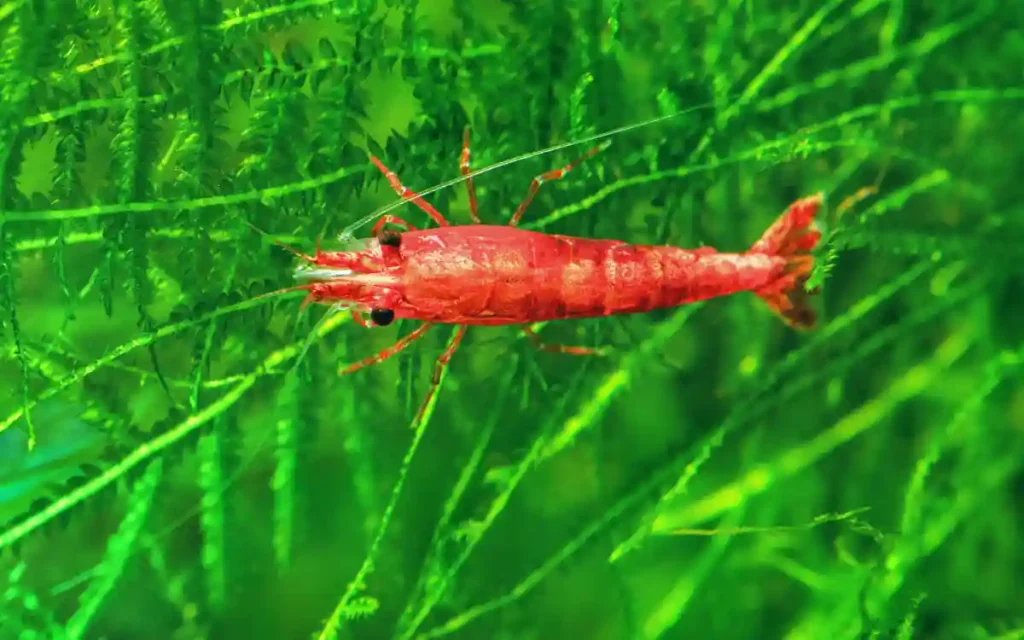
Key Takeaways
- A 10-gallon aquarium is easier for beginners, although cherry shrimp can breed in a mature 5-gallon tank.
- Start with 10–15 healthy shrimp to improve your chance of receiving both males and females.
- Keep ammonia and nitrite at 0 ppm and nitrate below 20 ppm.
- Use a sponge filter or cover the filter intake with a fine pre-filter sponge.
- Moss, plants, wood, and leaf litter provide food and shelter for newborn shrimp.
- Female cherry shrimp usually carry their eggs for around 25–30 days.
- Baby shrimp eat biofilm, soft algae, microorganisms, and very small food particles.
- Fish should be kept out of a breeding tank because most species will eat newborn shrimp.
- Stable water matters more than chasing one exact pH, GH, or TDS number.
- Avoid large water changes, overfeeding, copper-based medication, and sudden temperature shifts.
Can Cherry Shrimp Breed in a Home Aquarium?
Yes. Cherry shrimp (Neocaridina davidi) are among the easiest freshwater shrimp to breed at home. You don’t need hormone treatments, brackish water, or a separate larval-rearing system.
Healthy adult males and females will usually reproduce on their own when they have stable water, enough food, and safe hiding places.
Their breeding cycle works like this:
- A mature female molts and releases chemical signals into the water.
- Males begin swimming around the aquarium in search of her.
- Mating takes place shortly after the female molts.
- The fertilized eggs move beneath her abdomen.
- She carries, cleans, and fans the eggs for several weeks.
- Fully formed baby shrimp hatch and begin grazing.
Cherry shrimp do not pass through a free-swimming larval stage. The newborns look like tiny, mostly transparent versions of adult shrimp and can complete their full development in freshwater.
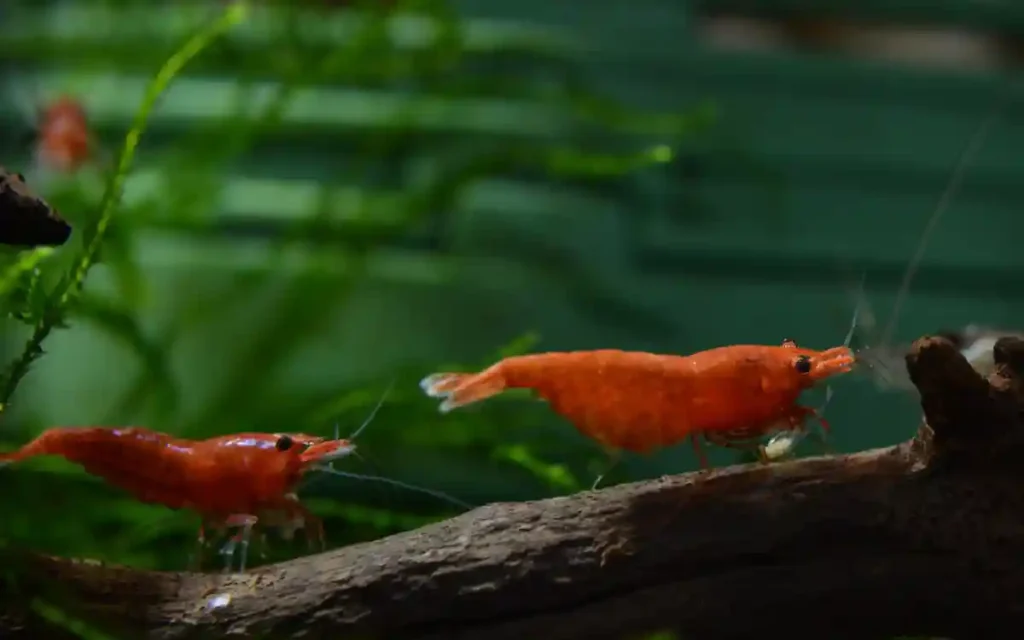
What You Need to Breed Cherry Shrimp
You don’t need an elaborate breeding system. A simple aquarium often works better because it is easier to keep clean and stable.
Recommended Tank Size
Cherry shrimp can reproduce in aquariums as small as 5 gallons. However, a 10-gallon tank is a better starting point for someone building their first colony.
The extra water volume gives you:
- Slower temperature changes
- More stable water chemistry
- More surfaces for algae and biofilm
- More room for the colony to grow
- A larger margin for feeding mistakes
Small tanks can work well, but a little excess food or replacement water with different mineral levels affects them more quickly. Read our shrimp tank setup guide before preparing a new aquarium.
Sponge Filter
A sponge filter is one of the safest choices for a breeding tank. Its flow is gentle, baby shrimp cannot easily get pulled inside, and the sponge becomes another grazing surface.
Shrimp spend a surprising amount of time picking food from mature filter sponges. Don’t replace the sponge simply because it looks brown. Rinse it gently in removed aquarium water when the flow becomes weak.
If you already use a hang-on-back, canister, or internal filter, fit a fine pre-filter sponge over the intake.
For more filter options, see Do Shrimp Need a Filter?.
Heater and Thermometer
A heater isn’t always necessary. If the room stays within a suitable range throughout the day and night, the shrimp can breed without one.
A thermometer is still useful. It lets you catch temperature swings caused by seasonal weather, nearby windows, air conditioning, or aquarium lights.
Don’t raise the temperature simply to force faster breeding. Warmer water can speed growth and reproduction, but it also holds less oxygen and causes shrimp to age faster.
Plants, Moss, and Hiding Places
Plants offer much more than decoration in a shrimp tank. Their leaves and stems collect algae, bacteria, and other microorganisms that shrimp eat throughout the day.
Good choices include:
- Java moss
- Christmas moss
- Subwassertang
- Guppy grass
- Anubias
- Java fern
- Floating plants
- Cholla wood
- Small pieces of driftwood
- Shrimp tubes and rock gaps
Moss is especially useful for newborns. Its dense structure gives them places to hide while trapping fine food particles.
You can find more suitable choices in our guide to the best plants for cherry shrimp.
Substrate and Lighting
Cherry shrimp can breed over sand, gravel, or active shrimp substrate. Beginners may find inert sand or fine gravel easier because it normally has less effect on pH and hardness.
Dark substrate can make red shrimp appear brighter, but substrate color alone will not improve their genetic grade.
Use enough light to support healthy plant growth and a small amount of algae. Strong light for long periods may leave the aquarium covered in algae, while very low light can limit natural grazing areas.
Best Water Parameters for Breeding Cherry Shrimp
Cherry shrimp adapt to a fairly wide range of conditions. What they don’t handle well is rapid change.
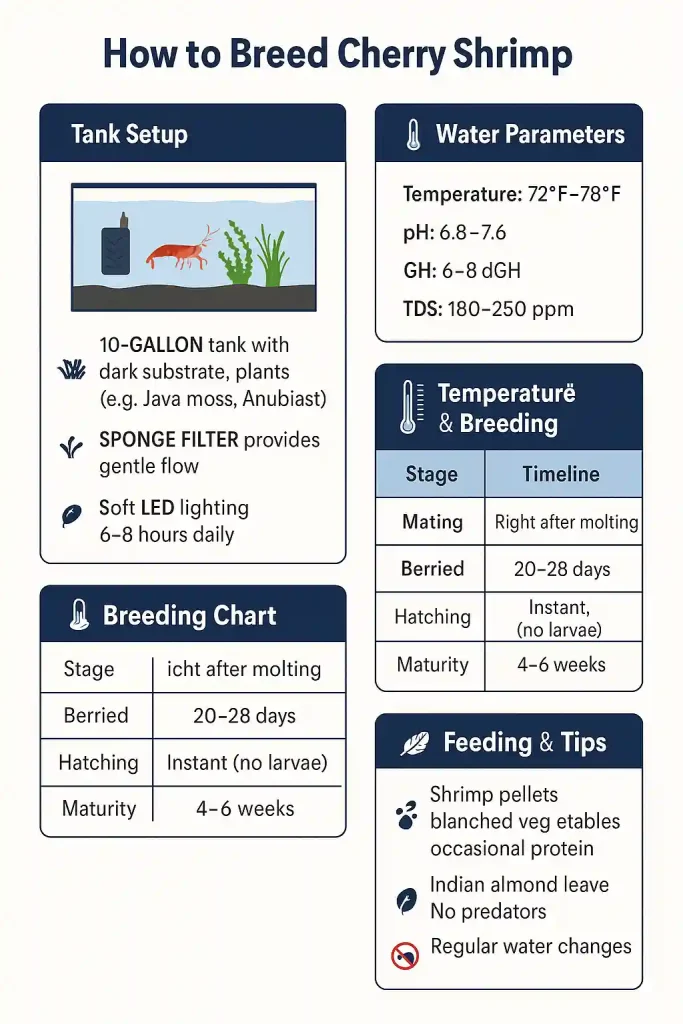
Use these ranges as a practical starting point:
| Water condition | Recommended range |
| Temperature | 72–76°F |
| pH | 6.8–7.8 |
| GH | 6–10 dGH |
| KH | 2–6 dKH |
| Ammonia | 0 ppm |
| Nitrite | 0 ppm |
| Nitrate | Below 20 ppm |
| TDS | Around 150–250 ppm |
A colony that has already adapted to slightly different conditions may breed without trouble. Don’t alter stable water just to reach a number from a chart.
Ask the breeder or store about the water in which the shrimp were raised. A large difference between their old water and your aquarium makes slow acclimation even more important.
Why GH and KH Matter
General hardness, or GH, measures minerals in the water, mainly calcium and magnesium. Cherry shrimp need a suitable mineral balance to form their shells and molt normally.
Water with very low GH may contribute to weak shells and failed molts. Extremely hard water can also cause trouble, especially when shrimp are moved into it without enough time to adjust.
Carbonate hardness, or KH, helps resist rapid pH changes. Very low KH does not automatically mean the tank is unsuitable, but the pH may move more easily.
Test the water before adding calcium, mineral powder, crushed coral, or remineralizing salts. Guessing can push the hardness far beyond what the shrimp need.
Do You Need to Measure TDS?
A TDS meter measures the total concentration of dissolved material in the water. It can help you notice changes, but it cannot tell you what those dissolved substances are.
A reading of 200 ppm could include useful minerals, waste, fertilizer, or other compounds. That is why TDS should be monitored alongside GH, KH, nitrate, and regular observation of the shrimp.
Use it as a warning tool rather than a complete water test.
Avoid Sudden Water Changes
A large or poorly matched water change can alter the temperature, pH, hardness, or TDS within minutes. Shrimp may become inactive, attempt to climb out, drop eggs, experience molting trouble, or die.
Change about 10–20% at a time unless you are dealing with an emergency. Condition the new water and match it as closely as practical to the aquarium.
Step 1: Cycle and Mature the Breeding Tank
Never add cherry shrimp to an uncycled aquarium. The filter must contain enough beneficial bacteria to process ammonia into nitrite and then nitrate.
Before introducing shrimp, confirm that:
- Ammonia remains at 0 ppm
- Nitrite remains at 0 ppm
- Nitrate is present but controlled
- Temperature stays steady
- The filter runs normally
A cycled tank is safe from routine ammonia and nitrite buildup. A mature tank goes a step further. Its surfaces contain algae, biofilm, and microorganisms that adult and baby shrimp can graze on.
Whenever possible, let the aquarium run for several additional weeks after cycling. Add plants and wood during this period so natural food can develop.
Our fish tank cycling guide explains the nitrogen cycle and testing process in more detail.
Step 2: Choose Healthy Breeding Shrimp
Start with around 10–15 juvenile or young adult shrimp. Buying a group gives you a much better chance of receiving both sexes than buying two or three shrimp.
Look for animals that are:
- Moving normally and actively grazing
- Free from fuzzy growths and visible parasites
- Able to use all their legs
- Kept in clean water
- Showing no white ring between the body and abdomen
- Suitable for the color grade you want to breed
Young shrimp often adjust to a new aquarium more easily than older adults. However, they may need several months before they reproduce.
Buying from two healthy, unrelated colonies can add genetic variety. Quarantine each group first. New shrimp may carry planaria, hydra, parasitic worms, or other unwanted organisms even when they appear healthy.
Step 3: Tell Male and Female Cherry Shrimp Apart
Sex differences become easier to see as cherry shrimp mature.
Female Cherry Shrimp
Adult females are usually:
- Larger than males
- Broader through the abdomen
- More deeply colored
- Rounded along the underside
- Equipped with wider abdominal plates for holding eggs
A mature female may also show a yellow, greenish, or cream-colored patch behind her head. This is called a saddle. It contains eggs developing in her ovaries.
Male Cherry Shrimp
Males are usually:
- Smaller and slimmer
- Straighter along the underside
- Lighter or more transparent
- Narrower through the abdominal area
- More active during mating periods
These features are less obvious in juveniles. Very young shrimp may be impossible to sex accurately.
Best Male-to-Female Ratio
A ratio of roughly one male for every two or three females works well when you can choose individual shrimp.
An exact ratio is not required. Even one healthy male can fertilize several females. Starting with too few shrimp, however, leaves a greater chance of receiving only one sex.
Step 4: Acclimate the Shrimp Slowly
Cherry shrimp react badly to sudden differences between transport water and aquarium water. Drip acclimation lets them adjust more gradually.
To drip-acclimate new shrimp:
- Place the shrimp and their transport water in a clean container.
- Run a piece of airline tubing from the aquarium to the container.
- Tie a loose knot in the tubing or use a valve to control the flow.
- Set the flow to approximately two to four drops per second.
- Let the water in the container gradually double in volume.
- Continue for around one to two hours, depending on the difference between the two water sources.
- Move the shrimp into the tank using a shrimp net.
- Discard the transport water.
Watch the container during this process. If the shrimp were shipped for a long time, the transport water may contain waste. Leaving them in it for several hours may be worse than a slightly shorter acclimation.
Keep the aquarium lights dim for the rest of the day and allow the shrimp to settle.
Step 5: Feed the Breeding Colony Properly
Cherry shrimp are constant grazers. In a mature aquarium, much of their food comes from biofilm, soft algae, decaying plant matter, and microorganisms.
Offer a varied diet that may include:
- Quality shrimp pellets
- Small pieces of algae wafer
- Mineral-based shrimp food
- Blanched zucchini
- Blanched spinach
- Dried Indian almond, mulberry, or similar shrimp-safe leaves
- Occasional protein-rich shrimp food
Remove vegetables before they begin to spoil. Wash them well and avoid produce exposed to pesticides.
How Often Should You Feed Breeding Shrimp?
Feed a small amount once a day or every other day, depending on the colony size and how much natural food is available.
Begin with less than you think they need. Most prepared food should be consumed within two or three hours. A feeding dish makes leftovers easier to see and remove.
You may not need to feed a small colony every day when the tank has plenty of biofilm and leaf litter.
Why Overfeeding Causes Breeding Problems
Extra food breaks down in the aquarium. It feeds bacteria, raises waste levels, lowers oxygen, and can attract pest organisms.
The adults may continue eating and appear normal while newborn shrimp disappear. Babies are more sensitive to poor water conditions than established adults.
If food remains untouched, remove it and reduce the next portion.
Step 6: Encourage Natural Mating
There is no special mating trigger that you need to add. A mature female becomes receptive after molting and releases pheromones into the water.
Males detect these chemical signals and may suddenly swim across the aquarium instead of grazing. This restless swimming can last for several hours while they search for the female.
That activity is usually normal when:
- Mainly males are swimming
- The other shrimp behave normally
- Water tests are safe
- No shrimp are trying to leave the aquarium
Test the water immediately if every shrimp becomes restless, gathers at the surface, lies still, or tries to climb out. Those behaviors can point to ammonia, nitrite, low oxygen, contamination, or a major water change.
Step 7: Identify a Berried Female
A berried female carries a cluster of fertilized eggs beneath her abdomen. The eggs are attached to her swimmerets rather than stored inside her body.
You may notice:
- Round eggs below the abdomen
- Regular fanning movements
- The female picking through the egg cluster
- More time spent beneath plants or wood
- Changes in the appearance of the eggs as they develop
What Color Should Cherry Shrimp Eggs Be?
Eggs can be yellow, green, brown, or darker shades. Color varies between females and does not tell you by itself whether the eggs are healthy.
Pay more attention to their shape and development. Healthy eggs generally remain round and attached beneath the female.
Why Does the Female Fan Her Eggs?
The female moves her swimmerets to pass water across the egg cluster. She also uses her legs to clean and rearrange the eggs.
This behavior supplies oxygen and helps prevent dirt from collecting around them. Frequent fanning is normal.
Should You Move a Berried Female?
Leave her in the established breeding aquarium whenever possible. Catching and moving her can cause enough stress to make her drop some or all of the eggs.
A separate tank only helps when it is already mature and closely matches the original water. A new container or small breeding box usually creates more problems than it solves.
Step 8: Wait for the Eggs to Hatch
Cherry shrimp eggs normally hatch after about 25–30 days. Development may take slightly longer in cooler water and less time in warmer conditions.
At first, the eggs look solid and round. As they develop, they may become clearer. Tiny dark eye spots can sometimes be seen shortly before hatching.
The female continues cleaning and fanning them throughout this period. Avoid netting her, changing the aquarium layout, or performing a large water change.
The babies hatch as fully formed shrimp. They don’t swim through the water as larvae. Instead, they settle on nearby surfaces and begin grazing almost immediately.
Step 9: Protect Newly Hatched Cherry Shrimp
Newborn cherry shrimp are only a few millimeters long. They are easy to miss, particularly when they hide in moss or match the substrate.
Don’t assume they died simply because you cannot see them. They often become easier to spot after one or two weeks.
Keep Fish Out of the Breeding Tank
A shrimp-only tank gives the babies their best chance of survival. Almost any fish that can fit a newborn shrimp into its mouth may eat it.
Dense plants can reduce losses in a community aquarium, but they cannot make the babies completely safe.
Some snails can live with breeding shrimp without hunting healthy babies. Check our cherry shrimp tank mates guide before adding another species.
Cover Every Filter Intake
Newborn shrimp can pass through openings that look far too small for them. Use a sponge filter or cover the intake with fine sponge.
Inspect filter chambers if babies appear to be missing. Shrimp sometimes survive inside hang-on-back filters by feeding on collected debris.
Don’t Overclean the Aquarium
A perfectly scrubbed shrimp tank may look attractive, but it offers less food to newborns.
Don’t remove every patch of soft algae, all leaf litter, or every trace of mulm. Clean enough to protect water quality while leaving mature surfaces for grazing.
Step 10: Feed Baby Cherry Shrimp
Baby cherry shrimp eat the same general foods as adults, but they need much smaller particles. During their first weeks, biofilm is their main food source.
Suitable foods include:
- Naturally grown biofilm
- Soft algae
- Mature leaf litter
- Powdered shrimp food
- Finely crushed shrimp pellets
- Tiny particles from algae wafers
Powdered food is easy to overuse. Because it spreads throughout the aquarium, you cannot remove it as easily as a pellet.
Use a very small amount and place it near moss or other areas where the babies gather. They have tiny stomachs and access to food throughout the day, so adding a visible cloud of powder is unnecessary.
Step 11: Maintain the Tank Without Harming the Babies
Continue routine maintenance after the babies hatch, but work carefully.
A safe routine includes:
- Testing ammonia, nitrite, and nitrate
- Changing around 10–20% of the water when needed
- Matching the replacement water to the tank
- Adding new water slowly
- Covering the siphon with fine mesh or sponge
- Checking removed water for baby shrimp
- Removing excess food without stripping away all biofilm
Use a white bucket when siphoning the aquarium. Tiny shrimp are much easier to see against a pale background.
Avoid deep gravel cleaning across the entire tank. Clean one small area at a time and leave the rest undisturbed.
Cherry Shrimp Breeding Timeline
| Breeding stage | Approximate timing |
| Sexual maturity | Around 3–5 months |
| Female molts and mates | Usually within several hours |
| Egg-carrying period | About 25–30 days |
| Baby shrimp hatch | Fully formed and free-moving |
| Color becomes easier to see | Over the following several weeks |
| Female may breed again | After a later molt |
This timeline will not be identical for every colony. Temperature, food, genetics, crowding, and water conditions all affect growth.
How Many Babies Do Cherry Shrimp Have?
A mature female commonly carries around 20–30 eggs. Young females may carry fewer, while large, established females can sometimes carry more.
Not every egg will hatch, and not every baby will reach adulthood. Some loss is normal.
Survival tends to be much higher when the aquarium has:
- No fish
- Gentle filtration
- Dense moss
- Mature biofilm
- Stable water
- Controlled feeding
- Covered filter intakes
Common Cherry Shrimp Breeding Problems
A lack of babies does not always mean the adult shrimp are infertile. Work through the conditions in the tank before trying additives or changing several parameters at once.
Shrimp Are Healthy but Not Breeding
Common reasons include:
- The shrimp are still too young.
- The group contains only males or only females.
- The temperature is consistently low.
- The diet lacks variety.
- The water changes too frequently.
- The colony has not finished adjusting to the tank.
- The aquarium has little biofilm.
Give newly added shrimp time. Moving them between different water conditions can pause breeding for several weeks.
Female Has a Saddle but No Eggs
A saddle contains unfertilized eggs inside the female’s body. It doesn’t mean she has already mated.
After her next molt, a male must fertilize the eggs before she moves them beneath her abdomen. If no mature male is present, she may continue developing saddles without becoming berried.
Berried Female Dropped Her Eggs
Females sometimes lose a few eggs while cleaning and fanning them. A young female carrying eggs for the first time may drop a larger number.
Other causes include:
- Sudden changes in water chemistry
- Poor water quality
- Stress from netting or moving
- Unfertilized eggs
- Physical injury
- Illness
- Severe temperature changes
One failed clutch does not necessarily point to a tank-wide problem. Repeated egg loss means you should test the water and review recent maintenance.
Eggs Turn White or Develop Fuzzy Growth
Unfertilized or damaged eggs can turn opaque and develop fungal growth. A healthy female often removes bad eggs herself.
Don’t try to pull individual eggs away from a living female. You may injure her or cause her to release the whole clutch.
Baby Shrimp Keep Disappearing
Check for:
- Fish or predatory tank mates
- Uncovered filter openings
- Ammonia or nitrite
- Large water changes
- Too little biofilm
- Excess powdered food
- Copper exposure
- Hydra or planaria
- Heavy substrate cleaning
Newborn shrimp hide exceptionally well, so observe the tank after the lights have been on for a while. Look closely at moss, filter sponges, and aquarium glass.
Shrimp Die While Molting
Molting problems can result from unsuitable GH, poor nutrition, rapid TDS changes, or unstable water.
Test GH and KH before adding mineral products. More calcium is not automatically better. Shrimp need the right mineral balance and enough time to adjust to it.
A failed molt can also happen occasionally even in a healthy colony. Several deaths within a short period suggest a wider water or dietary problem.
Should You Use a Breeding Box?
Standard fish breeding boxes are rarely useful for cherry shrimp. Small boxes collect waste, have limited grazing space, and may not receive enough water movement.
Confining a berried female can also stress her.
If you need to separate a breeding line, use another fully cycled, mature aquarium rather than a small temporary container.
How to Control a Growing Cherry Shrimp Colony
A well-kept colony can grow quickly. Crowding becomes a problem when waste rises, food becomes scarce, or the keeper starts overfeeding to support the larger population.
You can manage growth by:
- Feeding slightly smaller portions
- Moving shrimp to another mature aquarium
- Selling or giving away healthy shrimp
- Separating different color grades
- Increasing safe grazing space
- Checking nitrate more frequently
Don’t release aquarium shrimp into ponds, waterways, or drains. Rehome them through local aquarium groups, stores, or other responsible keepers.
Selective Breeding for Deeper Red Color
If every shrimp remains in one colony, pale individuals can continue passing on their color traits. Selective breeding means choosing which shrimp remain in the breeding group.
A basic process looks like this:
- Allow juveniles enough time to develop their color.
- Keep the healthiest shrimp with the strongest red coverage in the main tank.
- Move pale or transparent shrimp into another suitable aquarium.
- Continue comparing each new generation.
- Add healthy, unrelated shrimp from a trusted breeder when the line needs more genetic variety.
Lighting, diet, age, stress, and substrate can change how red a shrimp appears. Compare them under similar conditions before deciding which animals to move.
Separating lower-grade shrimp does not mean killing them. They can live normal lives in another aquarium.
Avoid mixing red cherries with blue, yellow, orange, or other Neocaridina color lines if you want to preserve a consistent red colony. The colors can interbreed, and later generations may become brown or transparent.
Frequently Asked Questions
How quickly do cherry shrimp breed?
A mature female can mate shortly after molting and carry eggs for about 25–30 days. Colony growth may still look slow at first because juveniles need several months to mature.
How old must cherry shrimp be before breeding?
Many cherry shrimp reach sexual maturity at around three to five months old. Their growth rate depends on temperature, diet, water conditions, and genetics.
Will cherry shrimp breed without a heater?
Yes, provided the room keeps the aquarium within a suitable and reasonably steady temperature range. A heater is helpful when the room becomes cold or changes sharply between day and night.
Can cherry shrimp breed in a community tank?
They can mate and carry eggs in a community tank. The main problem is baby survival. Even small, peaceful fish may eat newborn shrimp.
Do cherry shrimp need special breeding food?
No single food causes breeding. A varied diet, natural biofilm, suitable minerals, and steady water give the adults what they need to reproduce.
Can one female cherry shrimp reproduce alone?
She cannot reproduce without mating. However, a female bought from a mixed colony may already be fertilized or carrying eggs when she arrives.
How can I tell if cherry shrimp eggs are fertilized?
It can be difficult to confirm during the earliest stage. Healthy developing eggs remain attached and may become clearer over time. Dark eye spots are often visible close to hatching.
Why are male cherry shrimp swimming around the tank?
Several males may begin swimming when a recently molted female releases pheromones. If every shrimp is restless or trying to escape, test the water instead of assuming it is mating behavior.
Will adult cherry shrimp eat their babies?
Healthy adults rarely hunt their offspring. They may eat a dead or extremely weak baby, but fish and unsafe filter intakes are much greater threats.
How often can female cherry shrimp carry eggs?
A healthy female may become berried again after another molt. The interval varies with age, temperature, food, and water conditions.
How many cherry shrimp should I start with?
A group of 10–15 is a sensible starting point. It offers a good chance of receiving both sexes without placing a large initial load on the aquarium.
Can different cherry shrimp colors breed together?
Yes. Red, blue, yellow, orange, and other Neocaridina davidi varieties can interbreed. Their offspring may lose the parents’ bright colors over several generations and return toward a brown or transparent wild-type appearance.
