
Nitrogen Cycle Explained in Detail (Aquarium Guide)

The nitrogen cycle is the biological process that keeps aquarium water safe for fish. While beginners often hear about “cycling a tank,” fewer people understand what is actually happening inside the filter, gravel, and water at a biological level.
This guide explains the nitrogen cycle in detail but in simple language what each stage means, where beneficial bacteria live, why spikes happen, and how this process supports a stable aquarium over time.
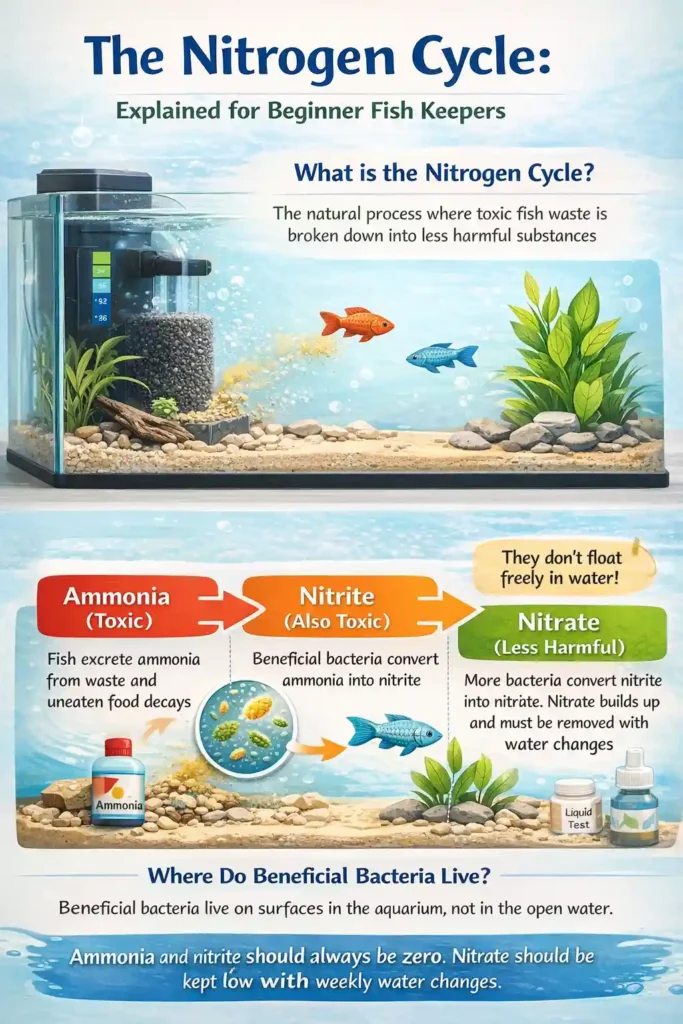
What the Nitrogen Cycle Is
The nitrogen cycle is a natural process where toxic waste is broken down into less harmful substances by beneficial bacteria.
In an aquarium, fish waste does not disappear. It changes form. The nitrogen cycle controls this transformation so waste does not build up to dangerous levels.
Without the nitrogen cycle:
- Ammonia would rise continuously
- Fish would suffer stress and gill damage
- Long-term survival would be impossible
This process happens in all aquariums, whether freshwater or saltwater.
Where Nitrogen Waste Comes From in an Aquarium
Nitrogen waste enters the aquarium from multiple sources, not just fish.
Common sources include:
- Fish poop
- Fish breathing (gill excretion)
- Uneaten food
- Decaying plant leaves
- Dead microorganisms
All of this waste eventually becomes ammonia, which begins the nitrogen cycle.
Stage 1: Ammonia (NH₃ / NH₄⁺)
Ammonia is the first and most dangerous stage of the nitrogen cycle.
Why Ammonia Is So Harmful
Ammonia:
- Burns fish gills
- Interferes with oxygen uptake
- Causes stress, lethargy, and death
Even small amounts can be toxic, especially in tanks with higher pH levels.
How Ammonia Appears
Ammonia forms as soon as waste breaks down. In new aquariums, ammonia rises quickly because there are no bacteria yet to process it.
This is why ammonia spikes are common in uncycled or overloaded tanks.
Stage 2: Nitrite (NO₂⁻)
As ammonia builds up, a specific group of beneficial bacteria begins to grow. These bacteria convert ammonia into nitrite.
Why Nitrite Is Still Dangerous
Nitrite:
- Blocks oxygen transport in fish blood
- Causes fish to gasp or become inactive
- Can be deadly even at low levels
Although nitrite is less toxic than ammonia, it is still unsafe.
Why Nitrite Spikes Happen
Nitrite spikes occur because:
- Ammonia-eating bacteria grow first
- Nitrite-eating bacteria grow later
- There is a delay between these stages
This delay is normal and part of the nitrogen cycle’s progression.
Stage 3: Nitrate (NO₃⁻)
The final stage of the nitrogen cycle is nitrate.
Another group of beneficial bacteria converts nitrite into nitrate, which is far less toxic to fish.
Why Nitrate Is Safer
Nitrate:
- Is tolerated by fish at low to moderate levels
- Builds up slowly
- Can be controlled through water changes
Unlike ammonia and nitrite, nitrate does not usually cause immediate harm unless it becomes very high.
Where Beneficial Bacteria Live in an Aquarium
Beneficial bacteria do not float freely in the water. They attach to surfaces.
The largest colonies live in:
- Filter media (sponges, ceramic rings, bio balls)
- Gravel and substrate
- Decorations and tank walls
This is why cleaning filter media incorrectly can disrupt the nitrogen cycle. Removing or washing these surfaces removes bacteria.
Why the Nitrogen Cycle Takes Time
The nitrogen cycle cannot be rushed because bacteria:
- Multiply slowly
- Need a steady food source (waste)
- Are sensitive to temperature and chemicals
Each stage depends on the previous one. If ammonia is not present, ammonia-eating bacteria cannot grow. If nitrite does not build up, nitrate-producing bacteria cannot establish themselves.
This natural progression explains why aquariums take weeks—not days—to stabilize biologically.
Common Nitrogen Cycle Problems and Spikes
Even in established tanks, the nitrogen cycle can become unstable.
Ammonia or Nitrite Spikes Can Happen When:
- Too many fish are added at once
- Fish are overfed
- Filter media is replaced or over-cleaned
- Medications or chemicals kill bacteria
- Power outages stop filter flow
Understanding these triggers helps prevent crashes.
Nitrogen Cycle vs Aquarium Cycling (Important Difference)
Although closely related, these are not the same thing.
- Nitrogen cycle = the biological process itself
- Aquarium cycling = the process of establishing that cycle in a new tank
The nitrogen cycle continues for the entire life of the aquarium. Cycling is just the beginning phase.
Related article: Aquarium cycling for beginners
How the Nitrogen Cycle Is Maintained Long-Term
Once established, the nitrogen cycle continues as long as:
- Fish waste is produced steadily
- Filter bacteria remain alive
- Regular maintenance is performed
Water changes remove nitrate but do not remove beneficial bacteria, which is why they are safe and necessary.
Why Understanding the Nitrogen Cycle Matters
Many aquarium problems trace back to misunderstandings about this process.
Knowing how the nitrogen cycle works helps you:
- Diagnose water quality issues
- Avoid sudden fish loss
- Maintain long-term stability
- Make better stocking decisions
This knowledge separates reactive fishkeeping from confident, informed care.
Final Thoughts
The nitrogen cycle is the invisible system that keeps aquariums alive. While fish and decorations are easy to see, beneficial bacteria do the most important work behind the scenes.
Understanding this process in detail allows you to manage your aquarium with confidence, prevent common problems, and create a stable environment where fish can thrive.
