
Angelfish Care Guide Beginner Tips

Freshwater angelfish need a tall, fully cycled aquarium, warm water at 78-82°F (26-28°C), gentle flow, and companions that will neither nip their fins nor fit inside their mouths. A 29-gallon tall tank is the minimum I would use for one adult. Choose 55 gallons or more for a bonded pair or community, and 75 gallons or more for a group.
They can be good fish for a prepared beginner, but they are not small community fish. A young angelfish sold at coin size may grow about 6 inches long and 8 inches tall with its fins. Adults can become territorial, especially when a pair lays eggs.
If your angelfish is gasping, clamping its fins, hiding, or refusing food, test ammonia and nitrite first. Both should read 0 ppm. Check the temperature and filter, then change part of the water with conditioned, temperature-matched water if a reading is unsafe. Medicine cannot fix an uncycled tank.
Are Freshwater Angelfish Good for Beginners?
Angelfish are suitable for beginners who can cycle a tank, test the water, and plan for adult size. They eat prepared food, captive-bred fish accept a fair range of water, and a single adult can settle into a calm community.
I would not pick one for a first 10- or 20-gallon aquarium. Long fins need depth, the body needs swimming room, and cichlid disputes need escape space. The easy-looking baby at the store is only the trial version.
This guide covers common freshwater angelfish, Pterophyllum scalare. It does not cover marine angelfish or the more demanding Altum angelfish, Pterophyllum altum.
Freshwater Angelfish Care at a Glance
| Care point | Practical recommendation |
| Scientific name | Pterophyllum scalare |
| Family | Cichlidae |
| Adult length | Up to about 6 inches |
| Adult height | Often 8 inches or more with fins |
| Lifespan | Commonly 8-12 years with good care |
| Care level | Beginner to intermediate |
| Temperament | Calm to semi-aggressive; territorial when pairing or breeding |
| Minimum tank | 29-gallon tall for one adult |
| Pair or community | 55 gallons or larger |
| Adult group | 75 gallons or larger, with a separation plan |
| Minimum useful height | About 18 inches; 20 inches is better for large or veiled fish |
| Temperature | 78-82°F (26-28°C) |
| pH | About 6.5-7.5 for most captive-bred fish |
| General hardness | Roughly 3-12 dGH |
| Diet | Omnivore; prepared staple with frozen or live foods |
| Swimming level | Middle, with some surface and bottom feeding |
| Breeding style | Egg layer; eggs placed on an upright surface |
What Is a Freshwater Angelfish?
The common freshwater angelfish is a South American cichlid with a flat, tall body and long dorsal, anal, and pelvic fins. The shape helps it move among upright roots and plants while looking much bigger from the side than from the front.
Angelfish often learn the feeding routine and follow people along the glass. That interest in you is charming until every visit to the room becomes a campaign for second breakfast.
They are usually calmer than many larger cichlids, but they still defend space, form pairs, chase rivals, and eat small animals. If you want to compare their behavior with other members of the family, read this guide to beginner-friendly types of cichlids.
Freshwater Angelfish Characteristics and Normal Behavior
A settled angelfish usually cruises through the middle of the aquarium, holds its fins open, and comes forward for food. It may rest among tall plants at night or briefly challenge another angelfish with a sideways display.
Use the result of an interaction to judge it. A five-second chase that ends with both fish returning to normal is different from one fish being forced behind the filter all day.
| Behavior | Likely meaning | What to do |
| Follows you at the glass | Learned feeding response | Feed on schedule, not every time it begs |
| Faces another angel with fins spread | Display or territory warning | Watch for biting or repeated pursuit |
| Cleans a leaf, pipe, or glass panel | A pair may be preparing to spawn | Expect stronger territory defense |
| Hides after moving tanks | Short-term settling stress | Dim the light and check water readings |
| Stays hidden and misses meals | Bullying, poor water, excess flow, or illness | Test the water and watch from a distance |
| Tilts, gasps, or loses balance | Water or health problem | Check ammonia, nitrite, oxygen, and temperature now |
Where Do Freshwater Angelfish Come From?
Pterophyllum scalare comes from tropical South America. Its range includes parts of the Amazon drainage and river systems in Peru, Brazil, Colombia, Guyana, Suriname, and French Guiana. Records include the Ucayali, Solimões, Essequibo, and Oyapock systems.
Wild angelfish are linked with slow or quiet water around flooded vegetation, overhanging cover, roots, and fallen branches. The water may be clear or silty, depending on the place and season.
You do not need to copy one exact river. The useful lesson is the shape of the habitat: upright cover, shaded areas, gentle movement, and clear paths between plants.
Seriously Fish lists a broad natural range and notes that most angelfish sold today are farm-raised rather than wild-caught. Ask the shop or breeder where its stock came from because captive fish are often used to the water in which they were raised.
How Big Do Angelfish Get?
Common freshwater angelfish can reach about 6 inches in body length and around 8 inches in total height, including their fins. Large veiltails may need even more fin clearance.
Size listings can look inconsistent because some sources measure standard length, which excludes the tail, while shops may describe body diameter or total size. Height is the measurement many care charts forget, yet it decides if the fish can extend its fins without brushing the substrate or decor.
A tall body also makes the old “one inch per gallon” rule useless here. Six inches of angelfish does not occupy a tank like six one-inch tetras.
How Long Do Angelfish Live?
Freshwater angelfish commonly live 8-12 years when their water stays clean, their diet is sound, and social stress is controlled. Aquarium Co-Op also gives an 8-12 year range.
Plan for the adult tank before buying the juvenile. This is a long-term fish, not a temporary decoration for a small aquarium.
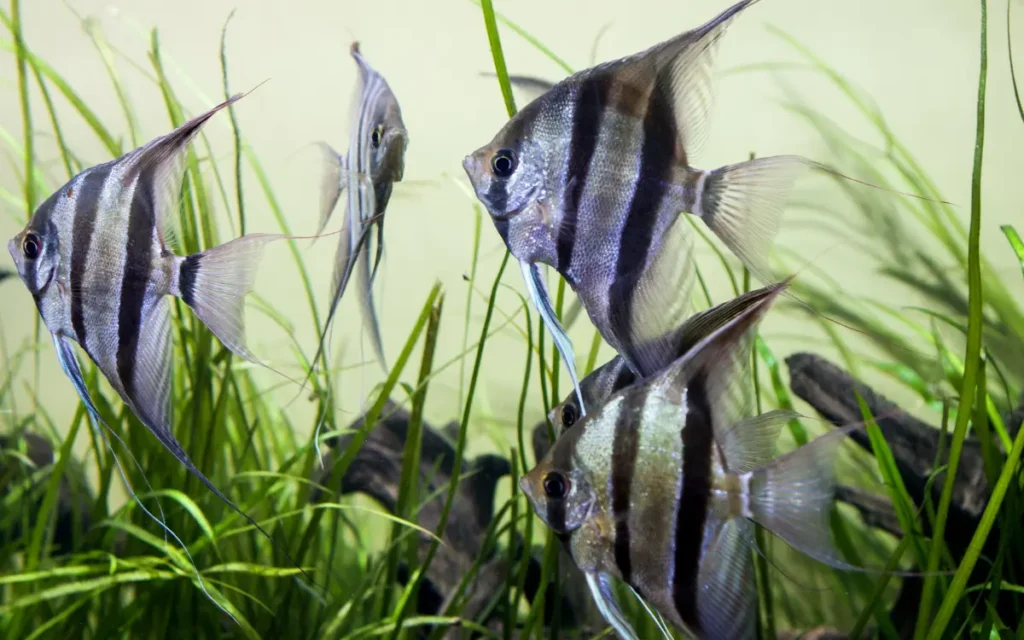
Angelfish Colors and Markings
Wild-type angelfish have a silver body with dark upright bars. The bars help break up the fish’s outline among roots and plant stems. Their intensity may change with mood, social status, lighting, or stress.
Selective breeding has produced many aquarium forms, including:
- Silver and zebra
- Marble and gold marble
- Black and black lace
- Gold and koi
- Platinum and albino
- Leopard and smokey
- Standard-fin and veiltail forms
These are usually color or fin forms of P. scalare, not separate species. An Altum angelfish is not simply a tall color variety. It is a different species with different space and water needs.
Color does not change the basic care plan, but fin form can. Veiltails need more vertical clearance and are easier targets for nippy companions. Keep rough plastic plants and sharp rock edges away from any long-finned angelfish.
Male vs Female Angelfish: Can You Tell the Difference?
Most juvenile angelfish cannot be sexed reliably by appearance. Forehead shape, body roundness, fin length, and aggression are often repeated as certain clues, but each one can mislead you.
The best visible clue appears close to spawning:
- A female’s ovipositor is wider and blunt.
- A male’s breeding papilla is narrower and more pointed.
The fish laying the eggs is female. Still, eggs do not prove that the second fish is male. Two females may form a pair and lay unfertilized eggs together.
If every egg turns white, possible causes include an infertile spawn, an inexperienced pair, poor egg care, or two females. Do not decide the second fish’s sex from one failed batch.
Buying one fish labeled male and one labeled female also does not create a compatible couple. If breeding is the goal, buy a proven pair from a good breeder or raise juveniles in a tank large enough for pairs to form. Have homes ready for fish you cannot keep.
What to Check Before Buying an Angelfish
First, confirm the species. Most shop fish are P. scalare, but a label such as “Altum,” “Peruvian,” or “wild” deserves a direct question.
Ask the seller to feed the fish. Choose one that swims upright, notices the food, and has a filled-out head and belly without swelling. The eyes should be clear, the body straight, and the fins open.
Leave behind a fish with rapid breathing, a pinched belly, cloudy eyes, cotton-like growth, open sores, bent fins, or trouble holding position. Sympathy purchases often turn one sick store fish into a sick home aquarium.
Ask about the store’s temperature, pH, hardness, diet, arrival date, and any recent treatment. If possible, keep the newcomer in a cycled quarantine tank for two to four weeks before it enters the display.
Do not buy six juveniles to “find a pair” unless you already own the adult group tank and have a rehoming plan. Six tiny angels are adorable. Six territorial adults are a housing meeting with no polite ending.
What Tank Size Do Angelfish Need?
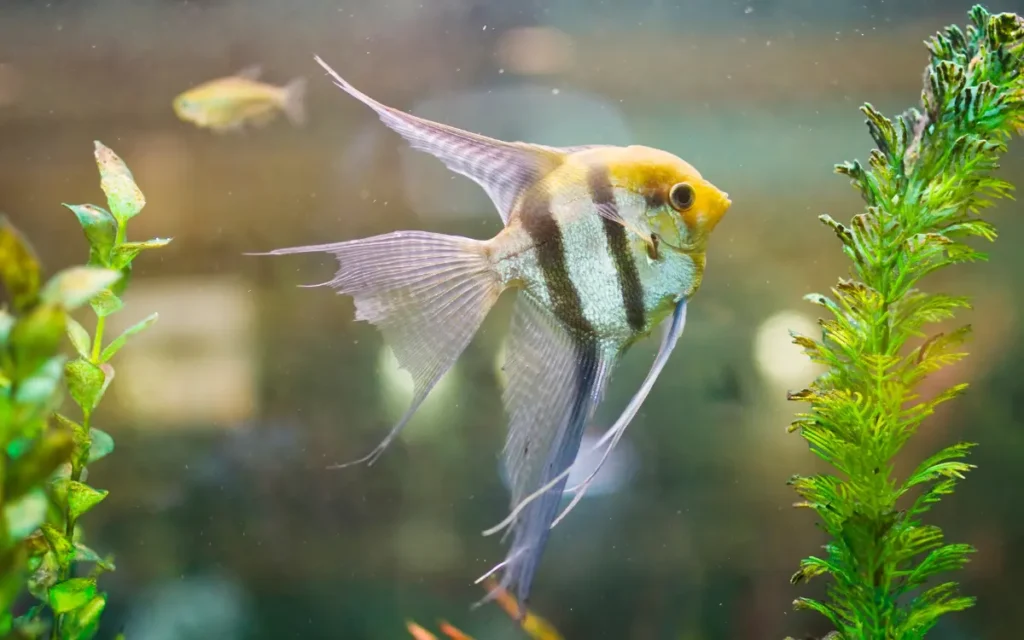
Use at least a 29-gallon tall tank for one adult angelfish. For a compatible pair or an angelfish community, I recommend 55 gallons or more. For a group of five or six adults, use 75 gallons or more and be ready to separate a pair or bullied fish.
Some care pages allow several adult angelfish in 29 gallons. I do not recommend that for a beginner. The tank may hold the fish physically, but it gives a chased fish little room once two adults claim a spawning area.
Published guidance varies. Petco gives 29 gallons as a minimum for one adult, while Aqueon recommends 55 gallons or larger for full-grown angelfish. Seriously Fish lists a smallest tank of about 39 x 16 x 20 inches. Those differences make more sense when you stop comparing gallon numbers and inspect the shape.
Tank Dimensions Matter More Than the Label
Exact dimensions vary by brand, so measure before buying.
| Common tank | Approximate dimensions | My opinion for adult angelfish |
| 20-gallon high | 24 x 12 x 16 inches | Breeding tank for a known pair only; too tight for a permanent community |
| 29-gallon | 30 x 12 x 18 inches | Minimum for one standard-finned adult |
| 40-gallon breeder | 36 x 18 x 16 inches | Good floor space, but shallow after substrate for a large veiltail |
| 55-gallon | 48 x 13 x 21 inches | Good height and length for a pair or light community |
| 75-gallon | 48 x 18 x 21 inches | Better front-to-back room for a group or fuller community |
Tank height on the box is not the same as swimming depth. Substrate takes space at the bottom, and the water line sits below the rim. An 18-inch tank may give only 15 or 16 inches of actual water.
Read the aquarium fish by tank size guide if you are planning the whole community rather than one centerpiece fish.
How Many Angelfish Should Be Kept Together?
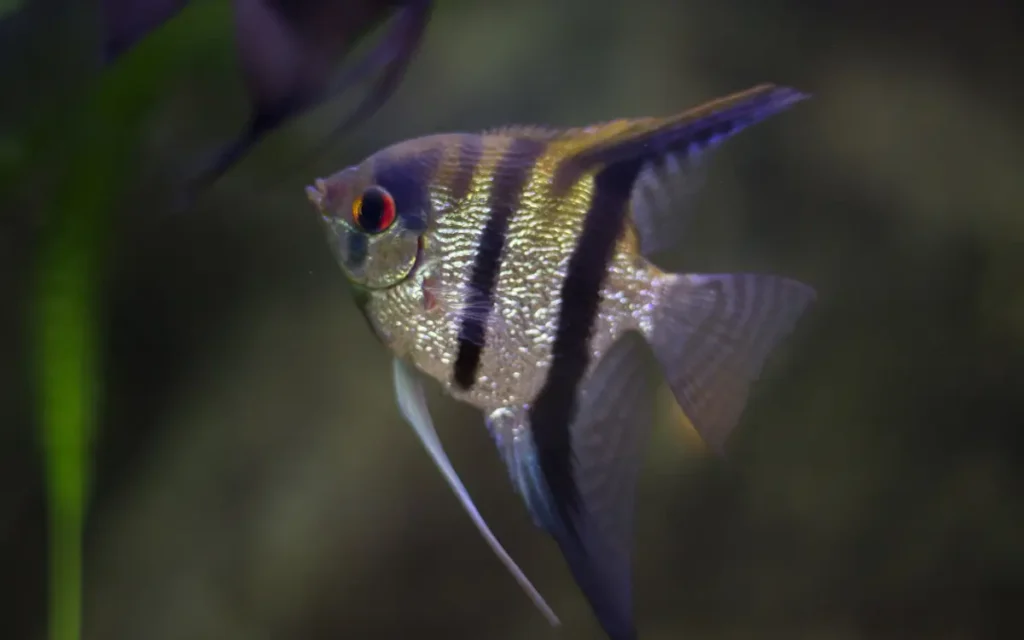
For a beginner, one angelfish or one bonded pair is easier to manage than a small random group. A single angelfish can live normally as the centerpiece of a suitable community tank.
Three is often a poor number in a small tank. If two pair up, the third fish may receive every chase. A larger group can spread social pressure, but only when the tank has enough room and the keeper can move fish.
For five or six adults, I would start with a 75-gallon aquarium, use tall barriers that divide the view, and keep a divider or spare tank available. More gallons reduce risk; they do not sign a peace treaty for the fish.
How to Set Up an Angelfish Tank
An angelfish aquarium should have tall cover around the edges and open swimming room through the middle. Set it up before the fish comes home.
1. Cycle the Tank Fully
Grow the biofilter before adding angelfish. Ammonia and nitrite must stay at 0 ppm after normal feeding. If you are unsure how to reach that point, follow this fish tank cycling guide.
Do not trust age alone. A tank that has contained water for four weeks is not cycled unless a working biofilter has been fed a source of ammonia and tested.
2. Protect Swimming Height
Keep deep substrate, tall rocks, and hard decor out of the main path below the fish. Large standard-finned adults do better with about 18 inches of tank height, while 20 inches or more gives large and veiled fish better clearance.
3. Use Smooth Substrate and Safe Decor
Sand or smooth fine gravel works. Angelfish may forage near the bottom, but they are not heavy sand sifters.
Run a finger over artificial plants and ornaments. If an edge catches skin or cloth, it may catch a long fin. Secure driftwood and rocks so a bump cannot send them falling.
4. Add Tall Plants and Upright Wood
Amazon swords, Vallisneria, Java fern, and other tall plants create cover without filling the entire swimming zone. Place them toward the back and sides. Broad leaves may later become spawning sites.
The Oceanbitez aquarium plant library can help you choose plants by position and light level.
5. Keep Water Movement Gentle
Use enough filtration for the aquarium’s waste, but do not point a hard jet across the full tank. Aim the outlet toward the glass, fit a spray bar, or break the flow with wood.
If an angelfish leans into the current all day or avoids one side, the flow is too strong in that area. A sponge over the intake protects fins and future fry.
6. Provide Shade Without Making a Dark Box
Use floating plants, wood, or taller leaves to form calmer shaded patches. Leave open water for feeding and observation. A light timer makes the daily rhythm steady and may limit algae.
7. Use a Heater, Thermometer, Lid, and Test Kit
Check the temperature with a separate thermometer instead of trusting only the heater dial. Cover gaps around cables because a startled fish can jump. Keep an ammonia, nitrite, nitrate, and pH test at home.
This freshwater aquarium setup guide covers the basic equipment if you are starting with an empty tank.
Best Water Parameters for Freshwater Angelfish
For most captive-bred P. scalare, aim for 78-82°F, pH 6.5-7.5, and about 3-12 dGH. Ammonia and nitrite must remain at 0 ppm. Try to keep nitrate below 20 ppm when your source water allows it, and pay attention to any steady rise between changes.
Source ranges are wider. FishBase reports 24-30°C, pH 6.0-8.0, and 5-13 dH, while Seriously Fish lists 24-30°C, pH 6.0-7.4, and up to 15 dGH. The narrower target above is easier for a mixed captive-bred aquarium and avoids living at either edge.
Do not force naturally hard tap water to a low pH with a bottle of acid. Fast swings are harder on fish than a steady reading within the accepted captive range. Test your GH and KH before changing chemistry, and ask a local breeder which water produced the fish.
Weekly Angelfish Care Routine
Change about 20-25% of the water each week, adjusting for stocking and test results. Use conditioner, match the temperature, and siphon debris without stripping every surface clean.
Rinse dirty filter sponge or media in removed tank water when flow drops. Do not replace all biological media on the same day. Much of the waste-processing bacteria lives on that media.
During the change, check the fish from both sides:
- Are the fins open and free of new tears?
- Is each fish eating without being blocked?
- Does the belly look filled out rather than pinched or swollen?
- Is breathing calm when the fish is resting?
- Can a weaker fish leave another’s territory?
A short weekly check beats trying to identify a sick fish from one blurry photo after the problem has grown.
What Do Angelfish Eat?
Freshwater angelfish are omnivores, but wild fish eat many small crustaceans and other aquatic animals. Feed captive adults a quality tropical or cichlid pellet or flake as the regular food, then rotate frozen or live brine shrimp, daphnia, mysis, and bloodworms.
Bloodworms are a rich extra, not a complete daily diet. Live foods should come from a safe source because food collected outdoors can bring unwanted organisms into the tank.
Feed adults once or twice per day, giving only what they finish in about two minutes. Growing juveniles can take two or three smaller meals, but extra feeding also creates extra waste. Watch the water, not just the calendar.
How to Tell if an Angelfish Is Getting Enough Food
A healthy angelfish is thin when viewed head-on but should not have a pinched belly or hollow area behind the head. It should approach meals and swallow food without repeated spitting.
Feed in two places if one fish controls the surface. Use some slow-sinking granules so shy fish can eat below the rush. Do not keep adding food because the boldest angelfish continues begging. Cichlids can look deeply betrayed five minutes after dinner.
Repeated food refusal, weight loss, or long white waste needs closer observation. White waste alone does not prove parasites; an empty gut, stress, diet, and illness can produce a similar sign. Isolate the fish and seek a sound diagnosis before treating.
Best Tank Mates for Angelfish
Good angelfish tank mates are large enough not to be swallowed, warm-water tolerant, calm around long fins, and able to eat without turning every meal into a race.
Safer choices in a large enough aquarium may include:
- Sterbai Corydoras or another Cory species suited to the chosen temperature
- Bristlenose Pleco
- Adult rummy-nose tetras
- Bleeding heart tetras
- Congo tetras in a 75-gallon or larger tank
- Calm, medium-sized rasboras whose full needs overlap
Every schooling fish still needs its proper group, so include the whole school in your stocking plan. A “small tetra” becomes a large waste load when ten are needed.
Read the full angelfish tank mates guide before buying companions. Use its list as a shortlist, then check the temperature, adult size, group number, and temperament of the exact species.
The Four-Part Angelfish Tank Mate Test
Ask four questions before adding any fish:
- Will an adult fit inside the angelfish’s mouth?
- Is the species known to nip long fins?
- Can it stay healthy at 78-82°F?
- Is there room for its full group after the angelfish claims a territory?
One failed answer is enough to choose something else.
Tank Mates to Avoid
Avoid Tiger Barbs, Serpae Tetras, very small rasboras, Ember Tetras, guppy fry, dwarf shrimp, large aggressive cichlids, and goldfish. Adult angelfish may also eat Neon Tetras, even if a juvenile ignored them for months.
Black Skirt Tetras are often listed as companions, but some groups nip fins. I would not make them a first choice for a veiltail. Bettas are also risky because both fish have long fins, occupy similar water, and may defend space.
Do not add German blue rams or Bolivian rams to a small angelfish tank just because all three are called peaceful cichlids. They still need their own territories and do not share exactly the same best temperature. This mix belongs in a larger, carefully watched setup.
Can Angelfish Live With Shrimp?
Adult angelfish will usually eat shrimplets and may hunt adult dwarf shrimp. Large Amano shrimp may survive with dense cover, but there is no promise. If growing a shrimp colony matters, use a separate shrimp tank.
Can Angelfish Live Alone?
Yes. A single angelfish can live well in a suitable community and is often the easiest setup for a beginner. It does not need a mate to stay healthy.
Keeping one also removes pair aggression and surprise eggs. The tank still needs full adult height and volume.
Why Are My Angelfish Fighting?
Angelfish fight over territory, social rank, food, or a breeding site. Pair formation is a common turning point. Fish that grew together peacefully may behave differently once two choose each other.
Brief displays and short chases can be normal. Act when one fish cannot rest, misses meals, loses scales, develops torn fins, breathes fast, or stays pinned behind equipment.
First, test the water. Stress from ammonia, nitrite, high heat, or low oxygen can make behavior worse. Then watch which fish starts the chase and where it happens.
Rearrange tall plants or wood to block the direct view across the tank. Feed in more than one place. If the target still cannot escape, separate the fish. Adding more angelfish to a crowded tank usually adds targets, not peace.
Common Angelfish Problems and First Checks
| Sign | Possible causes | First response |
| Gasping or fast breathing | Ammonia, nitrite, low oxygen, high heat, gill trouble | Test water, check temperature and filter movement |
| Clamped fins and hiding | Poor water, bullying, transport stress, illness | Test first, dim the light, watch tank interactions |
| Torn fins | Fighting, nipping companions, sharp decor | Find the cause and separate fish if attacks continue |
| Pinched belly and weight loss | Missed meals, internal illness, parasites | Watch the fish eat and move it to quarantine |
| Swollen belly | Heavy feeding, eggs, digestive trouble, internal illness | Stop guessing from shape alone; check appetite, waste, scales, and behavior |
| White spots or dusty coating | Several illnesses can look similar | Isolate if possible and obtain a proper diagnosis |
| Pits around the head | Ongoing water or health trouble | Check husbandry and contact an aquatic veterinarian or skilled fish-health adviser |
If ammonia or nitrite is above zero, change part of the water with conditioned water, improve surface movement, and check for a stopped filter, dead fish, excess food, or lost biofilter media.
Do not mix several medications “just in case.” A hospital tank lets you observe and treat one fish without exposing plants, invertebrates, and the biofilter unnecessarily.
How to Breed Freshwater Angelfish
Angelfish are egg-laying cichlids that form pairs and place eggs in neat rows on an upright surface. A broad plant leaf, slate, filter pipe, heater guard, or aquarium glass may become the chosen site.
Both adults may clean the site, fan the eggs, remove bad eggs, and guard the fry. Captive pairs sometimes eat their first few spawns. Movement outside the tank, other fish, poor privacy, or simple inexperience can contribute.
Step-by-Step Angelfish Breeding Setup
- Start with a proven pair. If raising a juvenile group, use at least a 75-gallon grow-out tank and plan homes for extras.
- Move the pair to a tall breeding tank. A 20-gallon high can work as a monitored breeding tank with no other adult fish, though I would use more space for a permanent home.
- Add an upright spawning surface. Use removable slate, a broad plant leaf, or a safe spawning cone.
- Use mature filtration. A gentle sponge filter gives biological filtration without pulling in fry.
- Hold steady warm water. Around 80-82°F often suits breeding pairs, but cleanliness and steady readings matter more than one magic number.
- Feed the pair well. Use a sound staple with small frozen or live foods rather than feeding bloodworms alone.
- Prepare fry food and grow-out space early. A successful pair can produce hundreds of young, and they soon need more room than the spawning tank.
The eggs often hatch in two to three days. The larvae remain attached as wrigglers while using their yolk sacs. They usually become free-swimming about three to five days later, depending on temperature and development.
Start newly free-swimming fry on newly hatched baby brine shrimp or another food small enough for them to eat. Give small meals several times per day and remove waste carefully. A sponge-covered siphon or airline tube helps protect tiny fry during water changes.
Should You Let the Parents Raise the Fry?
Letting the parents try is the simplest route and allows natural care, but other community fish will eat many fry. A dedicated pair tank gives the parents a better chance.
Artificially hatching eggs can raise more young, but it adds work around aeration, fungus, first foods, and cleaning. I would let a new pair practice unless there is a good reason to remove the eggs.
Before saving a full spawn, decide where hundreds of juveniles could go. Producing fry is the easy part. Growing them evenly and finding sound homes is the real breeding job.
Further Research Before Keeping Angelfish
Read these guides before setting up the tank:
- Angelfish tank mates for species-by-species compatibility
- Fish tank cycling if ammonia and nitrite are still confusing
- Aquarium fish by tank size for planning the full adult stock
- Freshwater aquarium setup for equipment and startup order
- Aquarium plants for tall background and broad-leaf choices
Also research the exact color form and source. Standard P. scalare, wild-caught locality fish, veiltails, and true Altums should not be treated as identical purchases.
Frequently Asked Questions
How Do You Care for Angelfish?
Keep angelfish in a tall, cycled aquarium at 78-82°F. Maintain 0 ppm ammonia and nitrite, change part of the water weekly, feed a quality prepared staple with varied frozen foods, and avoid tiny or fin-nipping companions.
Can an Angelfish Live in a 20-Gallon Tank?
A 20-gallon high can house a known breeding pair for spawning under close care, but I would not use it as a permanent adult community tank. Use a 29-gallon tall for one adult and 55 gallons or more for a pair or community.
Is a 29-Gallon Tank Big Enough for Angelfish?
A 29-gallon tall is the minimum I would use for one standard-finned adult. It is too cramped for a group, and a breeding pair may control most of the available length. More room gives safer tank-mate and territory choices.
How Many Angelfish Should Be Kept Together?
Keep one, a compatible pair, or a properly managed group. Avoid three in a small tank because a pair may target the third. A group of five or six adults needs about 75 gallons or more plus a plan for separating bullies or pairs.
What Do Angelfish Eat?
Angelfish eat quality flakes or pellets plus foods such as brine shrimp, daphnia, mysis, and bloodworms. Feed adults once or twice daily in small portions. Use bloodworms as one part of the diet, not the only food.
Will Angelfish Eat Neon Tetras?
Adult angelfish may eat Neon Tetras because they are slim and small enough to swallow. Some groups coexist when raised together, but that history does not remove the risk.
Can Angelfish Live With Bettas?
I do not recommend the mix for beginners. Both fish use similar swimming space, have long fins, and may act territorially. A setup can look calm for weeks before one fish begins chasing the other.
Can Angelfish Live With Guppies?
The pairing is risky. Adult angelfish may eat guppy fry or small adults, while long-finned male guppies can attract unwanted attention. Their best water hardness may also differ.
How Can You Tell if an Angelfish Is Male or Female?
Juveniles are very hard to sex. Near spawning, a female has a wider, blunt ovipositor, while a male usually has a narrower, pointed breeding papilla. The fish laying eggs is female, but the second fish may also be female.
Why Did My Angelfish Lay Eggs Without a Male?
A female can lay eggs without a male. The eggs will not be fertile. Two females can also behave like a pair and lay eggs together.
Why Is My Angelfish Chasing the Others?
Common causes are territory, pair formation, spawning, social rank, or food competition. Short chases may be normal. Separate fish if one cannot eat or rest, hides constantly, breathes hard, or suffers damage.
How Long Do Freshwater Angelfish Live?
They often live 8-12 years with enough space, clean warm water, a suitable diet, and low social stress.
