
How to Lower Nitrates in a Fish Tank Safely

High nitrate usually builds up slowly. Fish waste, uneaten food, decaying plants, crowded stocking, and nitrate already present in tap water can all raise the reading.
The safest immediate fix is a partial water change using conditioned, temperature-matched water. Afterward, reduce the source of the nitrate. Changing water may lower the number today, but nitrate will climb again if the tank is overfed, overcrowded, or poorly maintained.
Quick Nitrate Guide
| Nitrate reading | What it means | Recommended action |
| 0–10 ppm | Low | Usually no action needed |
| 10–20 ppm | Good for most freshwater tanks | Continue normal maintenance |
| 20–40 ppm | Acceptable for many fish, but worth monitoring | Check feeding and water-change routine |
| 40–80 ppm | Too high for routine long-term conditions | Complete a partial water change |
| Above 80 ppm | Very high | Lower it through repeated partial changes |
| Above 100 ppm in a neglected tank | Possible old tank syndrome | Use smaller, gradual water changes and check pH |
These are general freshwater guidelines. Shrimp, fry, wild-caught fish, and nitrate-sensitive species may need nitrate kept below 20 ppm. Reef aquariums usually need a much lower level than ordinary freshwater community tanks.
Ammonia and nitrite are different. Both should remain at 0 ppm in a stocked, cycled aquarium.
What Is Nitrate?
Nitrate is the final main product of the aquarium nitrogen cycle.
Fish release waste, leftover food breaks down, and dead plant matter begins to rot. This creates ammonia. Bacteria inside the filter and across other wet surfaces turn ammonia into nitrite and then nitrite into nitrate.
The process looks like this:
Waste → Ammonia → Nitrite → Nitrate
Nitrate is less immediately toxic than ammonia or nitrite, but it does not simply disappear. It accumulates until water changes, plant growth, or specialized filtration removes it.
A small nitrate reading in a cycled aquarium is normal. In fact, nitrate can be a sign that the biological filter is processing waste. The problem begins when nitrate rises faster than the keeper removes it.
Our nitrogen cycle guide explains how these three waste compounds are connected.
What Nitrate Level Is Safe for Fish?
There is no single nitrate limit that suits every aquarium animal. A hardy adult fish may tolerate a reading that causes problems for young fry, shrimp, or a sensitive wild-caught species.
For many freshwater community aquariums, keeping nitrate below 40 ppm is a practical upper limit. Staying below 20 ppm gives sensitive fish more protection and is a better target when possible.
Try to maintain:
- Below 20 ppm for shrimp, fry, sensitive fish, and breeding tanks
- Below 40 ppm for most ordinary freshwater community tanks
- As low as practical in marine and reef aquariums
- A stable reading rather than repeated swings between very high and very low levels
Do not confuse nitrate with nitrite. Nitrate is written as NO₃, while nitrite is NO₂. Nitrite is much more dangerous and should read 0 ppm.
Test-kit units can also differ. Most home aquarium kits report nitrate as NO₃, but laboratory reports may use nitrate-nitrogen, written as NO₃-N. Those numbers are not interchangeable. Follow the range supplied with your particular test.
Can High Nitrate Kill Fish?
Nitrate usually causes long-term trouble rather than sudden poisoning at the levels found in ordinary aquariums. Fish may be exposed for weeks before the keeper realizes anything is wrong.
Possible signs include:
- Reduced appetite
- Low activity
- Faded color
- Poor growth
- Increased stress
- Greater susceptibility to disease
- Breeding problems
- Poor survival among eggs or fry
- Persistent algae growth
These symptoms are not unique to nitrate. Ammonia, nitrite, low oxygen, unsuitable temperature, parasites, and infections can cause similar changes.
Test the full set of basic parameters instead of assuming nitrate is responsible:
- Ammonia
- Nitrite
- Nitrate
- pH
- Temperature
Long-term nitrate exposure affects species differently. Veterinary guidance also warns that test results may be reported as either nitrate or nitrate-nitrogen, making it unsafe to compare numbers without checking the units. Merck Veterinary Manual
The Fastest Safe Way to Lower Nitrates
A partial water change is the most reliable way to reduce nitrate quickly.
If the aquarium measures 80 ppm and the replacement water contains no nitrate, a 50% water change should reduce the level to approximately 40 ppm. The result may not be exact because waste can continue breaking down and the new water may contain some nitrate.
Use this simple estimate:
New nitrate level = Current nitrate × Water remaining after the change
For example:
- Current nitrate: 60 ppm
- Water change: 40%
- Water remaining: 60%
- Estimated result: 60 × 0.60 = 36 ppm
This calculation assumes the replacement water contains 0 ppm nitrate. If your tap water contains nitrate, the final reading will be higher.
Before Changing the Water
Test the tap or source water separately. Some homes receive water that already contains measurable nitrate. A water change cannot reduce the aquarium below the nitrate level entering with the new water.
Prepare the replacement water with:
- A suitable water conditioner
- A temperature close to the aquarium temperature
- Similar hardness and pH where possible
- The correct salinity in a marine or brackish aquarium
How Much Water Should You Change?
Use the nitrate reading and the aquarium’s maintenance history to decide.
| Situation | Suggested response |
| Nitrate between 40 and 60 ppm | Change approximately 25–40% |
| Nitrate between 60 and 100 ppm | Change approximately 40–50%, then retest |
| Nitrate still high after one change | Repeat a partial change later and investigate the cause |
| Fish are distressed and ammonia or nitrite is present | Complete a prompt partial change and increase aeration |
| Very old, neglected tank with low pH | Use smaller daily changes instead of one sudden correction |
A healthy, regularly maintained aquarium can usually handle a 40% to 50% water change when the new water is properly prepared.
The main exception is an aquarium that has gone without maintenance for a long time. Its pH, hardness, and mineral content may be very different from the tap water. A sudden large change can shock the fish.
The Merck Veterinary Manual recommends returning water conditions to normal gradually when old tank syndrome is suspected.
Lowering Nitrate in an Old, Neglected Tank
An aquarium with old tank syndrome may have extremely high nitrate, low pH, low alkalinity, and a large amount of trapped waste. Fish sometimes adjust to these poor conditions slowly. Replacing most of the water in one attempt can expose them to a sharp pH or mineral change.
Signs that this may be more than an ordinary high-nitrate problem include:
- The tank has not received a water change for months
- The pH is much lower than the source water
- Nitrate is at or beyond the test kit’s highest reading
- The substrate contains a thick layer of waste
- Fish appear thin, inactive, or have poor appetites
- The filter has been neglected for a long time
Start with a smaller change of around 10% to 20%. Retest the aquarium and compare its pH with the replacement water. Repeat small changes over several days while watching the fish.
Do not deep-clean the substrate, replace all filter media, scrub every decoration, and complete a huge water change on the same day. That is too much disruption at once.
Why Nitrate Keeps Coming Back
Nitrate returning after a water change is normal. The biological filter continuously turns fish waste into nitrate.
The real question is how quickly it returns.
If nitrate rises from 20 ppm to 80 ppm within a few days, the aquarium is producing more waste than its maintenance routine can handle.
Too Much Food
Overfeeding is one of the most common causes. Food that fish do not eat settles between gravel, behind decorations, or inside the filter. It continues breaking down even when it is no longer visible.
Feed an amount the fish finish without leaving food scattered around the tank. Bottom feeders may need sinking food, but adding extra food “just in case” often creates more waste.
Ask anyone else who feeds the fish how much they are using. Two people feeding the same aquarium is an easy way to double the waste without realizing it.
Too Many Fish
Every fish adds waste. A crowded aquarium may produce nitrate faster than weekly water changes can remove it.
Overstocking is especially common when:
- Fish were bought as juveniles and have grown
- Livebearers have reproduced
- The tank contains large, messy fish
- The keeper followed an unreliable “one inch per gallon” rule
- The filter was used to justify adding more fish
A stronger filter can process more ammonia, but it does not automatically remove the nitrate created during that process.
You may need a larger aquarium, fewer fish, or more frequent water changes.
Waste Trapped in the Substrate
Gravel can collect food, fish waste, and dead plant material. This trapped material continues contributing to nitrate.
Use a gravel vacuum during water changes. You do not need to clean every part of the substrate each week. Work through one section at a time, especially in a heavily planted aquarium.
Sand should usually be siphoned lightly across the surface. Pushing the siphon deeply into fine sand can disturb plant roots and make a mess.
Dead Leaves and Hidden Animals
Remove decaying plant leaves before they fall apart. Look behind rocks, inside caves, and around the filter intake if a fish, snail, or shrimp is missing.
A small dead fish may disappear quickly in a community tank, but its body still adds waste as it breaks down.
Dirty Mechanical Filter Media
Sponges, pads, and filter floss catch waste. If that material stays inside the filter for too long, it continues decomposing in the water flow.
Rinse dirty mechanical media in water removed from the aquarium. Do not wash biological media with soap, and do not replace every filter component at once.
Cleaning the filter will not directly erase nitrate already dissolved in the water, but removing collected debris reduces the amount produced later.
Test Your Tap Water for Nitrate
Do not skip this step when nitrate remains high after water changes.
Fill a clean container with tap water, add conditioner if your test instructions require it, and test it separately. Follow every shaking and waiting step listed with the kit.
If the tap water contains 30 ppm nitrate, a water change cannot bring the aquarium down to 10 ppm using that water alone.
Possible options include:
- Mixing tap water with remineralized reverse-osmosis water
- Using nitrate-selective filter media
- Increasing the number of healthy, fast-growing plants
- Using prefiltered replacement water
Never use pure reverse-osmosis or distilled water in a freshwater aquarium without adding the minerals the fish need. Pure water can have very low hardness and almost no buffering capacity.
Species that prefer hard, mineral-rich water, including many livebearers and African cichlids, can be harmed by poorly prepared RO water.
Can Live Plants Lower Nitrate?
Yes. Healthy aquarium plants use nitrogen as they grow. Fast-growing plants usually consume more than slow-growing species.
Useful choices include:
- Hornwort
- Water sprite
- Guppy grass
- Anacharis
- Amazon frogbit
- Salvinia
- Duckweed
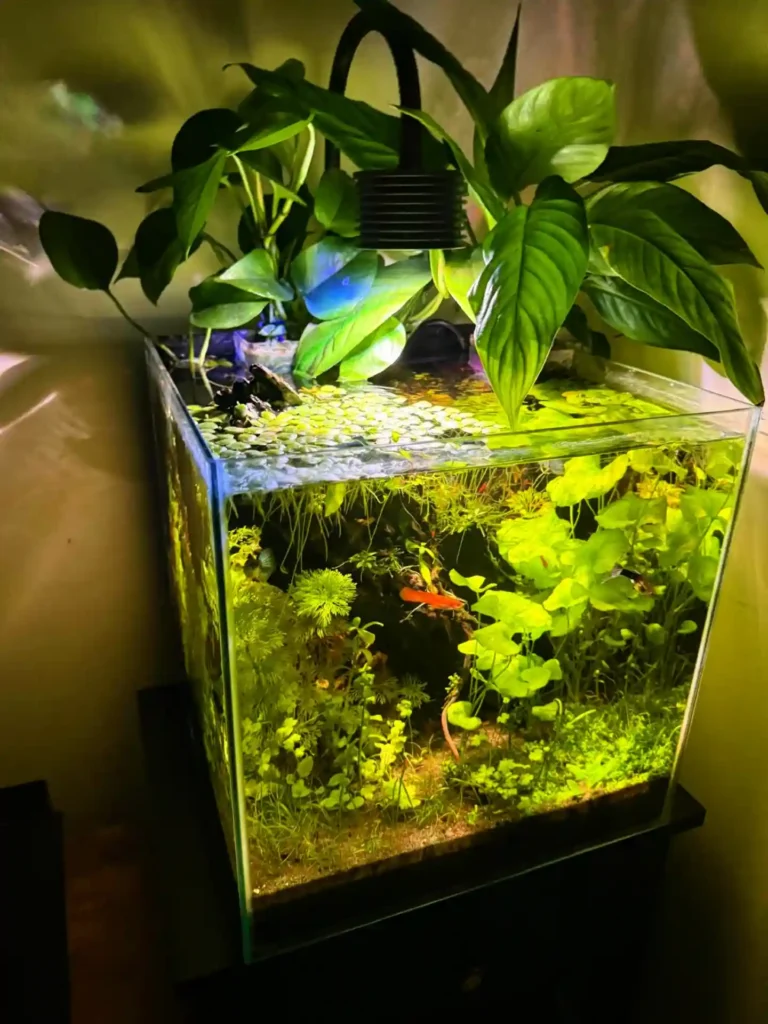
- Pothos with only its roots in the aquarium
Floating plants can be particularly useful because they receive direct access to light and atmospheric carbon dioxide. Pothos can also remove nutrients through its roots, but its leaves and stems should remain above the water.
Plants only remove nitrate permanently when you trim or remove some of their growth. If dead leaves rot inside the tank, some of those nutrients return to the water.
Plants are support, not permission to stop changing water. Water changes also control dissolved waste and restore minerals that a nitrate test does not measure.
Explore suitable options in the aquarium plants guide.
Does a Bigger Filter Remove Nitrate?
Ordinary biological filtration does not remove much nitrate. It usually produces nitrate by turning ammonia and nitrite into a less harmful form.
A bigger filter may:
- Improve water circulation
- Catch more solid waste
- Provide more surface area for bacteria
- Help prevent ammonia and nitrite spikes
Those are useful benefits, but nitrate will still accumulate.
Some specialized media, deep anaerobic systems, refugiums, and denitrifying filters can remove nitrate. These methods require the correct setup and monitoring. They are rarely the first answer for an ordinary freshwater aquarium.
Start with feeding, stocking, waste removal, and water changes.
Do Nitrate-Removing Filter Pads Work?
Nitrate-removing resins and pads can lower nitrate under the right conditions. Their results depend on:
- The type of product
- Water chemistry
- Flow through the media
- The amount of nitrate being produced
- How often the media is replaced or regenerated
They can help when source water already contains nitrate or when a temporary reduction is needed. They should not be used to hide overfeeding, overcrowding, or missed maintenance.
Read the product instructions carefully. Some resins affect other parts of water chemistry or are designed only for freshwater.
Should You Use Chemicals to Lower Nitrate?
A bottled nitrate reducer may help in some aquariums, but it should not be your first response.
Products work in different ways. Some bind compounds temporarily, some feed bacteria that consume nitrate, and others support plant or microbial growth. A rapid bacterial increase can reduce oxygen if the product is overdosed.
Avoid combining several nitrate treatments at once. You may create a new problem while making it harder to understand which product caused it.
A properly prepared water change gives a more predictable result.
Can You Lower Nitrate Without a Water Change?
Plants, nitrate-removing media, refugiums, and denitrifying systems can reduce nitrate without an immediate water change. Reducing food and removing waste can slow future buildup.
However, these methods may take time. If the nitrate reading is already high, a partial water change remains the quickest and most predictable option.
Do not avoid water changes because you are worried about beneficial bacteria. Most of those bacteria live on the filter media, substrate, plants, glass, and decorations. They are not floating freely in large numbers.
Replacing part of the water does not restart a healthy cycle. Replacing or sterilizing colonized filter media is a much greater risk. See the fish tank cycling guide for a beginner-friendly explanation.
Why Nitrate Does Not Drop After a Water Change
If the test shows nearly the same number after a water change, check these possibilities.
The Water Change Was Too Small
A 10% change removes only about 10% of the nitrate when the replacement water contains none.
If nitrate starts at 80 ppm, a 10% change should leave approximately 72 ppm. Many color-chart kits cannot show that small difference clearly.
The Tap Water Contains Nitrate
Test the replacement water on its own. This is especially important when every water change produces a smaller reduction than expected.
The Test Was Used Incorrectly
Liquid nitrate tests often require strong shaking because one reagent can settle inside the bottle. Missing this step may produce an inaccurate result.
Check:
- Expiration date
- Required shaking time
- Number of drops
- Waiting time
- Whether the tube is clean
- Whether you are reading the color under neutral white light
When a result seems impossible, repeat it before making a drastic change.
Waste Is Still Breaking Down
A water change removes dissolved nitrate, but it does not remove food buried in gravel, a dead fish behind a decoration, or sludge sitting inside the filter.
Remove the source, then test again after the tank has circulated.
The Reading Exceeds the Test’s Range
If the test color is at the darkest end of the chart, the true reading may be much higher than the maximum shown.
You can test a diluted sample using distilled water, but follow the kit manufacturer’s method if one is provided. Dilution introduces room for error, so treat the result as an estimate.
A Better Weekly Routine
A normal maintenance routine for many freshwater aquariums may look like this:
- Test nitrate before the water change.
- Check ammonia and nitrite if the tank is new or fish are behaving strangely.
- Remove dead leaves and uneaten food.
- Change approximately 20% to 30% of the water.
- Siphon one dirty section of substrate.
- Rinse clogged mechanical media in removed tank water.
- Add conditioned, temperature-matched replacement water.
- Test nitrate again if the previous reading was high.
Your aquarium may need a different schedule. A lightly stocked planted tank may produce nitrate slowly, while a crowded goldfish tank may need larger or more frequent changes.
Use the test results to set the routine. If nitrate rises by 30 ppm every week and your target is below 40 ppm, a 10% weekly water change will not be enough.
Nitrate Problems in Planted Aquariums
A nitrate reading of zero is not always the goal in a planted tank. Plants need nitrogen, and a complete shortage can cause weak or yellowing growth.
The keeper has to balance the needs of the plants with the needs of the animals. Heavily planted tanks may receive nitrate through fertilizers, so check the fertilizer label before assuming all nitrate comes from fish waste.
Do not keep dosing nitrogen fertilizer while trying to solve an unexplained high reading. Pause, test the source water, review the dose, and check how quickly the plants are growing.
Mistakes That Make High Nitrate Worse
Replacing All the Filter Media
This does little to remove dissolved nitrate and may remove a large part of the biological filter. Ammonia and nitrite can then rise.
Completing a 100% Water Change
A total change is rarely needed. It may expose fish to a sudden difference in temperature, pH, hardness, or salinity.
Adding Aquarium Salt
Salt does not remove nitrate. It may have a place in certain treatments, but it is not a general solution for high nitrate. Some fish, plants, shrimp, and snails are sensitive to added salt.
Adding More Fish or Cleaner Animals
Plecos, snails, and shrimp do not remove nitrate. They eat certain materials and then produce waste of their own.
Stopping Feeding Completely
Short-term reduced feeding can slow waste production, but starving fish is not a maintenance plan. Correct the portion and frequency instead.
Deep-Cleaning the Entire Aquarium
Removing all the substrate, washing every decoration, and replacing all filter media can disturb the cycle. Remove waste in stages while protecting colonized surfaces.
How Long Does It Take to Lower Nitrates?
A partial water change lowers nitrate as soon as the old water is removed and the new water has mixed through the aquarium.
Solving the cause can take longer. Feeding changes may show results within a week or two. Plants need time to establish and grow. An overcrowded aquarium will continue producing nitrate until stocking or maintenance changes.
Test at the same point each week, preferably just before the water change. This tells you how quickly nitrate accumulates between maintenance days.
Frequently Asked Questions
Is 40 ppm nitrate safe for fish?
Many hardy freshwater fish can live at 40 ppm, but it is better treated as an upper routine limit than an ideal target. Aim below 20 ppm for sensitive fish, fry, shrimp, and breeding tanks.
How do I lower nitrate immediately?
Complete a partial water change with conditioned, temperature-matched water. A 50% change should cut nitrate by about half when the replacement water contains no nitrate.
Will a 50% water change hurt my fish?
It is usually safe in a regularly maintained aquarium when temperature, conditioner, pH, hardness, and salinity are matched. Use smaller gradual changes in a severely neglected tank with very different water chemistry.
Why is nitrate high when ammonia and nitrite are zero?
That usually means the biological filter is working. It is converting ammonia and nitrite into nitrate, but nitrate is accumulating faster than water changes and plants remove it.
Does aquarium carbon remove nitrate?
Ordinary activated carbon does not reliably remove nitrate. It is mainly used for discoloration, odors, and certain dissolved compounds. Use water changes, plants, or nitrate-specific media instead.
Do water conditioners remove nitrate?
Most standard conditioners treat chlorine, chloramine, and sometimes temporarily bind ammonia. They do not permanently remove a large nitrate buildup. Check the exact claims and instructions on the product label.
Can high nitrate cause algae?
High nitrate can contribute to algae growth when enough light and other nutrients are present. Lowering nitrate alone may not clear the algae if the aquarium receives too much light or contains excess phosphate.
Why does my nitrate stay at zero?
A zero reading may be normal in a heavily planted or lightly stocked tank. It can also result from an incorrectly performed or expired test. Repeat the test carefully and check ammonia and nitrite to confirm the tank is cycled.
How often should I test nitrate?
Test weekly in an established aquarium. Test more often when the tank is new, nitrate has recently been high, stocking has changed, or you are adjusting the water-change schedule.
Can plants replace water changes?
No. Plants can consume nitrate, but water changes also dilute other dissolved waste and help restore minerals. A planted tank may need fewer or smaller changes, but it still needs regular monitoring and maintenance.
