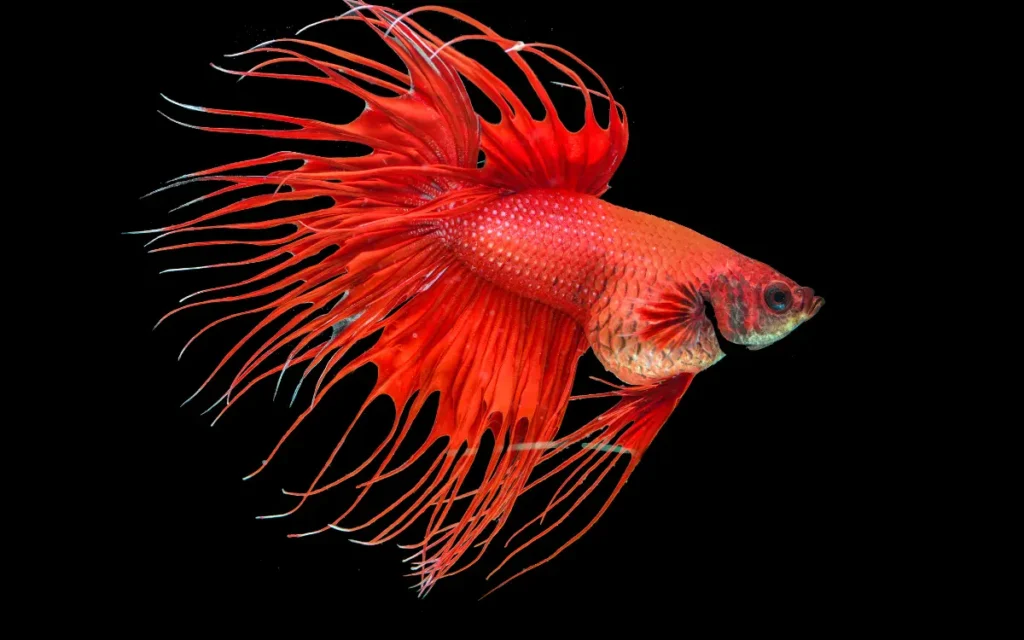
A 60 gallon aquarium is where you move beyond “beginner community tank” territory. This size gives you real freedom — larger schools, medium-sized centerpiece fish, and semi-aggressive species that would feel cramped in smaller setups.
If you’ve worked through 40 or 50 gallon tanks already, you’ll immediately notice that 60 gallons allows better territory spacing, stronger filtration, and more impressive aquascaping. It’s not a monster tank like a 125 gallon, but it’s large enough to build something that truly stands out.
What Can You Keep in a 60 Gallon Tank?
A properly filtered 60 gallon tank can comfortably support:
- 20–30 small schooling fish
- 2–4 medium centerpiece fish (depending on temperament)
- 10–12 bottom dwellers
- Controlled semi-aggressive or cichlid setups
It is large enough for medium cichlids, larger rainbowfish groups, and impressive schooling displays — but still too small for giant species like Oscars long term.
Why 60 Gallons Is a Strong Upgrade
The difference between 50 and 60 gallons isn’t just extra water — it’s flexibility.
At 60 gallons, you get:
- Greater water stability
- More defined territory zones
- Room for multiple medium fish
- Stronger aquascaping layouts
- Reduced aggression in many species
More water volume means slower parameter swings and less stress on fish.
In my opinion, 60 gallons is the point where hobbyists can confidently explore medium-sized species without constant space concerns.
Tank Dimensions: Standard vs Long vs Tall
Not all 60 gallon tanks are shaped the same.
Standard 60 Gallon
- Balanced footprint
- Works for most community tanks
60 Gallon Long
- More horizontal swim room
- Ideal for rainbowfish, danios, and cichlids
60 Gallon Tall
- Better for vertical swimmers
- Works well for angelfish displays
If you’re keeping active fish, horizontal space is more important than height.
How Many Fish Can You Keep in a 60 Gallon Tank?
Avoid chasing a “maximum fish number.” Structure your stocking instead.
A balanced 60 gallon often looks like:
- 2–3 medium centerpiece fish
- 20–25 small schooling fish
- 8–12 bottom dwellers
- 1 algae grazer
Filtration strength plays a big role here.
Planning Guide
| Category | Typical Range | Notes |
| Medium fish | 2–3 | Avoid mixing dominant males |
| Small schooling fish | 20–30 | Larger groups reduce stress |
| Bottom dwellers | 8–12 | Keep same species |
| Pleco | 0–1 | Choose manageable size |
Best Centerpiece Fish for a 60 Gallon Tank
This is where medium fish really shine.
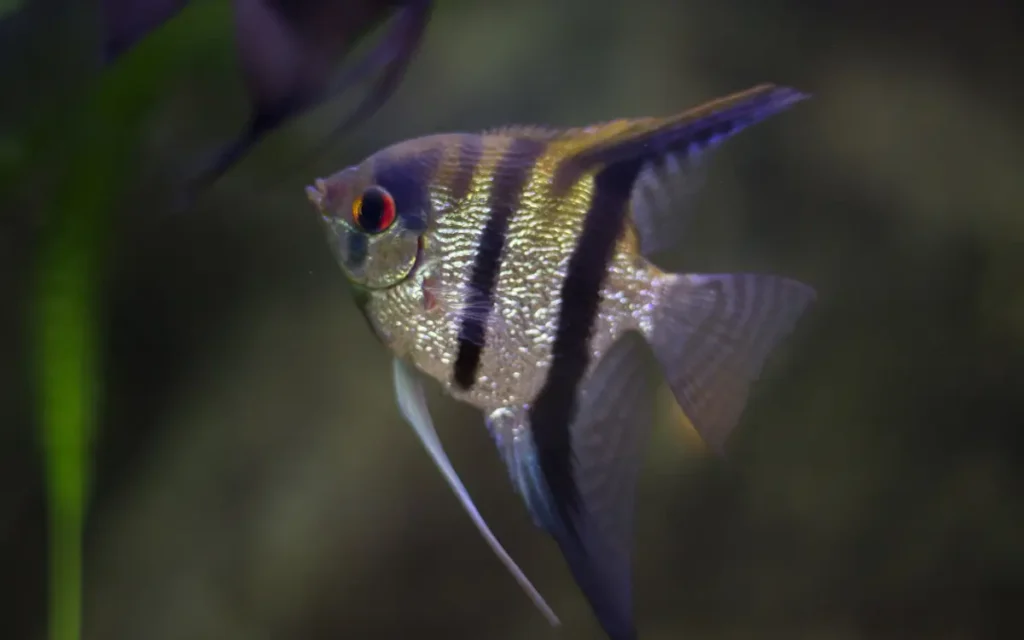
Angelfish
A group of 5–6 angelfish raised together can work in 60 gallons. Monitor for pair formation and aggression as they mature.
Electric Blue Acara
A pair thrives in this size tank and works well in semi-peaceful communities.
Severum
A single severum is more comfortable here than in smaller tanks.
Geophagus
Some smaller geophagus species can work in a 60 gallon with careful planning.
Best Schooling Fish for a 60 Gallon Aquarium
Large, coordinated schools are one of the highlights of this size tank.
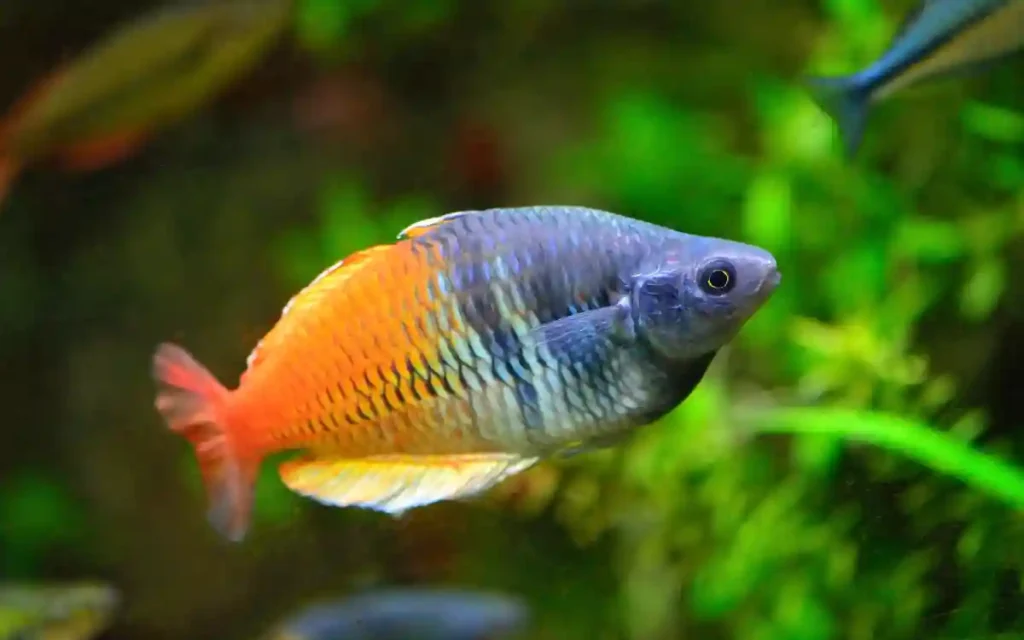
Boesemani Rainbowfish
Keep groups of 8–10 with more females than males.
Congo Tetra
A large group looks impressive and fits well in 60 gallons.
Rummy Nose Tetra
A school of 20+ creates strong visual impact.
Denison Barb
Active and eye-catching, but require strong filtration and swimming space.
Bottom Dwellers for a 60 Gallon Tank
With expanded floor space, bottom species are more comfortable.
Corydoras
Keep larger species in groups of 8–10.
Kuhli Loach
A larger group works well in planted tanks.
Bristlenose Pleco
One bristlenose is usually ideal.
Semi-Aggressive and Cichlid Setups
60 gallons allows moderate cichlid communities.
Firemouth Cichlid
A pair works well with defined territories.
Convict Cichlid
Breeds easily and can become territorial. Plan accordingly.
Jack Dempsey
A single specimen can work, but this pushes the limits of 60 gallons long term.
Semi-aggressive setups require strong filtration and visual barriers.
Fish to Avoid in a 60 Gallon Tank
Even 60 gallons has limits.
- Oscar
- Arowana species
- Large common plecos
- Full-grown silver dollars (large groups)
- Giant gourami
These species require significantly larger tanks.
Sample 60 Gallon Stocking Ideas
Large Peaceful Community
25 Rummy Nose Tetras 10 Corydoras 1 Electric Blue Acara
Stable, active, balanced.
Angelfish Show Tank
6 Angelfish 20 Cardinal Tetras 8 Corydoras
Monitor adult aggression.
Rainbowfish Display
10 Boesemani Rainbowfish 15 Harlequin Rasboras 1 Bristlenose Pleco
Colorful and energetic.
Semi-Aggressive Setup
Pair of Firemouth Cichlids 15 Congo Tetras 1 Bristlenose Pleco
Requires strong filtration and careful layout.
Aquascaping a 60 Gallon Tank
This size supports:
- Large driftwood focal pieces
- Rock caves and defined territories
- Open swim lanes
- Dense planted backgrounds
Breaking sight lines helps reduce aggression significantly.
Filtration and Equipment
A 60 gallon tank benefits from:
- Strong canister filter or dual HOB filters
- Heater rated for larger volume
- Secure lid
- Quality lighting if planted
Under-filtering is one of the most common mistakes at this size.
Maintenance Routine
- 30–40% weekly water change
- Vacuum open substrate areas
- Monitor fish behavior
- Rinse filter media in tank water
Larger tanks are more stable but still require consistent care.
Frequently Asked Questions
Is 60 gallons enough for angelfish?
Yes. It can support a small group more comfortably than 40 or 50 gallons.
Can I keep two electric blue acaras?
Yes, especially if they form a compatible pair.
How many rainbowfish can I keep?
8–10 medium rainbowfish plus additional schooling fish works well.
Is 60 gallons beginner friendly?
Yes, if space and budget allow. Larger water volume increases stability.
Is 60 gallons enough for an Oscar?
No. Oscars require significantly larger tanks long term.
Final Thoughts
A 60 gallon aquarium offers strong flexibility without entering very large, high-maintenance territory. It supports medium centerpiece fish, larger schooling groups, and controlled semi-aggressive setups.
For your tank-size content cluster, this article fits naturally after your 50 gallon guide and before 75 gallon setups.
 **2. Platy** Platies are hardy and easygoing. They enjoy swimming in groups and come in a variety of bright colors. Great for peaceful community tanks. ➡️ [Platy Fish Guide →](#) **3. Zebra Danio** Known for their energy and toughness, zebra danios are perfect for cycling new tanks. They tolerate a wide range of conditions and like to dart around in groups. ➡️ [Zebra Danio Guide →](#) **4. Corydoras Catfish** Peaceful bottom-dwellers that help keep your tank clean. Keep them in groups of 3 or more and give them soft substrate. ➡️ [Cory Catfish Care →](#) **5. Molly** Adaptable to various water conditions (even brackish), mollies are lively and great for community aquariums. ➡️ [Molly Fish Care Guide →](#) **6. Swordtail** Easy to care for and great in peaceful groups. Males have a signature sword-like tail and love swimming space. ➡️ [Swordtail Fish Guide →](#) **7. Betta Fish** Low-maintenance and visually stunning. Best kept alone or with very peaceful tank mates like snails or Corydoras. ➡️ [Full Betta Fish Care Guide →](#) **8. Neon Tetra** Small and peaceful, neon tetras love to school and light up a planted tank. Keep them in groups of 6 or more. ➡️ [Neon Tetra Care Guide →](https://oceanbitez.com/neon-tetras/) **9. Harlequin Rasbora** A calm and schooling species that fits right into community setups. Easy to feed and care for. ➡️ [Harlequin Rasbora Guide →](#) **10. Dwarf Gourami** A gentle and colorful addition to a beginner’s tank. Likes planted environments and peaceful neighbors. ➡️ [Dwarf Gourami Guide →](#) **11. White Cloud Mountain Minnow** Can live in cooler temperatures and is perfect for unheated tanks. Small, peaceful, and easy to care for. ➡️ [White Cloud Minnow Guide →](#) **12. Cherry Barb** Peaceful and social, cherry barbs do well in planted tanks and enjoy being in small groups. ➡️ [Cherry Barb Care →](#) --- ### Sample Beginner Tank Combos **Combo 1: 10–15 Gallon Easy Starter** * 4–6 Guppies * 3 Corydoras Catfish * 1 Nerite Snail **Combo 2: 20 Gallon Planted Community** * 6 Harlequin Rasboras * 6 Neon Tetras * 1 Dwarf Gourami * 3 Otocinclus (optional if algae control is needed) --- ### Beginner Tips for a Successful Aquarium * Cycle your tank before adding fish (ammonia → nitrite → nitrate) * Start with hardy species before delicate ones * Feed small amounts once or twice daily * Do weekly partial water changes (20–30%) * Don’t mix aggressive or fin-nipping species * Use a heater for tropical fish (75–80°F) --- ### Final Thoughts These beginner fish are ideal for getting started in the hobby without frustration. They're low-maintenance, compatible, and fun to watch. Once you’re comfortable, you can explore more advanced species and community combinations. ➡️ Check out our full guide to [Freshwater Aquarium Fish →](https://oceanbitez.com/freshwater-fish/)](https://oceanbitez.com/wp-content/uploads/2024/06/Best-Freshwater-Fish-for-Your-Aquarium-1024x640.webp)