
Why Are My Fish Chasing Each Other?

Fish usually chase each other because they are mating, guarding territory, setting a social order, competing for food, or reacting to stress. Some brief chasing is normal. It becomes a problem when one fish cannot escape, stops eating, hides constantly, or develops torn fins and missing scales.
The reader should watch which fish starts the chase, when it happens, and what happens afterward. Those details often reveal the cause.
Are the Fish Playing, Mating, or Fighting?
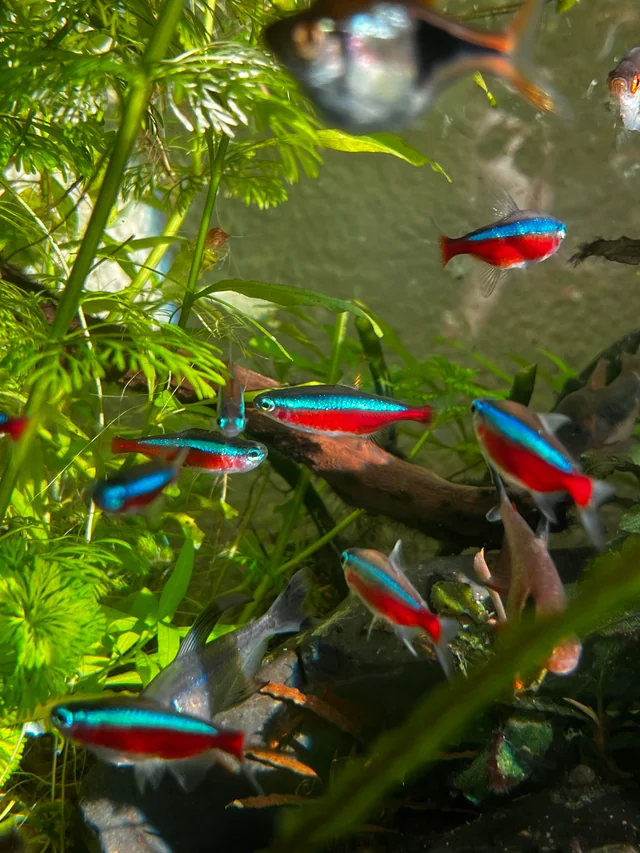
Include an early comparison table.
| Behavior | What it may mean | Should you intervene? |
| Brief chasing with no injuries | Social behavior or a minor dispute | Watch closely |
| Male following a round female | Courtship or spawning | Monitor the female |
| One fish guarding a cave | Territorial behavior | Add space and hiding places |
| Chasing only during meals | Food competition | Spread food across the tank |
| Several fish chasing one fish | Bullying or an unsuitable group | Take action |
| Biting, torn fins, or missing scales | Harmful aggression | Separate the fish |
| One fish hides and stops eating | Ongoing stress | Act quickly |
| Chasing after adding a new fish | Territory or social order being reset | Monitor and rearrange the tank |
Seven Reasons Fish Chase Each Other
1. Mating and Spawning Behavior
Explain that males of many species chase females before spawning. The male may follow the female, nudge her belly, display brighter colors, or lead her toward a nesting area.
Common examples include:
- Guppies
- Mollies
- Platies
- Goldfish
- Cichlids
- Koi
- Barbs
- Danios
Explain that breeding chases are not always harmless. Koi and goldfish spawning can become rough enough to push females into rocks or tank walls. California Fish Vet
Signs the Chasing Is Related to Mating
- One or more males follow a female
- The female has a rounder belly
- Males display brighter colors
- The behavior happens near plants, caves, or flat rocks
- The fish clean or guard a spawning site
- Eggs appear shortly afterward
When Mating Chases Become Dangerous
Cover:
- Too many males pursuing one female
- A small tank with nowhere to escape
- Exhaustion
- Torn fins or lost scales
- The female hiding and refusing food
- The female being forced into décor or filter equipment
Suggest checking the recommended male-to-female ratio for the species rather than using one ratio for every fish.
2. Territorial Behavior
Explain that some fish claim a cave, plant, corner, rock, or section of the aquarium.
Territorial chasing is common among:
- Bettas
- Cichlids
- Gouramis
- Angelfish
- Damselfish
- Some plecos
- Breeding pairs
Signs include:
- The same fish always starts the chase
- The chase begins when another fish enters one area
- The aggressive fish returns to its chosen spot
- The fish flares its fins, gill covers, or body
- The behavior becomes stronger during breeding
Mention that territory-related chasing often gets worse in an open tank with no visual barriers.
3. Establishing a Social Order
Explain that fish living in groups may chase each other while forming a pecking order. This can happen after:
- Adding a new fish
- Removing a dominant fish
- Changing the tank layout
- Moving the group into another tank
- A young fish reaching maturity
Short displays may settle down. Constant attacks against the weakest fish should not be dismissed as normal hierarchy behavior.
4. Competition for Food
Some fish chase others away from food, especially when all the food lands in one place.
Signs include:
- Chasing starts when food enters the tank
- Fast fish eat most of the food
- Slow or timid fish become thin
- Chasing stops after feeding
- One fish guards a feeding ring or pellet pile
Explain how body shape can affect competition. Long-bodied goldfish, for example, may beat slower fancy goldfish to food even without trying to injure them.
Suggest:
- Feed in two or more areas
- Use food that reaches different water levels
- Make sure slow fish receive their share
- Avoid adding excessive food to reduce fighting
5. Overcrowding or Not Enough Space
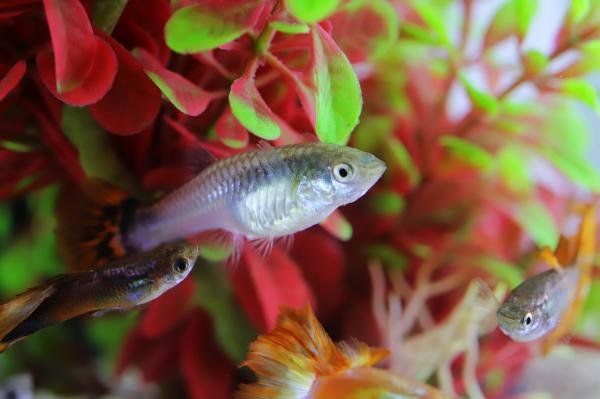
Explain that crowding brings fish into one another’s territory and increases competition for food, shelter, and resting spots.
Possible signs:
- Frequent chasing throughout the tank
- High nitrate readings
- Fish crowding around one hiding place
- Fast waste buildup
- Damaged fins
- Fish staying near the surface
Mention that tank capacity should be based on adult fish size, behavior, waste production, and swimming needs—not only a basic “inch per gallon” rule.
6. An Unsuitable Group Size
Schooling and shoaling fish may become stressed or aggressive when kept in groups that are too small.
Possible examples:
- Tiger barbs
- Serpae tetras
- Danios
- Some rasboras
- Loaches
- Rainbowfish
In a small group, the strongest fish may focus all its attention on one weaker fish. In a suitable group, social behavior is often spread among more members.
Clarify that adding more fish is only safe when the aquarium has enough space and filtration.
7. Incompatible Tank Mates
Some fish have different temperaments, swimming speeds, feeding styles, or territorial needs.
Common compatibility problems include:
- Fin nippers with long-finned fish
- Large fish with fish small enough to swallow
- Aggressive cichlids with peaceful community fish
- Fast feeders with slow feeders
- Cold-water fish with tropical fish
- Two territorial fish competing for the same area
- Male bettas kept together
State that a large aquarium cannot always make incompatible species safe.
Is It Playing or Fighting?
Explain that people sometimes call chasing “playing,” but this can hide a welfare problem. It is safer to judge the result of the interaction rather than assume the fish are having fun.
Chasing That May Be Harmless
- It lasts only a few seconds
- Different fish take turns
- No fish is trapped
- All fish continue eating
- Fins and scales remain undamaged
- Fish return to normal swimming
- No fish hides for long periods
Signs of Real Aggression
- One fish is always the target
- The target cannot rest or eat
- Fins are clamped or torn
- Scales are missing
- The fish is pushed into glass or decorations
- The fish breathes rapidly
- The target stays behind the filter or heater
- The fish becomes pale or unusually dark
- Chasing continues for much of the day
Why Are Several Fish Chasing One Fish?
Explain that group bullying can happen when:
- The targeted fish is new
- It looks or behaves differently
- It is sick or weak
- The group is too small
- The species forms a strict social order
- A breeding pair is driving others away
- The target enters another fish’s territory
Recommend checking the targeted fish for early illness. Fish may act differently toward a weak tank mate before the keeper notices clear symptoms.
Why Is a Male Fish Chasing a Female Fish?
Discuss courtship first, but explain that constant male attention can exhaust the female.
The reader should check:
- Whether the species is a livebearer
- The number of males and females
- Whether the female has somewhere to hide
- Whether the male is biting rather than displaying
- Whether the female can reach food
- Whether the behavior continues all day
Do not recommend adding females without checking tank capacity and the species’ social needs.
Why Are My Fish Chasing Each Other After a Water Change?
Possible reasons include:
- The tank layout changed
- Old territorial boundaries disappeared
- Fish became stressed by a temperature or pH shift
- Spawning behavior was triggered
- The fish became more active in cleaner water
- A fish was temporarily removed and reintroduced
Tell readers to test the water if chasing begins with gasping, clamped fins, rapid breathing, or erratic swimming.
Why Are My New Fish Being Chased?
Explain that established fish may see a newcomer as:
- A territorial intruder
- A rival
- A new member of the social group
- Competition for food or shelter
- Potential prey
Warn that simply placing a new fish into the aquarium and hoping the behavior settles can lead to injury.
How to Stop Fish From Chasing Each Other
Step 1: Check for Injuries
Look for:
- Torn fins
- Missing scales
- Red marks
- Open wounds
- Cloudy eyes
- Rapid breathing
- Difficulty swimming
Separate a badly injured or exhausted fish into a properly prepared hospital tank.
Step 2: Test the Water
Test:
- Ammonia
- Nitrite
- Nitrate
- pH
- Temperature
- Salinity in marine or brackish tanks
Poor water conditions can increase stress and make aggression worse.
Step 3: Identify the Aggressor and Target
Suggest recording a short video or watching from a distance. Fish sometimes act differently when someone stands close to the aquarium.
Write down:
- Which fish begins the chase
- When it happens
- Where it happens
- Whether food or a nesting site is involved
- Whether the target can escape
Step 4: Add Visual Barriers and Hiding Places
Suitable options may include:
- Live or artificial plants
- Driftwood
- Rockwork
- Caves
- Tall decorations
- Floating plants
Visual barriers can stop one fish from seeing and chasing another across the entire tank. Hiding places should have more than one exit so a weaker fish cannot become trapped.
Step 5: Rearrange the Aquarium
Explain that moving rocks, caves, and plants can break up established territories.
This can help when:
- A new fish is introduced
- Two fish claim the same cave
- One fish controls most of the tank
- A pair becomes territorial
Do not destroy an active nest or spawning site without understanding the species’ behavior.
Step 6: Change How You Feed
Recommend:
- Feeding in several places
- Using floating and sinking foods when suitable
- Watching each fish eat
- Keeping portions controlled
- Using a feeding divider when necessary
Step 7: Correct the Group Size or Sex Ratio
Explain that the correct solution depends on the species. Some fish need a larger school, while others need to be kept alone.
Adding more fish should only happen after checking:
- Adult size
- Minimum group size
- Tank capacity
- Filtration
- Male-to-female ratio
- Compatibility
Step 8: Separate Fish When Necessary
Permanent separation may be the best choice when:
- Injuries continue
- One fish cannot eat
- A predator is chasing prey
- Two species are incompatible
- A male betta attacks another betta
- A breeding pair takes over the aquarium
- Rearranging the tank does not help
A divider can work temporarily, but it must allow suitable water movement and prevent jumping or biting through gaps.
What Not to Do
- Do not assume repeated chasing is playful.
- Do not add random medication for aggression.
- Do not overcrowd the tank by adding more fish without checking capacity.
- Do not place the injured fish in an unheated, unfiltered bowl.
- Do not switch off the filter to calm the fish.
- Do not punish, tap the glass, or chase the aggressor with a net.
- Do not add decorations that can trap the weaker fish.
- Do not release an aggressive aquarium fish into the wild.
- Do not wait for severe injuries if one fish is clearly being targeted.
Species-Specific Chasing Behavior
Betta Fish Chasing Other Fish
Cover territorial behavior, fin flaring, nipping, unsuitable tank mates, and why male bettas should not share a tank.
Goldfish Chasing Each Other
Discuss spawning, food competition, overcrowding, and the difference between fast common goldfish and slower fancy varieties.
Chasing, nipping, and pushing another fish into decorations are signs that a goldfish pairing may not be working. California Fish Vet
Guppies Chasing Each Other
Cover male courtship, male-to-male displays, too few females, and stressed females.
Cichlids Chasing Each Other
Discuss territory, breeding pairs, caves, tank footprint, line-of-sight barriers, and species compatibility.
Danios Chasing Each Other
Explain that short chases may be connected to their social or spawning behavior. However, injuries or constant targeting still require action. Territorial chasing can occur during zebrafish spawning. RSPCA zebrafish care guidance
Frequently Asked Questions
Why are my fish suddenly chasing each other?
A change in territory, maturity, breeding condition, group structure, or tank environment may have triggered the behavior.
Why do my fish chase each other in circles?
They may be courting, displaying dominance, or fighting over territory. Look for biting, exhaustion, and whether one fish is always trying to escape.
Why are my fish chasing each other after feeding?
They may be competing for food or guarding a preferred feeding area.
Should I separate fish that are chasing each other?
Separate them when one fish is injured, exhausted, unable to eat, or unable to escape.
Do fish chase each other when mating?
Yes. Many species use chasing as part of courtship and spawning, but rough or nonstop pursuit can injure the female.
Will fish aggression stop on its own?
Brief disputes may settle, especially after introducing a new fish. Constant bullying rarely improves if the tank setup or species combination remains unchanged.
Can a small tank make fish aggressive?
Yes. Limited swimming room, too few hiding places, and overlapping territories can increase conflict.
Why does one fish chase every other fish?
It may be highly territorial, guarding a nest, protecting food, or simply unsuitable for a community aquarium.
