
Rainbow Tetra Care

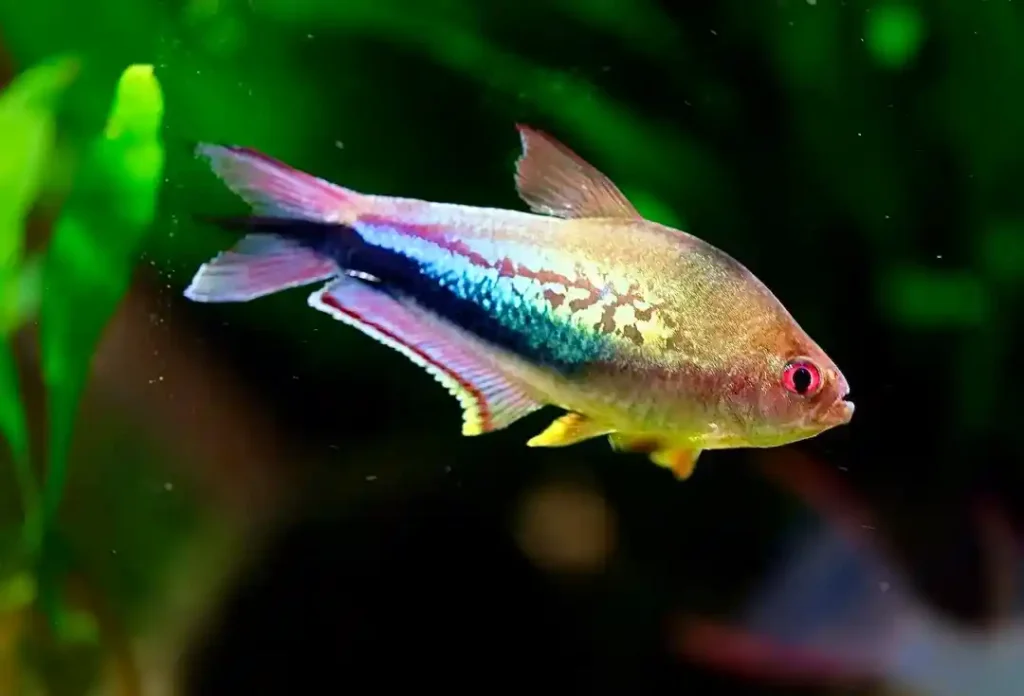
Rainbow tetras are small Colombian fish with far more color than their name suggests. Mature males can show red, blue, purple, green, and gold across the same body. Their red eyes and dark horizontal stripe make them easy to recognize once their adult colors develop.
The fish sold as a rainbow tetra is Nematobrycon lacortei. Shops may also call it the rainbow emperor tetra or Lacorte’s tetra. It is closely related to the emperor tetra, Nematobrycon palmeri, but the two are separate species.
Rainbow tetras stay small, yet they are not ideal for an unplanned nano tank. Males claim small spaces, display toward rivals, and may chase one another. A proper group, shaded planting, and enough horizontal room keep this behavior from turning into constant stress.
Rainbow Tetra Care at a Glance
| Care requirement | Recommended conditions |
| Scientific name | Nematobrycon lacortei |
| Common names | Rainbow tetra, rainbow emperor tetra, Lacorte’s tetra |
| Adult size | Around 1.4–1.6 inches |
| Lifespan | Commonly 3–5 years |
| Minimum tank size | 20-gallon long for a species-focused group |
| Better community tank | 29 gallons or larger |
| Group size | At least 8; preferably 10–12 |
| Temperature | 73–81°F (23–27°C) |
| Preferred pH | 5.6–7.2 |
| Water hardness | Soft to moderately hard, up to about 12 dGH |
| Temperament | Peaceful with mild territorial behavior |
| Diet | Omnivore with a preference for small animal foods |
| Swimming area | Middle level |
| Breeding style | Egg scatterer |
| Care level | Moderate |
| Native range | San Juan River basin in western Colombia |
Natural Range and Habitat
Rainbow tetras come from western Colombia. Their known range lies within the San Juan River system, particularly waters connected to the Río Calima.
This is a much smaller natural range than many popular aquarium tetras have. They are associated with quiet forest pools, shallow tributaries, and slow-moving water near plant growth and overhanging vegetation.
Fallen leaves and other organic material can tint these waters and make them mildly acidic. Trees restrict direct sunlight, while submerged plants, roots, and leaf litter give the fish cover.
An aquarium does not need to copy every part of this habitat. The useful details are subdued lighting, clean water, plant cover, a darker background, and open space between sheltered areas.
Rainbow Tetra Appearance
Adult rainbow tetras have a deep, laterally compressed body with a dark stripe running from the eye toward the tail. The colors above this stripe can change as the fish moves beneath the light.
A healthy adult may appear purple from one angle and green, copper, or blue from another. Young fish are usually much less impressive. Newly purchased juveniles may look silver or brown until they mature and settle into good conditions.
The tail has an extended central section that creates the three-pointed appearance associated with emperor tetras. Rainbow tetras also lack the small adipose fin found on many other tetra species.
Poor color does not always mean illness. Transport stress, bright shop lighting, pale substrate, an exposed aquarium, or an aggressive tank mate can all make the fish appear washed out.
Rainbow Tetra or Emperor Tetra?
Rainbow and emperor tetras share a similar body shape, dark side stripe, and extended central tail ray. Their common names are sometimes mixed by aquarium sellers.
| Feature | Rainbow tetra | Emperor tetra |
| Scientific name | Nematobrycon lacortei | Nematobrycon palmeri |
| Typical male eye color | Red | Blue |
| Male body color | Mixed red, purple, green, and gold sheen | Usually blue, violet, or greenish sheen |
| Native range | Río Calima and San Juan system | Atrato and San Juan systems |
| Adult size | About 1.5 inches | About 1.5–2 inches |
| Availability | Less common | More widely sold |
Eye color is one of the easiest clues when identifying mature males. A red-eyed male is more likely to be N. lacortei, while a blue-eyed male usually points to N. palmeri.
Shop labels are not always accurate, so check the fish rather than relying only on the tank card.
How Large Do Rainbow Tetras Get?
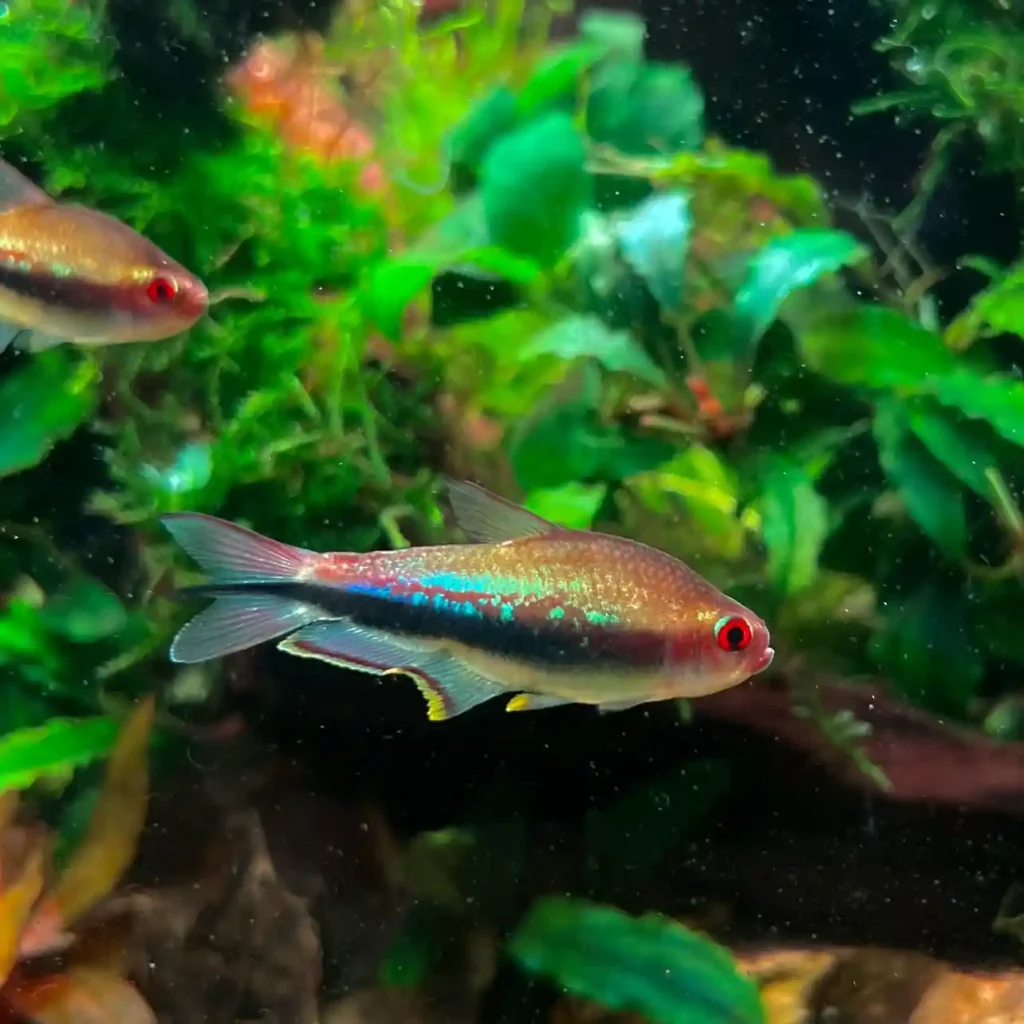
The recorded maximum standard length is about 3.6 centimeters, or 1.4 inches. Standard length does not include the tail, so a mature aquarium fish may measure close to 1.5 inches from nose to the end of the tail.
They are small enough to live with other peaceful community fish, but their social behavior creates the need for more room. Several males may each try to hold a position near a plant, branch, or open display area.
A tiny aquarium forces these territories together. The result can be faded color, frequent hiding, damaged fins, or one male being pushed away from the group.
The Best Tank Size
A 20-gallon long aquarium is the smallest setup I would recommend for a group of eight rainbow tetras. Its 30-inch length gives the fish more usable swimming room than a tall tank with the same water volume.
A 29-gallon or larger aquarium is the better choice when keeping them with other species. The added volume gives you room for 10–12 rainbow tetras, plant cover, and compatible tank mates without crowding the middle of the tank.
Tank shape matters. A long rectangular aquarium works better than a tall or cube-shaped tank because males need separate display areas and the group needs room to move horizontally.
Keep a fitted lid over the aquarium. Rainbow tetras can jump when startled, chased, or moved into unfamiliar surroundings. Cover gaps around filter pipes and cables.
Keep a Proper Group
Rainbow tetras should not be kept alone or as a pair. A small group of three or four can place too much pressure on the weakest fish, especially if several males are present.
Start with at least eight. A group of 10–12 is better when the tank has enough space. More fish spread the attention of territorial males and make the group feel secure enough to remain visible.
They do not always school tightly. In a calm aquarium, individuals may separate and hold small positions around plants. They usually gather when frightened, feeding, or moving across an open part of the tank.
This loose social structure is normal. A scattered group is not automatically a sign that the fish dislike one another.
Managing Male Competition
Mature males display by deepening their color, spreading their fins, and facing rivals. Short chases are also normal.
The situation needs attention when one fish cannot leave its hiding place, misses meals, develops torn fins, or stays pale throughout the day. Adding random fish is not always the answer. First check whether the tank provides enough room and visual barriers.
Tall plants, pieces of wood, and shaded corners break the males’ lines of sight. Leave gaps between these features so weaker fish do not become trapped.
A group containing more females than males can be easier to manage, but sexing young shop fish may not be possible. In that case, choose a larger group and provide several sheltered areas from the beginning.
Water Temperature
Keep rainbow tetras between 73 and 81°F, or 23–27°C. A stable temperature around 75–78°F works well for most community aquariums.
Avoid rapid changes. Matching the correct number on the heater will not help if the tank drops several degrees overnight or receives direct afternoon sun.
Place a thermometer on the opposite side from the heater. This gives a more useful reading of the whole aquarium instead of the warmest area beside the heating element.
A heater guard can prevent burns if the fish regularly shelter behind equipment, though this is more important with powerful glass heaters in compact tanks.
pH and Water Hardness
The species naturally comes from soft, mildly acidic water. A pH between 5.6 and 7.2 is suitable, with approximately 6.0–7.0 being a sensible target for long-term care.
Water hardness should remain soft to moderate, generally no higher than about 12 dGH. Extremely hard, alkaline water may keep the fish alive, but it can reduce breeding success and may prevent them from developing their best color.
Do not use bottled pH-lowering chemicals to force the water down for a day. Sudden movement between acidic and alkaline conditions is harder on the fish than a slightly imperfect but stable reading.
Test your tap water before changing it. Aquarists with very hard water can mix dechlorinated tap water with reverse-osmosis water. The mixture should be prepared consistently so each water change has similar chemistry.
Water Quality
Rainbow tetras are less forgiving of poor water than hardier species such as Buenos Aires tetras or black skirt tetras. Add them only after the aquarium has completed its nitrogen cycle.
Maintain:
- Ammonia at 0 ppm
- Nitrite at 0 ppm
- Nitrate preferably below 20 ppm
- A stable temperature
- No sudden change in pH or hardness
Change 20–30% of the water every week. Use a gravel vacuum in exposed areas where food and waste settle, but leave some established plant cover undisturbed.
Rinse reusable filter media in a bucket of removed aquarium water. Untreated tap water can harm the bacteria living on the media.
Rainbow tetras come from quieter waters, so they do not need forceful current across the whole aquarium. A gentle to moderate flow with calmer areas around plants works well. A sponge pre-filter can prevent small fish and future fry from being pulled into the intake.
Setting Up the Aquarium
A good rainbow tetra tank has open swimming room through the middle with plants and wood around the sides and back.
Dark sand or fine gravel can make their changing colors easier to see. Pale substrate and strong overhead light often leave the fish looking less colorful and more exposed.
Suitable plants include:
- Java fern
- Anubias
- Cryptocoryne
- Java moss
- Amazon sword
- Water sprite
- Floating plants with manageable roots
Rainbow tetras do not have the plant-eating habit associated with Buenos Aires tetras. They can be kept in a planted display without expecting widespread leaf damage.
Floating plants help shade the aquarium, but do not let them cover the entire surface. Open areas are needed for gas exchange and feeding.
Driftwood branches can divide the tank into several small visual areas. Smooth stones and dried aquarium-safe leaves may also be used. Replace leaves as they break down rather than allowing a thick layer of decaying material to collect in an aquarium with limited filtration.
Lighting and Color
Moderate or subdued light brings out better behavior than an extremely bright, exposed setup. Bright light can still be used for plants if floating cover and shaded areas are available.
Their iridescent scales look best when light reaches the fish from above and slightly toward the front. A dark background prevents visual distraction and makes the red eyes easier to see.
Color should come from good care, not color-enhancing food alone. Stable water, low stress, a varied diet, and mature age make the largest difference.
What Rainbow Tetras Eat
Rainbow tetras are small omnivores that feed heavily on tiny animal matter. Their natural diet is thought to include small aquatic invertebrates, insect larvae, crustaceans, and other foods small enough to fit in their mouths.
Use a fine tropical flake or small slow-sinking micro pellet as the regular food. Large floating pellets are a poor choice because these fish have small mouths and often feed in the middle of the water.
Offer frozen or live food several times per week:
- Baby brine shrimp
- Daphnia
- Cyclops
- Small mosquito larvae
- Finely chopped bloodworms
- Microworms
Bloodworms should be an occasional food. Whole large bloodworms can be difficult for a small rainbow tetra to swallow, so use small ones or chop them before feeding.
Feed adults once or twice per day. Give an amount they can finish within about two minutes. Drop food over a wide area so dominant males cannot control one feeding spot.
Watch the fish during meals. A rainbow tetra that repeatedly takes food and spits it out may find the pieces too large. A fish that wants to eat but cannot compete may need food delivered closer to its hiding area while the social problem is corrected.
Suitable Tank Mates
Rainbow tetras are peaceful toward other species. The mild territorial behavior seen between adult males usually does not extend to unrelated tank mates.
Good companions are small, calm fish that enjoy similar warm, soft-to-neutral water. Options include:
- Small rasboras
- Pencilfish
- Hatchetfish
- Peaceful dwarf Corydoras
- Kuhli loaches
- Otocinclus
- Small peaceful tetras
- Calm dwarf cichlids in a larger, structured tank
Ember tetras can share a planted community aquarium with rainbow tetras when both species have proper groups. Embers are much smaller, so feeding needs to be spread across the tank.
Black neon tetras are another reasonable choice. They are active enough to remain visible but do not have the long fins that invite attention.
The types of tetras guide can help you compare adult size, behavior, and water needs before adding another school.
Tank Mates to Avoid
Do not combine rainbow tetras with large predatory fish. Their small adult size makes them an easy meal for many cichlids, catfish, and larger community fish.
Avoid highly aggressive barbs or fin-nipping tetra species in a confined aquarium. Constant disturbance prevents males from displaying normally and can keep the whole group hidden.
Large, fast feeders may consume most of the food before rainbow tetras get enough. This is a common problem when they are kept with boisterous rainbowfish, large danios, or bigger barbs.
Long-finned bettas and fancy guppies are not my first choice. Although rainbow tetras are generally peaceful, male disputes can include brief nipping, and the water preferences of the fish may not match well in every setup.
Adult dwarf shrimp may survive in a densely planted aquarium, but baby shrimp are likely to be eaten. Do not choose this tetra if growing a large shrimp colony is the main purpose of the tank.
Male and Female Rainbow Tetras
Mature rainbow tetras are easier to sex than many other small tetra species.
Male Rainbow Tetra
Adult males usually have a red iris. They develop stronger iridescent color and longer, more pointed fins. The extended middle section of the tail may also be more noticeable.
Males tend to remain slimmer and spend more time displaying or holding small positions around the aquarium.
Female Rainbow Tetra
Females usually have blue-green or bluish eyes. Their bodies are fuller, particularly through the abdomen when they are carrying eggs.
Their fins are generally shorter, and their colors may be softer than those of mature males. Healthy females can still be colorful, so body shape and eye color are more useful than brightness alone.
Juveniles may not show clear differences. Wait until the fish mature before trying to identify an exact male-to-female ratio.
Breeding Rainbow Tetras
Rainbow tetras are egg scatterers. The adults provide no parental care and may eat the eggs soon after they are laid.
They sometimes produce a few surviving fry in a mature, densely planted species tank. Controlled breeding gives far better results because the eggs can be separated from hungry adults.
Preparing the Breeding Tank
Use a separate 10-gallon aquarium with a mature sponge filter. Keep the flow gentle and the lighting dim.
Cover much of the bottom with Java moss, spawning mops, plastic mesh, or glass marbles. The goal is to let eggs fall into spaces the adults cannot easily reach.
Use soft, mildly acidic water. A pH around 5.5–6.5 and a temperature near 77–80°F can encourage spawning. Clean water matters more than repeatedly adjusting the pH.
Condition the selected adults for one to two weeks with small live or frozen foods. A well-fed female develops a rounder abdomen, while a ready male shows stronger color and increased display behavior.
Spawning
Place a mature pair or a small breeding group in the prepared tank during the evening. Spawning often begins after the aquarium receives dim morning light.
The male displays and follows the female through the moss or spawning material. Eggs are released and fertilized among the plants.
Remove the adults after spawning. Do not wait to see them caring for the eggs because parental care does not occur.
Unfertilized eggs turn opaque white. Fertile eggs are more likely to remain clear or lightly amber. Remove badly fungused eggs with a pipette if they begin affecting nearby eggs.
Raising the Fry
Hatching time depends on temperature and water conditions, but the eggs commonly hatch within one or two days. Newly hatched larvae remain very small and live from their yolk sacs before becoming free-swimming.
Begin with infusoria, paramecium, or a suitable commercial liquid fry food. Once the fry grow enough to catch larger prey, offer microworms and newly hatched brine shrimp.
Feed very small portions several times per day. Excess food can ruin water quality quickly in a breeding tank.
Make small water changes using airline tubing. Cover the intake with fine sponge and check the bucket before discarding removed water because young fry are difficult to see.
Acclimating New Rainbow Tetras
Rainbow tetras are less common in stores than neons or black skirts. Some may have spent a long time in wholesale and retail systems before reaching your aquarium.
Quarantine new arrivals for two to four weeks when possible. This gives thin fish time to eat without competition and lets you watch for ich, parasites, fin damage, or bacterial infections.
Float the closed bag for about 15–20 minutes to equalize temperature. Open it and add small amounts of aquarium water over the next 20–30 minutes. If the shop water is very different from your tank, extend this process carefully without leaving the fish in an opened bag for hours.
Transfer the fish with a net and discard the shipping water. Keep the aquarium light low for the rest of the day.
Buy the full group together if possible. Adding one new fish to an established group can leave the newcomer at the bottom of the social order.
Health Problems
Rainbow tetras do not have a disease limited to their species. Most illness comes from poor water, transport stress, infected new arrivals, or unsuitable tank mates.
Ich
Ich usually appears as numerous small white spots on the fins and body. Fish may rub against objects, clamp their fins, or breathe faster than usual.
Treat the entire aquarium if all fish have been exposed. Check whether the chosen medication is safe for catfish, shrimp, snails, and other sensitive animals sharing the tank.
Fin Damage
Occasional display behavior should not leave a fish with steadily worsening fins. Repeated tears may point to cramped conditions, too few rainbow tetras, an unbalanced sex ratio, or an aggressive tank mate.
Clean water can help small splits heal. Red tissue, swelling, pale edges, or continuing fin loss may mean infection has followed the injury.
Weight Loss
A fish that eats but continues losing weight may have internal parasites or another digestive problem. White stringy waste can occur with intestinal trouble, but it is not enough to identify a specific parasite by itself.
Move the affected fish to a quarantine tank and identify the likely cause before combining medications.
Gasping and Sudden Lethargy
Test ammonia, nitrite, nitrate, and temperature before assuming gasping fish have an infection. Ammonia exposure, nitrite poisoning, low oxygen, overheating, or a failing filter can affect several fish at once.
A prompt water change and increased surface movement may be needed while you find the cause.
Common Rainbow Tetra Care Mistakes
The first mistake is placing a pair or trio in a small aquarium. Rainbow tetras need a group, and mature males need enough room to avoid constant contact.
Another mistake is using intense lighting without plant cover. The fish may stay pale or hide even when the water readings appear correct.
Hard, alkaline tap water can also become a problem. The fish may survive in water outside their preferred range, but long-term color, health, and breeding results may suffer.
Avoid these additional problems:
- Adding them to an uncycled tank
- Keeping too few fish
- Buying a tall tank with little swimming length
- Providing no cover between male territories
- Feeding only dry flakes
- Choosing food that is too large
- Keeping them with fast or aggressive feeders
- Allowing nitrate to rise between water changes
- Trying to correct pH with repeated chemical doses
The most easily missed problem is underfeeding shy individuals. Watch every fish eat instead of judging the meal by how quickly the food disappears.
Are Rainbow Tetras Good for Beginners?
Rainbow tetras can suit a beginner who already understands cycling, weekly water changes, and basic water testing. Their diet is simple, they stay small, and they normally behave well with peaceful tank mates.
They are not the easiest first tetra for someone with hard alkaline water or a newly established 10-gallon tank. Neon, ember, or black neon tetras are usually easier to find, which also makes replacing or enlarging a group simpler.
Rainbow tetras are a better choice for an aquarist who wants an unusual planted-tank fish and is willing to build the aquarium around a proper group.
Frequently Asked Questions
How many rainbow tetras should be kept together?
Keep at least eight rainbow tetras. A group of 10–12 is better in a larger aquarium because it spreads male attention and gives the fish more confidence.
Can rainbow tetras live in a 10-gallon tank?
A 10-gallon tank is too cramped for a permanent group. It may hold a breeding pair temporarily, but a 20-gallon long is a more suitable minimum for normal care.
Are rainbow tetras aggressive?
They are generally peaceful toward other species. Adult males may display, defend small areas, and chase rival males. Serious trouble is more likely in a small tank with too few fish or little cover.
Do rainbow tetras need live plants?
Live plants are not strictly required, but plant cover makes the fish feel secure and divides male territories. Silk plants can provide cover if maintaining live plants is difficult.
Will rainbow tetras eat shrimp?
They may leave adult shrimp alone, especially in a planted aquarium. Baby shrimp are small enough to be eaten and should not be expected to survive in large numbers.
What is the difference between a rainbow tetra and a rainbowfish?
A rainbow tetra is a small South American characin. Rainbowfish belong to a different group and mostly come from Australia, New Guinea, and nearby regions. Many rainbowfish grow much larger than Nematobrycon lacortei.
Why has my rainbow tetra lost its color?
Transport stress, bright lighting, pale décor, poor water, unsuitable tank mates, or a lack of cover can weaken its color. Juveniles are also naturally plainer than mature males.
How long do rainbow tetras live?
A reasonable expectation is three to five years. Stable water, a varied diet, a proper group, and low nitrate give them the best chance of reaching the upper end of that range.
