
Kuhli Loach Care Guide: Tank Setup, Food, Tank Mates and Behavior

Kuhli Loaches are peaceful, eel-like bottom dwellers that bring a lot of personality to freshwater aquariums. They are shy during the day, active after the lights dim, and fun to watch when they wiggle through plants, caves, and soft substrate.
They are not the type of fish that always stays in front of the glass. Some days, you may barely see them. But when they feel safe in a proper group, they become much more active, especially during feeding time.
The key to keeping Kuhli Loaches healthy is simple: use soft substrate, keep them in a group, give them plenty of hiding places, cover the tank, and make sure food actually reaches the bottom.

Kuhli Loach Species Profile
| Characteristic | Details |
| Scientific Name | Pangio kuhlii |
| Common Name | Kuhli Loach, Coolie Loach |
| Origin | Southeast Asia |
| Adult Size | 3 to 4 inches |
| Lifespan | 7 to 10 years |
| Care Level | Easy to moderate |
| Temperament | Peaceful, shy, social |
| Minimum Tank Size | 20 gallons |
| Best Tank Shape | 20-gallon long or larger |
| Minimum Group Size | 5 to 6 |
| Temperature | 75 to 82°F |
| pH Range | 5.5 to 7.0 |
| Water Hardness | 3 to 8 dGH |
| Diet | Omnivore |
| Tank Level | Bottom |
| Activity | Mostly evening and night |
| Plant Safe | Yes |
| Shrimp Safe | Usually safe with adult shrimp |
| Breeding Difficulty | Difficult |
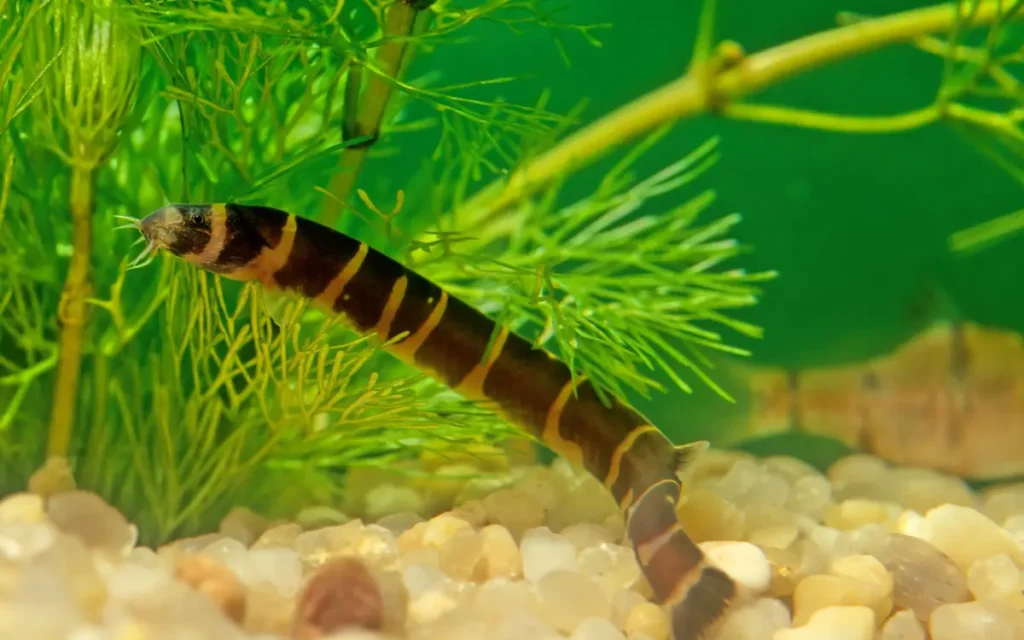
What Are Kuhli Loaches?
Kuhli Loaches are small, snake-like fish from slow-moving waters in Southeast Asia. They are often found around soft bottoms, roots, leaf litter, and shaded areas. This is why they prefer aquariums with sand, plants, driftwood, and dimmer lighting.
They are peaceful fish and do not bother most tank mates. Unlike many active bottom fish, Kuhli Loaches spend much of their time hiding. This is normal behavior, not a sign that something is wrong.
They are social, but they do not school tightly like tetras. Instead, they feel safer when kept with their own kind. A single Kuhli Loach may hide most of the time, while a group of six often becomes much more confident.
For a peaceful planted community tank, they are one of the most interesting bottom dwellers you can keep.
Kuhli Loach Appearance
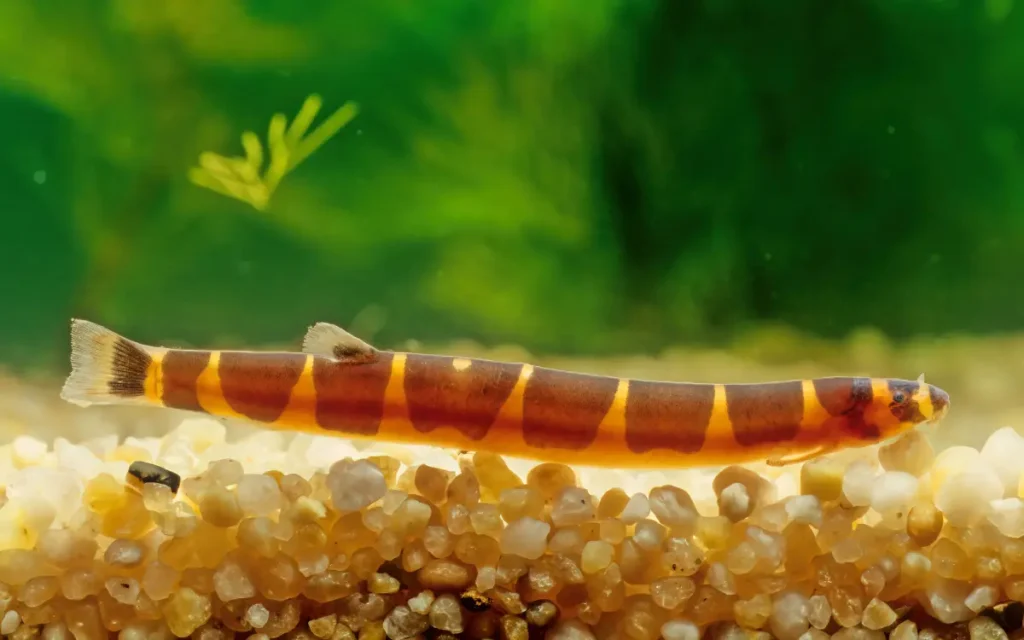
Kuhli Loaches have long, thin bodies that look more like tiny eels than typical aquarium fish. Most have yellow-orange bodies with dark brown or black bands, giving them a striped look.
Their body shape helps them move through tight spaces. They can slip under driftwood, between plant roots, and into small caves. They also have small barbels near the mouth that help them find food along the substrate.
Because their belly and barbels stay close to the bottom, the substrate matters a lot. Sharp gravel can scrape them and lead to injuries. Soft sand is the safest choice.
Kuhli Loach Behavior
Kuhli Loaches are shy, peaceful, and mostly active during low-light hours. During the day, they often stay hidden under wood, inside caves, behind plants, or even under the substrate.
At night or near feeding time, they become more active. You may see them wiggling across the bottom, weaving through plants, or gathering around sinking food.
In my experience, Kuhli Loaches are much more fun in groups. One or two may disappear for days. A group of six feels more natural, and you are more likely to see them exploring together in the evening.
They are not aggressive. They may pile together in the same cave or rest in a group under wood. This is normal and usually means they feel safe.
Why Is My Kuhli Loach Hiding?
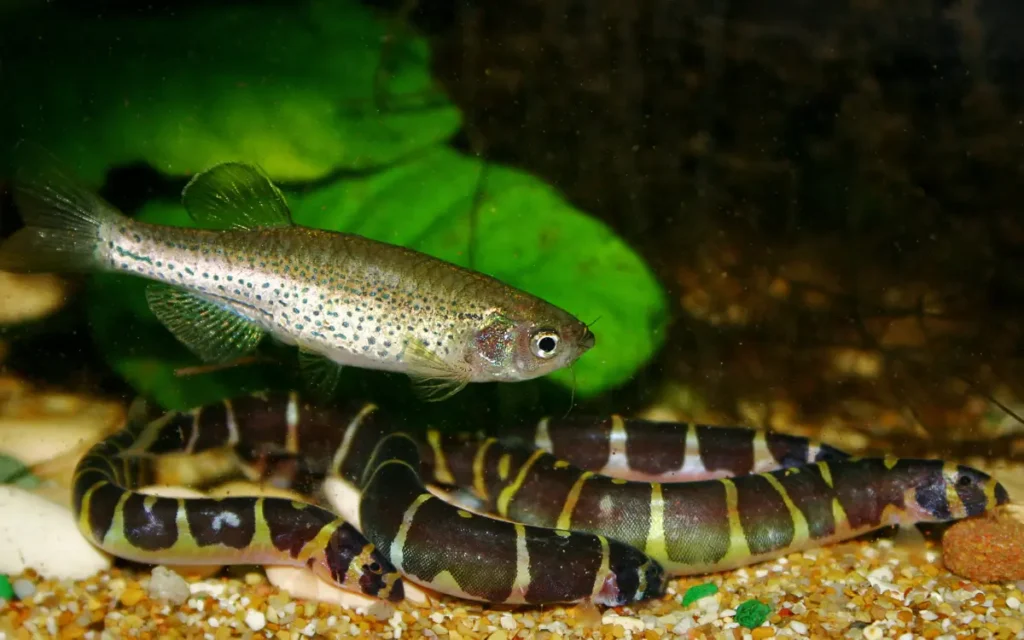
A hiding Kuhli Loach is usually normal. These fish are naturally shy and like covered areas. Many beginners worry because they add Kuhli Loaches and then do not see them for several days.
They may hide because:
- They are new to the tank
- The lights are too bright
- The tank does not have enough cover
- They are kept alone or in a very small group
- Tank mates are too active or aggressive
- The aquarium is too open
- Water conditions are unstable
To make them more visible, keep them in a group of at least five or six, add more plants and caves, use floating plants to reduce harsh light, and feed after the lights dim.
However, hiding can be a problem if it comes with warning signs. Watch for heavy breathing, red patches, damaged barbels, weight loss, not eating, or strange floating. Those signs can point to stress, injury, or illness.
How Many Kuhli Loaches Should You Keep?
Keep at least five or six Kuhli Loaches together. They are social fish and feel safer in groups.
A single Kuhli Loach may survive, but it will often hide more and behave less naturally. When kept in a proper group, they usually become bolder and more active at feeding time.
For a 20-gallon long tank, a group of six is a good starting point. In a larger tank, you can keep eight or more if the bottom area is not overcrowded.
My direct opinion: do not buy just one Kuhli Loach as a “cleanup fish.” They are social animals, not tools for cleaning the tank.
Best Tank Size for Kuhli Loaches
A 20-gallon long tank is the best starting size for Kuhli Loaches. They spend most of their time on the bottom, so floor space matters more than height.
A tall 20-gallon tank is less useful than a long tank because Kuhlis do not use vertical space much. They need room to move along the substrate, search for food, and hide under decor.
Here is a simple tank size guide:
| Tank Size | Recommendation |
| 10 gallons | Too small for a proper group |
| 15 gallons | Possible short term, but not ideal |
| 20-gallon long | Best minimum choice |
| 29 gallons | Better for Kuhlis and tank mates |
| 40 gallons+ | Great for a planted community tank |
A bigger tank also makes feeding easier. In small tanks, Kuhli Loaches may compete with other bottom fish for space and food.
Ideal Water Parameters
Kuhli Loaches prefer warm, soft, slightly acidic water. They can adjust to a reasonable range, but sudden changes can stress them.
| Water Parameter | Ideal Range |
| Temperature | 75 to 82°F |
| pH | 5.5 to 7.0 |
| Hardness | 3 to 8 dGH |
| Ammonia | 0 ppm |
| Nitrite | 0 ppm |
| Nitrate | Under 20 to 40 ppm |
Stable water is more important than chasing a perfect number. If your pH is slightly above 7.0 but stable and the fish are healthy, do not keep changing it with chemicals.
Before adding Kuhli Loaches, make sure the aquarium is fully cycled. They spend a lot of time near the substrate, so poor water quality and dirty bottom areas can affect them quickly.
My Experience: Kuhli Loaches are expert hiders. I often saw them vanishing under driftwood or into soft substrate during the day. But at night, especially during feeding time, they became a wriggling group of busy cleanup crew members.
Best Tank Setup for Kuhli Loaches
A good Kuhli Loach tank should feel safe, shaded, and natural. Think soft bottom, lots of cover, and gentle water movement.
They do not need a complicated aquascape, but they do need hiding places. If the tank is too open, they may stay hidden all day and only move when the room is dark.
A simple setup can include:
- Soft sand substrate
- Driftwood
- Smooth caves
- Live plants
- Leaf litter if you like a natural look
- Gentle filter flow
- Tight-fitting lid
- Sponge cover on filter intake
This setup helps them behave naturally and lowers stress.
Best Substrate for Kuhli Loaches
Soft sand is the best substrate for Kuhli Loaches. Their bodies and barbels touch the bottom all the time, so sharp gravel can cause damage.
Fine sand lets them search for food safely. Some Kuhli Loaches may also bury themselves slightly, especially when scared.
Avoid sharp gravel, rough stones, and crushed coral. Crushed coral can also raise hardness and pH, which is not ideal for them.
If you already have gravel, make sure it is smooth and not sharp. Still, for a new Kuhli Loach tank, I would choose sand every time.
Plants and Hiding Places
Kuhli Loaches love planted tanks. They do not eat or uproot healthy plants, so they are safe for planted setups.
Good plants for a Kuhli Loach tank include:
- Java Fern
- Anubias
- Cryptocoryne
- Java Moss
- Water Wisteria
- Amazon Sword
- Hornwort
- Floating plants
Cryptocoryne plants are especially nice because they create low cover near the bottom. Java moss also gives small shrimp and microfauna places to hide.
For hardscape, use driftwood, smooth rocks, coconut caves, and small tunnels. Make sure any caves are safe and do not have sharp edges.
One thing I like about Kuhli Loaches is how they use the tank differently than other fish. While tetras swim in open water, Kuhlis explore the hidden spaces.
Lighting for Kuhli Loaches
Kuhli Loaches prefer low to moderate lighting. Bright tanks can make them nervous, especially if there are not enough plants or hiding areas.
You do not need a dark tank, but you should create shaded areas. Floating plants help soften the light and make the fish more comfortable.
A simple trick is to feed them shortly before or after the main light turns off. You may see much more activity during this time.
Filter Safety and Tank Lid
Kuhli Loaches are escape artists. They can squeeze through very small gaps, especially at night. Always use a tight-fitting lid.
Check around filter pipes, heater cords, and feeding holes. If there is a gap, a Kuhli Loach may find it.
Filter intake safety is also important. Kuhlis can squeeze into small spaces and may get stuck near filter intakes. Add a sponge pre-filter to cover the intake. This also protects shrimp and small fry.
This is one of the most important care tips for Kuhli Loaches, but many beginners miss it.
What Do Kuhli Loaches Eat?
Kuhli Loaches are omnivores and scavengers. They search the bottom for leftover food, tiny worms, and small edible bits. In the aquarium, they need sinking foods because they do not usually compete well at the surface.
Good foods include:
- Sinking wafers
- Bottom feeder pellets
- Micro pellets
- Frozen bloodworms
- Frozen brine shrimp
- Daphnia
- Repashy gel food
- Blanched zucchini
- Blanched spinach
Do not rely only on leftovers. Kuhli Loaches need their own food. In community tanks, faster fish may eat everything before the food reaches the bottom.
A good routine is to feed sinking food after the lights dim. This gives Kuhli Loaches a better chance to eat without competing with active midwater fish.
Simple Feeding Schedule
| Food Type | How Often |
| Sinking wafers or pellets | Main diet |
| Frozen bloodworms | 1 to 2 times weekly |
| Brine shrimp or daphnia | 1 to 2 times weekly |
| Vegetable-based food | Occasionally |
| Gel food | Optional, 1 to 2 times weekly |
Feed only what they can finish. Uneaten food can sink into the substrate and harm water quality.
Kuhli Loaches may help clean leftover food, but they do not eat fish waste. No fish removes the need for water changes and substrate cleaning.
Best Tank Mates for Kuhli Loaches
Kuhli Loaches do best with peaceful fish that stay in the middle or upper areas of the aquarium. Since Kuhlis are shy bottom dwellers, avoid tank mates that harass them or steal all their food.
Good Kuhli Loach tank mates include:
| Tank Mate | Why It Works |
| Neon Tetras | Peaceful midwater fish |
| Ember Tetras | Small, calm, and colorful |
| Harlequin Rasboras | Peaceful and active |
| Cherry Barbs | Calm compared to many other barbs |
| Honey Gourami | Gentle centerpiece fish |
| Dwarf Gourami | Can work if peaceful |
| Otocinclus | Small and calm algae eater |
| Corydoras | Peaceful, but needs enough bottom space |
| Mystery Snails | Peaceful and easy to keep |
| Amano Shrimp | Usually safe with Kuhlis |
Kuhli Loaches and Corydoras can live together, but the tank should be large enough. Both use the bottom, so a 20-gallon long or larger tank is better than a small tank.
Learn more fish like this:-
- Neon Tetra Care Guide
- Cherry Barb Care Guide
- Corydoras Catfish Care Guide
- Best Community Fish for Beginners
Fish to Avoid With Kuhli Loaches
Avoid large, aggressive, or rough fish. Kuhli Loaches are thin, shy, and easy to bully.
Fish to avoid include:
- Oscars
- Jack Dempseys
- Large cichlids
- Large goldfish
- Red Tail Sharks in small tanks
- Aggressive barbs
- Large loaches
- Crayfish
- Any fish large enough to eat them
Also be careful with very competitive bottom feeders. Kuhli Loaches are not strong feeders, so they can miss meals if kept with pushy bottom fish in a small tank.
Can Kuhli Loaches Live With Shrimp?
Kuhli Loaches can usually live with adult shrimp. They are not active shrimp hunters, but they may eat very tiny baby shrimp if they find them.
A planted tank gives shrimp a better chance. Java moss, floating plants, and thick root systems help baby shrimp hide.
Amano Shrimp are a safer choice because they are larger. Adult Cherry Shrimp can also work, but do not expect every baby shrimp to survive.
Internal link idea: link to your Cherry Shrimp Care Guide or Types of Freshwater Aquarium Shrimp.
Can Kuhli Loaches Live With Snails?
Yes, Kuhli Loaches can live with most peaceful aquarium snails. They usually do not bother Mystery Snails, Nerite Snails, or Ramshorn Snails.
They may eat tiny snail eggs or very small soft foods around the tank, but they are not reliable snail control fish. If you have a snail problem, overfeeding is usually the real cause.
Are Kuhli Loaches Good Cleanup Fish?
Kuhli Loaches help eat leftover food that reaches the bottom, but they are not a replacement for tank cleaning.
They do not eat fish poop. They do not remove ammonia. They do not clean dirty substrate for you.
Think of them as bottom-feeding fish with their own care needs, not as a cleanup tool. You still need water changes, filter maintenance, and light substrate cleaning.
How to Add Kuhli Loaches to a New Tank
Kuhli Loaches should be added to a cycled, stable aquarium. Do not add them to a brand-new tank with ammonia or nitrite.
Before adding them, make sure the tank already has hiding places. If you add them to an open tank, they may panic and hide in unsafe spots.
A good introduction method:
- Turn the aquarium lights low
- Float the bag to match temperature
- Acclimate slowly
- Release them near plants or hiding spots
- Keep the lid closed
- Avoid moving decor for a few days
- Feed lightly after they settle
Do not worry if they disappear after being added. Many Kuhli Loaches hide for several days in a new tank.
Common Kuhli Loach Problems
Kuhli Loaches are hardy once settled, but they can have problems if the tank setup is wrong.
Damaged Barbels
Damaged barbels can happen from sharp gravel, dirty substrate, or poor water quality. This is one of the biggest reasons to use soft sand.
Red Patches or Sores
Red marks can come from injury, infection, or irritation from rough substrate. Check water quality first and make sure the bottom is clean.
Not Eating
Kuhli Loaches may not get enough food in busy community tanks. Feed after lights out and use sinking foods.
Floating or Strange Swimming
Kuhlis sometimes dart around after water changes or during weather changes. But constant floating, rolling, or loss of balance is not normal.
Escaping
If a Kuhli Loach escapes, the tank lid has gaps. Check every opening around the filter, cords, and lid corners.
Disappearing for Days
This is common, especially in planted tanks. Check the filter intake and floor around the tank if one is missing, but do not tear the whole tank apart every time. They may simply be hiding well.
Breeding Kuhli Loaches
Breeding Kuhli Loaches in home aquariums is difficult and uncommon. It can happen, but beginners should not expect it.
Females may become rounder when carrying eggs. Some keepers notice more activity, chasing, and group movement before spawning. Spawning may happen in planted areas, moss, or low-light spaces.
A breeding setup should have soft, slightly acidic water, warm temperature, dim lighting, and heavy plant cover. Fine plants or moss can help catch eggs.
The adults do not care for the eggs and may eat them. If eggs appear, they need protection from adults and other fish.
Fry are tiny and need very small foods at first. This makes raising them harder than breeding many common livebearers or egg scatterers.
My honest take: enjoy Kuhli Loaches for their behavior first. Breeding is a bonus, not something most home aquariums can plan easily.
FAQs
Do Kuhli Loaches need to be in groups?
Yes, Kuhli Loaches should be kept in groups of at least five or six. They feel safer and become more active in groups.
Why did my Kuhli Loach disappear?
Kuhli Loaches are expert hiders. They may hide under driftwood, inside caves, behind plants, or in soft substrate. Also check filter intakes and tank gaps.
Do Kuhli Loaches bury themselves?
Yes, some Kuhli Loaches may bury themselves slightly in soft sand, especially when scared. This is normal if they are otherwise healthy.
Are Kuhli Loaches good for planted tanks?
Yes, they are excellent for planted tanks. They do not damage plants and enjoy hiding around roots, moss, and driftwood.
Can Kuhli Loaches live with shrimp?
They can usually live with adult shrimp, but they may eat tiny baby shrimp if they find them.
Do Kuhli Loaches eat snails?
They are not good snail control fish. They may eat small eggs or soft leftovers, but they usually do not remove snail problems.
Do Kuhli Loaches eat fish poop?
No, Kuhli Loaches do not eat fish poop. They eat leftover food and small edible matter, but you still need to clean the tank.
Can Kuhli Loaches live with bettas?
Sometimes, yes. A peaceful betta in a larger planted tank may work. Avoid this mix in small tanks or with aggressive bettas.
How long do Kuhli Loaches live?
Kuhli Loaches can live around 7 to 10 years with good care.
Are Kuhli Loaches good for beginners?
Yes, but only if the beginner provides soft substrate, a secure lid, hiding places, and a proper group.
