
Bolivian Ram Cichlid Care Guide

The Bolivian ram is one of the better first cichlids for a fish keeper who already understands the nitrogen cycle. Keep one fish or a compatible pair in a cycled 20-gallon-long tank or larger, use fine sand, hold the temperature around 75-79°F (24-26°C), and choose calm tank mates that will not steal every meal.
This fish is more forgiving than the German blue ram, but it is not a starter fish for a brand-new, uncycled tank. Poor water, rough gravel, and a mismatched pair can still cause trouble.
If your Bolivian ram is hiding, refusing food, or breathing fast, test ammonia and nitrite now. Both should be 0 ppm. Check the temperature and filter flow, then make a partial water change with conditioned, temperature-matched water if a reading is unsafe. Do not throw several medicines into the tank before checking the basics. Fishkeeping has enough mysteries without turning the aquarium into a chemistry experiment.
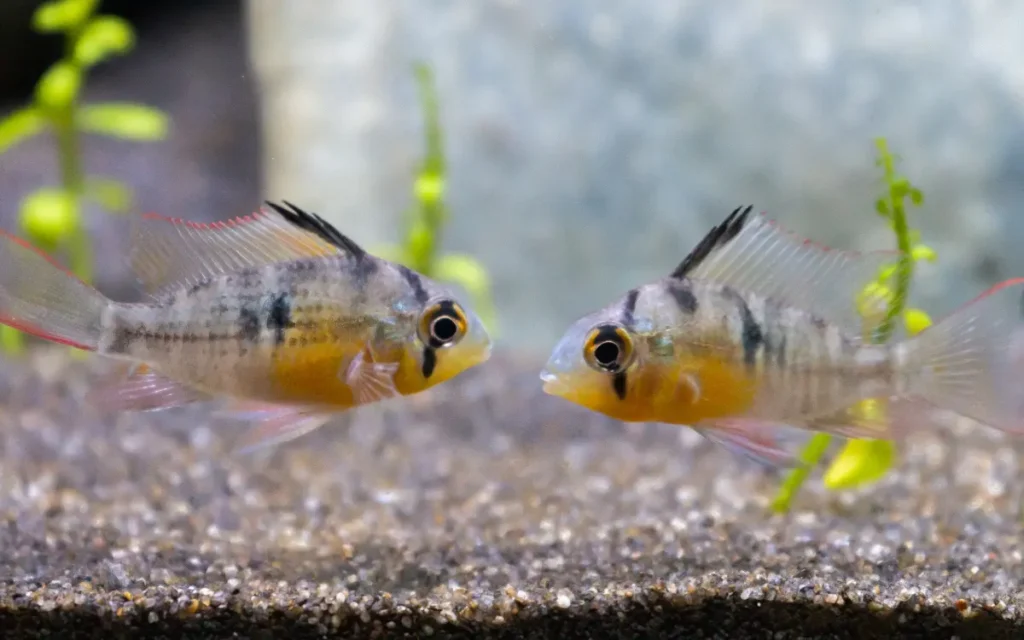
Is a Bolivian Ram Right for Your Aquarium?
A Bolivian ram is a good choice if you can give it a mature tank with open sand, cover, gentle flow, and peaceful company. It spends much of its time near the bottom, inspecting the substrate one mouthful at a time.
Choose a different fish for now if your tank is under 20 gallons, newly set up, filled with sharp gravel, or already crowded with bottom dwellers. A ram may be peaceful by cichlid standards, but a spawning pair will still claim a patch of floor and chase away intruders.
Bolivian Ram Care at a Glance
| Care point | Recommendation |
| Scientific name | Mikrogeophagus altispinosus |
| Other names | Bolivian butterfly cichlid, ruby crown cichlid |
| Adult size | About 3-4 inches including the tail |
| Lifespan | Often 4-6 years with steady care |
| Care level | Beginner to intermediate; established tanks only |
| Temperament | Usually calm; territorial when breeding |
| Minimum tank | 20-gallon long for one or a proven pair |
| Better community tank | 40-gallon breeder or another tank with a 36 x 18-inch base |
| Temperature | 75-79°F (24-26°C) is a practical overlap range |
| pH | 6.0-7.5; stability matters more than chasing a perfect number |
| Hardness | About 1-10 dGH |
| Diet | Small sinking foods plus frozen or live foods |
| Tank level | Bottom to lower middle |
| Breeding style | Biparental open-substrate spawner |
What Is a Bolivian Ram Cichlid?
The Bolivian ram, Mikrogeophagus altispinosus, is a small South American cichlid. You may also see it sold as the Bolivian butterfly cichlid, hi-fin ram, or ruby crown cichlid.
It is related to the German blue ram, Mikrogeophagus ramirezi, but they are different species. Bolivian rams grow larger, prefer somewhat cooler conditions, and usually cope better with small changes in water chemistry. They are still sensitive to a dirty or immature aquarium.
If you are comparing fish beyond rams, this overview of different types of cichlids explains how dwarf cichlids differ from larger, rougher species.
Bolivian Ram Characteristics and Behavior
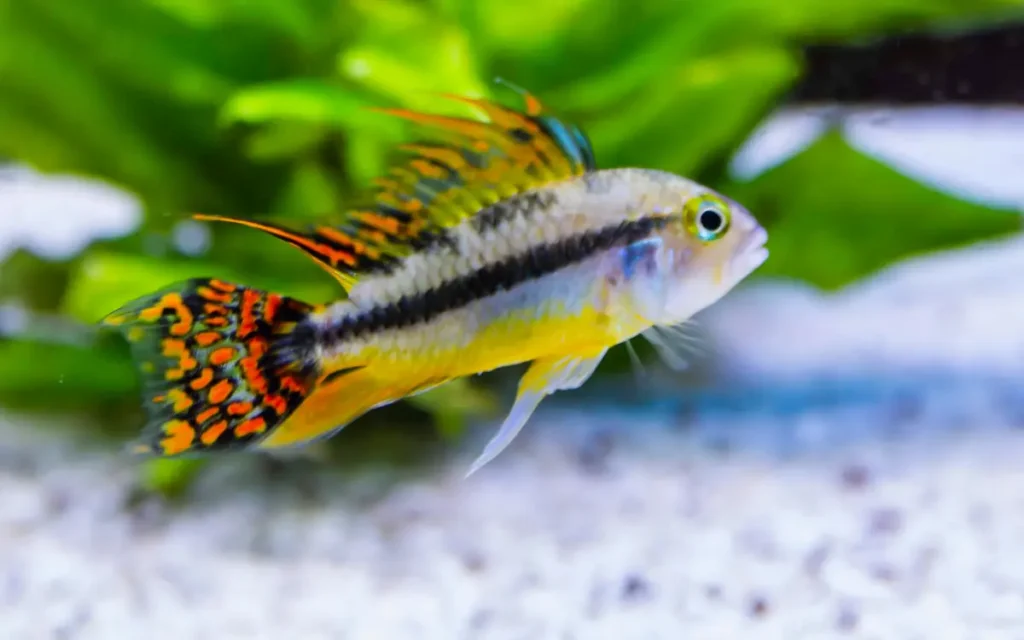
Bolivian rams have a stop-and-start way of swimming. A fish may move a few inches, freeze in place, tilt toward the sand, then take a mouthful and spit the cleaned grains out through its mouth or gill openings. That is normal foraging, not bad table manners.
They are observant fish. Once settled, many learn who brings food and come to the front of the tank. They are less frantic than many community fish, so their food can disappear before it reaches them.
Normal behavior includes:
- Hovering near the bottom
- Sifting fine sand
- Resting under wood or plants
- Brief chases around a chosen territory
- Darker color when displaying or guarding young
Constant hiding, clamped fins, gasping, or repeated attacks that pin one fish in a corner are not normal settled behavior.
How Big Do Bolivian Rams Get?
Most adult Bolivian rams reach about 3-4 inches in total length, with males often larger than females.
You may see smaller figures in fish databases because scientists often report standard length, measured from the nose to the base of the tail. Aquarium shops usually quote total length, which includes the tail. The fish has not changed size. The ruler has changed starting rules.
How Long Do Bolivian Rams Live?
Bolivian rams often live 4-6 years in a stable aquarium. Genetics, condition at purchase, diet, water quality, and long-term stress all affect the result. A lifespan number is an estimate, not a warranty card.
Where Do Bolivian Rams Come From?
Bolivian rams come from the upper Madeira River system in Bolivia and Brazil. Records include the Mamoré and Guaporé drainages, with the Guaporé known as the Iténez in Bolivia.
Wild habitat reports are limited, but the species is associated with river margins, tributaries, oxbow areas, and lakes with sand or mud below. That history explains three useful aquarium choices: a soft substrate, calmer water, and cover close to the bottom.
You do not need to build a museum copy of a Bolivian river. Give the fish a place to sift, a place to retreat, and enough clear floor to move between them.
Bolivian Ram Colors and Markings
A settled Bolivian ram has a warm tan, olive, or golden body. A dark line crosses the eye, and a black spot usually sits high on the side. Red or orange edges on the dorsal, tail, and anal fins give the fish its “ruby crown” look. Fine blue-green speckles may show around the face and fins under good light.
Fish in a store often look gray. Shipping, bright bare tanks, and nearby dominant fish can wash out their color. Give a healthy fish cover and time before judging it.
Color can also work like body language:
| What you see | What it may mean | What to check |
| Pale body soon after purchase | Normal transport stress | Dim the light and allow quiet time |
| Dark markings during a short chase | Display or territory claim | Make sure the chased fish can leave |
| Strong color near a cleaned rock | Courtship or spawning | Watch for eggs and increased defense |
| Lasting dull color with clamped fins | Stress or illness | Test water and observe breathing, appetite, and waste |
Color alone cannot diagnose disease. Read it beside the fish’s breathing, posture, appetite, and behavior.
Male vs Female Bolivian Ram: How Can You Tell?
Adult males are usually larger, more strongly colored, and more likely to develop longer extensions on the dorsal, anal, and tail fins. Females tend to be smaller, rounder through the belly, and shorter-finned.
Those are clues, not guarantees. Young Bolivian rams are hard to sex, and a smaller male can look like a female when kept beside a dominant fish. The central black spot is not a reliable sex marker.
The clearest signs often appear when mature fish court or spawn. A female develops a short, blunt egg tube, while the male’s breeding tube is narrower. Even then, use several signs together.
Buying one fish labeled “male” and one labeled “female” does not create a bonded pair. They may ignore each other, fight, or pair later. Have a divider or second tank ready before trying to force romance in a glass box.
What to Check Before Buying a Bolivian Ram
Ask the seller for the scientific name. This prevents a German blue ram or another dwarf cichlid from going home under a vague “ram” label.
Watch the fish for a few minutes. A healthy candidate should hold itself upright, breathe at a calm rate, react to movement, and have a reasonably full belly. Skip fish with a sunken abdomen, bent spine, cloudy eyes, open sores, tightly clamped fins, or rapid breathing.
Also ask:
- What temperature and pH is the store using?
- Is the fish eating pellets, frozen food, or only live food?
- How long has it been at the store?
- Has it been treated for a known illness?
- Is the apparent pair choosing to stay together, or is one fish trapped in a corner?
Quarantine new fish when you can. It is much easier to watch one newcomer in a simple hospital tank than to catch it from a planted display after a problem appears.
What Tank Size Does a Bolivian Ram Need?
Use a 20-gallon-long tank as the minimum for one Bolivian ram or a proven, compatible pair. A 40-gallon breeder, with a 36 x 18-inch base, is a better pick for a pair in a community aquarium.
Tank footprint matters because these fish live and defend space near the bottom. The common 29-gallon aquarium holds more water than a 20-long but has almost the same 30 x 12-inch floor. More height does not give a chased fish much extra escape room.
Published care sources do not all set the same minimum. Some hobby guides accept 20 gallons, while Seriously Fish recommends a 36 x 18-inch base for an individual in a community tank or a pair. My practical reading is simple:
- 20-gallon long: one fish or a known pair, light stocking, several sight breaks
- 40-gallon breeder: the safer community choice for a pair
- 48-inch tank or larger: a long-term group, with extra territories and a backup plan
Do not keep two random adults in a 20-gallon tank and assume they will sort it out. If one fish controls the food and the other stays behind the heater, the tank is not working, even if the calculator says the gallons are correct.
For more stocking context, see this aquarium fish by tank size guide.
How to Set Up a Tank for Bolivian Rams
The best setup gives the ram open feeding ground without leaving it exposed. You can build that balance in seven steps.
1. Cycle the Aquarium Before Adding the Fish
Do not use a Bolivian ram to test if a new tank is ready. Establish the biofilter first and confirm that it can process waste without an ammonia or nitrite reading. If this part is new, follow the fish tank cycling guide before shopping for the fish.
2. Use Fine, Smooth Sand
Sand lets a ram perform its natural pick-and-sift feeding behavior. Rough gravel can block that behavior and may injure delicate gill tissue if the fish tries to mouth it.
Choose aquarium sand with smooth grains. It does not need to be bright white. A natural tan or darker shade often helps the fish feel less exposed.
3. Make an Open Feeding Area
Leave part of the front or center floor open. This is where you can place sinking food and watch each fish eat. A tank packed from glass to glass with rocks may look dramatic, but it takes away the ram’s dinner table.
4. Break Up Lines of Sight
Use driftwood, plants, and small rock groups to divide the bottom into separate visual zones. A weaker fish should be able to turn a corner and disappear from a dominant fish’s view.
Add one or two smooth, flat stones. A pair may use one as a spawning site.
Hardy attached plants and shaded planting can work well around wood. If your aquarium light is modest, these low-light aquarium plants are a useful starting point.
5. Keep the Flow Gentle to Moderate
Bolivian rams do not need stagnant water, but they should not spend all day fighting a powerhead. Aim the filter return along the glass or use wood and plants to create calm pockets.
Fit a sponge over a strong intake if needed. It protects fins and later keeps fry from disappearing into the filter, which is a very efficient but disappointing baby collector.
6. Add a Heater, Thermometer, and Lid
Use a reliable heater if the room does not hold the tank inside the target range. Check the temperature with a separate thermometer rather than trusting the heater dial.
A lid slows evaporation and prevents surprises. Bolivian rams are not famous jumpers, but frightened fish do not read species profiles.
7. Add Fish Slowly
Keep the tank lightly stocked while the ram settles. Add only species that match its temperature, water chemistry, and calm feeding style. The freshwater aquarium setup guide covers equipment choices if you are starting from an empty tank.
Best Water Parameters for Bolivian Rams
Keep Bolivian rams at 75-79°F (24-26°C), pH 6.0-7.5, and roughly 1-10 dGH. Ammonia and nitrite must stay at 0 ppm. Keep nitrate low and steady through sensible stocking, filter care, and regular water changes.
The temperature advice online can look messy. FishBase reports 22-26°C, Practical Aquariums gives 22-27°C, and Seriously Fish gives 24-28°C. The 75-79°F range sits inside all three and suits many calm tropical community fish.
Do not chase an exact pH with quick-fix chemicals. A steady pH of 7.3 is safer than repeated swings between 6.8 and 7.3. If your tap water falls far outside the species’ range, learn its GH and KH before changing it. Water changes become a chore when every bucket needs a laboratory recipe.
A Simple Weekly Care Routine
Once a week, test the water and change about 15-25%, adjusted for stocking and nitrate trend. Match the new water’s temperature, add conditioner as directed, and remove debris from open areas without digging through the whole substrate.
Rinse filter sponge or media in removed tank water when flow slows. Do not replace every piece of media at once, and do not wash biological media under untreated tap water. The bacteria that process fish waste live mainly on wet surfaces, not floating loose in the water. This nitrogen cycle explanation shows why that matters.
At feeding time, run a 60-second fish check:
- Does each ram leave cover on its own?
- Does each one get food near the bottom?
- Is breathing calm after the meal?
- Can both fish move around without one being cornered?
That minute often catches a problem before a test strip, photograph, or late-night forum post does.
What Do Bolivian Rams Eat?
Bolivian rams are bottom-oriented omnivores and micropredators. In nature they sift substrate for small edible animals and other food. In the aquarium, feed a small sinking pellet or granule as the staple, then rotate frozen or live foods such as brine shrimp, daphnia, mysis, and bloodworms.
Bloodworms are a rich extra, not the whole menu. Flakes can be used, but floating food is easy for faster tank mates to steal.
Feed adults once or twice a day in portions they finish within a couple of minutes. A fish may take a pellet, chew, and spit it out because the piece is too large or hard. Try a smaller food or soak a dry pellet briefly. Repeated spitting with weight loss needs closer attention.
How to Make Sure a Shy Ram Gets Fed
Drop the first small pinch at one end for the schooling fish. While they are busy, place sinking food near the ram’s usual feeding patch. A feeding tube or long pipette makes this easy.
Do not judge the portion only by how fast the tank empties it. A squad of tetras can perform a convincing impression of fish that have never eaten in their lives.
Best Tank Mates for Bolivian Rams
The best Bolivian ram tank mates are peaceful fish that use the middle or upper water, accept similar conditions, and do not rush every sinking meal. Calm schooling fish can also help a shy ram feel that the coast is clear.
Good candidates, after checking each species’ full needs, include:
- Pencilfish
- Black neon tetras
- Glowlight tetras
- Lemon tetras
- Other small, calm characins that suit 75-79°F water
Corydoras can live with Bolivian rams in a roomy community tank, but they use the same floor. A Cory group may wander straight through a spawning site and get chased all afternoon. Keep them out of a dedicated breeding tank, and give both species more bottom space in a display tank.
Fish to Avoid With Bolivian Rams
Avoid aggressive cichlids, fin nippers, large predators, and frantic feeders. Hard-water livebearers are not my first choice because their preferred mineral level may conflict with a soft-water ram setup.
Do not casually mix a Bolivian ram with another dwarf cichlid in a small tank. Both fish may look peaceful at the store and still want the same cave, root, and patch of sand at home.
Can Bolivian Rams Live With Shrimp?
Large adult Amano shrimp may coexist with a well-fed Bolivian ram if they have cover. Small dwarf shrimp and shrimplets are potential food. This Amano vs cherry shrimp comparison explains the size and care differences. If breeding shrimp is the goal, choose a fish-free tank. A ram cannot be expected to recognize an expensive baby shrimp as a family pet.
Can Bolivian Rams Live Alone?
Yes. A single Bolivian ram can live well without a mate. Keeping one is often easier than placing two unbonded adults together.
A compatible pair can show courtship and shared brood care, but “pair” means two fish that accept each other. It does not simply mean one male plus one female.
Bolivian Ram Care Problems and What to Check First
When behavior changes, start with water and social pressure. Many symptoms look alike, so avoid diagnosing from one sign.
| Sign | Common possibilities | First checks |
| Fast breathing or hanging near the surface | Ammonia, nitrite, low oxygen, high temperature, gill trouble | Test water, check temperature, confirm filter movement |
| Hiding and pale color | Recent move, bright tank, bullying, poor water | Dim light, test water, add cover, watch tank mates |
| One fish stays behind equipment | Pair mismatch or territorial pressure | Look for chasing and blocked access to food |
| Sunken belly or weight loss | Not getting food, internal illness, parasites | Watch it eat, inspect waste, use quarantine if needed |
| Torn fins | Chasing, rough decor, fin-nipping tank mate | Observe interactions and inspect the layout |
| Small pits around the head | Water-quality trouble or illness needing proper diagnosis | Test water and seek an aquatic veterinarian or experienced fish-health professional |
If ammonia or nitrite is above zero, make a partial water change with conditioned, temperature-matched water and increase aeration. Check for a dead fish, missed filter maintenance, heavy feeding, or a recently replaced filter cartridge.
If the water is safe but one ram is under attack, separate the fish. Adding one more cave rarely fixes a relentless pair mismatch in a small footprint.
Do not combine medications “just in case.” Treatments can stress fish, damage the biofilter, and hide the real pattern. Quarantine gives you more control and protects the display tank.
How to Breed Bolivian Rams
Bolivian rams are biparental open-substrate spawners. They do not need a breeding cave. A pair usually cleans a flat stone, broad leaf, piece of wood, or open patch before the female lays rows of eggs and the male fertilizes them.
Both parents normally guard the eggs and young. First-time pairs may eat a spawn. That is frustrating, but it does not always mean something is wrong. Many pairs improve after a few attempts.
Step-by-Step Bolivian Ram Breeding Setup
- Start with a compatible pair. If you raise a juvenile group to let fish choose partners, use a tank at least 48 inches long and have homes ready for the extras.
- Use a mature, quiet aquarium. A species-only breeding tank is easier than trying to defend eggs in a busy community.
- Add fine sand and several flat surfaces. Let the pair choose instead of moving their favorite rock every day.
- Feed a varied diet. Small live or frozen foods can help bring adults into breeding condition.
- Keep maintenance steady. Clean water matters, but a sudden giant water change can disturb a pair and alter chemistry.
- Protect the filter intake. A sponge prefilter keeps tiny fry out of the machinery.
- Prepare fry food before they swim. Microworms and newly hatched brine shrimp are common first foods once the fry are free-swimming.
Eggs usually hatch in about 2-3 days. The young then remain as wrigglers for several more days while the parents move them among small pits. Seriously Fish reports a further 5-8 days before they become free-swimming, though timing shifts with temperature and development.
If you want to raise a good number of fry, remove other fish or breed the pair in its own tank. Community fish see eggs and fry as snacks, no matter how impressive the parents’ security patrol looks.
Watch the adults too. Breeding can increase aggression, and one parent may turn on the other after a failed spawn. A divider is cheap insurance.
Bolivian Ram vs German Blue Ram: Which Is Easier?
For most newer cichlid keepers, I would choose the Bolivian ram. It generally tolerates cooler community temperatures and a wider range of conditions than the German blue ram. It is also larger and less intensely colored.
| Difference | Bolivian ram | German blue ram |
| Scientific name | M. altispinosus | M. ramirezi |
| Adult size | About 3-4 inches total length | Usually about 2-3 inches total length |
| Practical temperature | Mid to upper 70s Fahrenheit | Usually low to mid 80s Fahrenheit |
| General hardiness | More forgiving once settled | More sensitive to poor water and cool conditions |
| Appearance | Earthy gold with red fin edges | Strong blue iridescence and brighter color forms |
Do not split the difference and keep both species together in a small tank. Their preferred temperatures are not identical, and both use the same lower territory. Pick the species that suits the tank you can maintain.
Further Research Before You Buy
A good care guide should lead to better questions, not pretend every aquarium works the same way. Before buying, read about:
- How aquarium cycling works, if ammonia and nitrite are still unfamiliar
- Fish choices for different tank sizes, if the ram will share its aquarium
- Low-light plants, if you need cover without a powerful light
- The adult size, group needs, temperature, hardness, and feeding speed of every planned tank mate
Also check the fish in front of you. Captive-bred stock may be accustomed to local tap water, while a newly imported fish may need a slower adjustment. Ask the seller what it has actually been living in.
Frequently Asked Questions
Are Bolivian Rams Good for Beginners?
Bolivian rams are good for beginners who can maintain a fully cycled aquarium and test the water. They are a poor choice for cycling a new tank or learning maintenance by trial and error.
Can a Bolivian Ram Live in a 20-Gallon Tank?
One Bolivian ram or a proven pair can live in a 20-gallon-long tank with careful stocking and broken sightlines. A 40-gallon breeder is safer for a pair with community fish because it has much more floor space.
How Many Bolivian Rams Can Live in a 20-Gallon Tank?
Keep one fish or one compatible pair. Do not keep a group in a 20-gallon tank. If two fish fight constantly, separate them even if they were sold as a pair.
Do Bolivian Rams Need Sand?
Yes, fine smooth sand is strongly recommended. Bolivian rams naturally sift substrate for food, and coarse or sharp gravel can block that behavior or injure the fish.
Are Bolivian Rams Aggressive?
They are mild for cichlids, but they are not passive. Adults may chase rivals, and a breeding pair will defend its eggs, fry, and nearby floor space.
Can Bolivian Rams Live With German Blue Rams?
It is possible only in a large, carefully planned aquarium, but it is not a good beginner mix. The two species prefer different temperature ranges and compete for similar bottom territory.
How Can I Tell if My Bolivian Ram Is Male or Female?
Adult males tend to be larger, brighter, and longer-finned. Females are often smaller and rounder. Juveniles are difficult to sex, so use several clues and do not trust one fin or spot alone.
Why Is My Bolivian Ram Hiding?
A new fish may hide for several days. Lasting hiding can point to bright lighting, too little cover, bullying, poor water, strong flow, or illness. Test ammonia and nitrite, check temperature, and observe what happens when the fish tries to eat.
How Often Should I Feed a Bolivian Ram?
Feed once or twice daily in small portions. Use a sinking staple and rotate suitable frozen or live foods. Confirm that the ram gets food before faster tank mates clean up the tank.
How Long Do Bolivian Ram Eggs Take to Hatch?
Eggs commonly hatch in 2-3 days. The fry remain as wrigglers for several more days before swimming and eating small live foods. Temperature and development affect the timing.
