
Tiger Barb Care Guide: Tank Setup, Tank Mates, Feeding and Aggression Tips

Tiger Barbs are bold, active freshwater fish known for their black vertical stripes, orange fins, and nonstop movement. They are beautiful fish, but they are not the calmest choice for every community tank.
The biggest thing beginners need to know is this: Tiger Barbs are semi-aggressive schooling fish. They can nip fins, chase slower fish, and cause stress in the wrong setup. But when you keep them in a proper group, give them enough swimming space, and choose the right tank mates, they can be one of the most exciting fish in a freshwater aquarium.
This guide covers Tiger Barb tank size, water conditions, feeding, tank mates, aggression control, breeding, and common problems.

Tiger Barb Species Profile
| Feature | Details |
| Scientific Name | Puntigrus tetrazona |
| Common Name | Tiger Barb |
| Adult Size | 2.5 to 3 inches |
| Lifespan | 5 to 7 years |
| Care Level | Easy to moderate |
| Temperament | Semi-aggressive, active |
| Minimum Tank Size | 20 gallons |
| Better Tank Size | 30 gallons or larger |
| School Size | 6 minimum, 8 to 12 better |
| Temperature | 74 to 79°F |
| pH Range | 6.0 to 7.5 |
| Diet | Omnivore |
| Tank Level | Middle areas |
| Breeding Type | Egg scatterer |
What Are Tiger Barbs?
Tiger Barbs are small, fast-moving freshwater fish from Southeast Asia. They are popular because they are hardy, colorful, and full of energy.
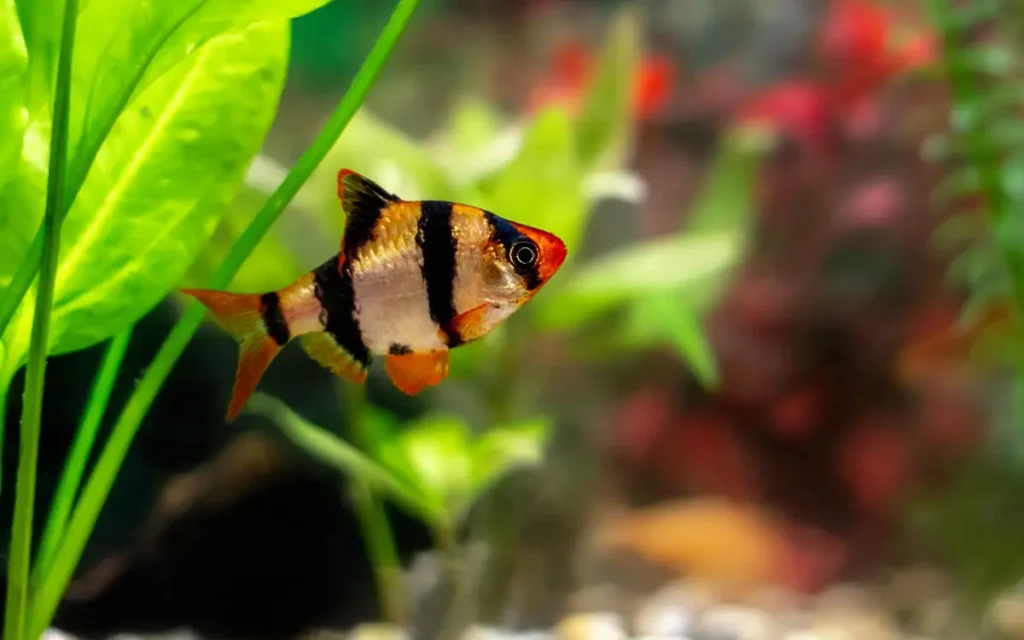
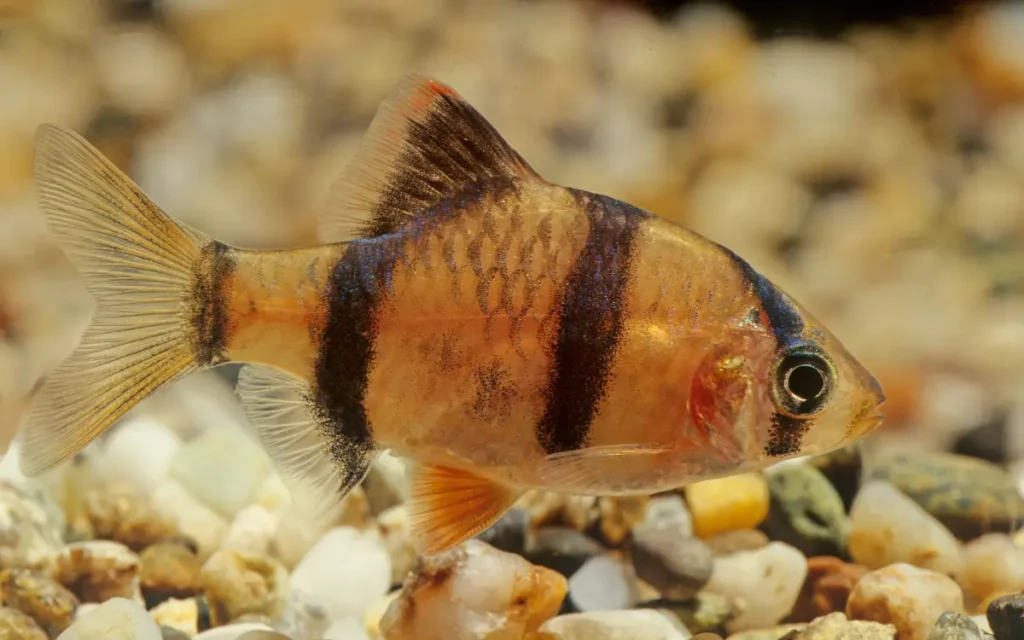
Their striped pattern gives them their common name. Most Tiger Barbs have a golden or silver body with four dark vertical bands and orange-red fins. Selective varieties are also available, including Green Tiger Barbs, Albino Tiger Barbs, and Longfin Tiger Barbs.
Tiger Barbs are schooling fish, but they are not peaceful in the same way as Neon Tetras or Harlequin Rasboras. They have a strong group hierarchy. If the group is too small, they may turn their energy toward other fish in the tank.
That is why school size matters so much.
Tiger Barb Appearance
Tiger Barbs are easy to recognize. Their body is short, deep, and rounded compared to many slim schooling fish. The black bands across the body make them stand out, especially when mixed with orange fins.
Healthy Tiger Barbs should look alert, active, and full-bodied. Their fins should be open, not clamped. Their colors are usually stronger when they are kept in clean water, fed a varied diet, and housed in a proper group.
Males are usually slimmer and may show brighter red on the nose and fins. Females are often rounder, especially when carrying eggs.
Tiger Barb Behavior
Tiger Barbs are active, social, and sometimes pushy. They spend much of the day swimming in the middle areas of the tank, chasing each other, and exploring.
Some chasing inside the group is normal. Tiger Barbs create a pecking order. The problem starts when the group is too small or the tank is too cramped. In that case, the strongest fish may keep picking on the weaker ones, or the group may bother other tank mates.
Tiger Barbs are also known for fin nipping. Long fins can trigger their chasing behavior. This is why they are poor tank mates for fish like Bettas, Fancy Guppies, and Angelfish.
My direct opinion: Tiger Barbs are not bad fish, but they are often kept in the wrong community tank. They need an active setup built around their behavior.
How Many Tiger Barbs Should You Keep?
Keep at least six Tiger Barbs together. That is the minimum.
A better group is eight to twelve. The larger group spreads out aggression and keeps their attention focused on each other instead of slower tank mates.
Small groups of two, three, or four are where most problems happen. In small numbers, Tiger Barbs can become more aggressive, stressed, and unpredictable.
For beginners, I would recommend:
| Group Size | Recommendation |
| 1 to 3 | Not recommended |
| 4 to 5 | Still too small |
| 6 | Minimum group |
| 8 to 12 | Much better |
| 12+ | Great in larger tanks |
If you want peaceful behavior, do not keep them alone or in pairs.
Best Tank Size for Tiger Barbs
A 20-gallon tank is the minimum for a small group of Tiger Barbs, but I would only use that for a species-only setup or a very simple tank.
A 30-gallon tank or larger is better. Tiger Barbs are active swimmers, and they need room to move. A longer tank shape is better than a tall tank because it gives them more swimming space.
Here is a better tank size guide:
| Tank Size | Best Use |
| 20 gallons | Minimum for 6 Tiger Barbs |
| 30 gallons | Better for 8 to 10 Tiger Barbs |
| 40 gallons | Great for a larger group and tank mates |
| 55 gallons+ | Best for an active community setup |
If you want to keep Tiger Barbs with other fish, go bigger than 20 gallons. A larger tank helps reduce chasing and gives other fish room to avoid the barb group.
Ideal Water Parameters
Tiger Barbs are hardy, but they still need stable water. Do not add them to an uncycled tank.
| Water Parameter | Ideal Range |
| Temperature | 74 to 79°F |
| pH | 6.0 to 7.5 |
| Ammonia | 0 ppm |
| Nitrite | 0 ppm |
| Nitrate | Under 20 to 40 ppm |
They can handle slightly different conditions if the water is stable, but ammonia and nitrite should always be zero.
Weekly water changes help keep them healthy. In most tanks, a 25 to 30 percent water change each week works well.
Best Tiger Barb Tank Setup
Tiger Barbs need a tank with open swimming space and enough decor to break up sightlines.
The best setup has plants and hardscape around the edges, with open swimming space in the center. This gives them room to move while also helping reduce aggression.
Good setup features include:
- Open swimming area
- Plants along the back and sides
- Driftwood or smooth rocks
- Moderate water flow
- Strong filtration
- Secure lid
- Stable heater
Tiger Barbs are active and produce a decent bioload when kept in groups, so filtration matters. Use a filter that keeps the water clean without creating an extreme current.
Plants and Decor
Tiger Barbs do well in planted tanks, but leave enough open space for swimming.
Good plants for Tiger Barb tanks include:
- Java Fern
- Anubias
- Amazon Sword
- Cryptocoryne
- Vallisneria
- Water Wisteria
- Hornwort
Plants help create visual barriers. This means one fish can move away from another fish instead of being chased across an empty tank.
Driftwood and rocks also help break the line of sight. Avoid sharp decor that could damage fins during fast swimming.
Learn about Freshwater Aquarium Setup Guide
Tiger Barb Diet and Feeding
Tiger Barbs are omnivores and easy to feed. They usually accept flakes, pellets, frozen foods, and live foods.
A varied diet helps keep their color strong and supports better health.
Good foods include:
- High-quality flakes
- Micro pellets
- Frozen brine shrimp
- Frozen bloodworms
- Daphnia
- Tubifex worms
- Spirulina flakes
- Blanched spinach
- Blanched zucchini
Feed small portions once or twice daily. They should finish the food within two to three minutes.
Do not overfeed. Tiger Barbs are greedy eaters, and extra food can quickly pollute the water.
A simple feeding routine:
| Food Type | How Often |
| Flakes or pellets | Main daily food |
| Frozen brine shrimp or daphnia | 2 to 3 times weekly |
| Bloodworms | 1 to 2 times weekly |
| Vegetable-based food | Occasionally |
If you want better color, use a mixed diet instead of feeding only cheap flakes.
Tiger Barb Aggression
Tiger Barb aggression is the main reason many beginners struggle with this fish.
They may chase each other, nip fins, and bother slow tank mates. This behavior becomes worse when they are kept in small groups or cramped tanks.
The good news is that you can reduce most problems with the right setup.
To reduce Tiger Barb aggression:
- Keep at least six, but eight or more is better
- Use a 30-gallon or larger tank if possible
- Avoid long-finned fish
- Add plants and driftwood to break sightlines
- Choose fast, active tank mates
- Feed a varied diet
- Avoid overcrowding
Some chasing inside the group is normal. Constant bullying, torn fins, or one fish hiding all day is not normal.
Why Are My Tiger Barbs Nipping Fins?
Tiger Barbs usually nip fins for three reasons.
First, the school is too small. When there are not enough Tiger Barbs, they may direct their energy toward other fish.
Second, the tank mates are wrong. Long-finned or slow fish are easy targets.
Third, the tank is too small or too open. In a bare tank, weaker fish have nowhere to escape.
If your Tiger Barbs are nipping, do not only blame the fish. Look at the setup first.
Best Tank Mates for Tiger Barbs
The best Tiger Barb tank mates are active fish that can handle a busy aquarium. Avoid slow, shy, or long-finned fish.
Good Tiger Barb tank mates include:
| Tank Mate | Why It Works |
| Zebra Danios | Fast and active |
| Giant Danios | Strong swimmers for larger tanks |
| Rosy Barbs | Active and similar energy |
| Cherry Barbs | Can work in larger planted tanks |
| Black Skirt Tetras | Tougher community fish |
| Serpae Tetras | Active, but watch for extra nipping |
| Yo-Yo Loaches | Active bottom dwellers |
| Clown Loaches | Only for very large tanks |
| Rainbowfish | Fast and colorful |
| Bristlenose Pleco | Stays mostly at the bottom |
A species-only Tiger Barb tank is also a great option. A big group of Tiger Barbs can look better and behave more naturally than a mixed community tank.
Fish to Avoid With Tiger Barbs
Avoid slow-moving, long-finned, or delicate fish.
Bad tank mates include:
- Betta fish
- Fancy Guppies
- Angelfish
- Longfin Danios
- Fancy Goldfish
- Small shrimp
- Slow gouramis
- Small peaceful tetras in cramped tanks
Bettas and Guppies are two of the worst matches because their long fins can trigger nipping.
Angelfish are also risky. Their long fins and slower movement make them easy targets, especially in smaller tanks.
Can Tiger Barbs Live With Shrimp?
Tiger Barbs are not a good choice for shrimp tanks. They may chase, harass, or eat small shrimp.
Large Amano Shrimp might survive in a heavily planted tank, but even then, it is not risk-free. Cherry Shrimp are much more likely to be eaten or stressed.
If you want a peaceful shrimp tank, choose calmer fish instead.
Can Tiger Barbs Live With Snails?
Yes, Tiger Barbs can usually live with larger aquarium snails like Nerite Snails or Mystery Snails.
They may pick at small soft foods around the snail, but they usually do not bother healthy adult snails. Still, make sure the snails are not being flipped over or harassed.
Breeding Tiger Barbs
Tiger Barbs are egg scatterers and can breed in aquariums, but the adults will eat their eggs if given the chance.
A separate breeding tank is best.
Use a 10 to 15-gallon breeding tank with:
- Heater
- Sponge filter
- Fine-leaved plants
- Spawning mop
- Marbles or mesh on the bottom
- Slightly warmer water around 78 to 80°F
Condition the adults with protein-rich foods like brine shrimp, daphnia, and bloodworms. When the female becomes rounder and the male becomes more colorful, they may be ready to spawn.
After eggs are laid, remove the adults. Eggs usually hatch in 2 to 3 days. Once fry become free-swimming, feed them infusoria, liquid fry food, or powdered fry food. Later, move them to baby brine shrimp.
Common Tiger Barb Health Problems
Tiger Barbs are hardy, but poor water quality and stress can still cause problems.
Ich
Ich looks like tiny white spots on the body and fins. It often appears after stress, sudden temperature changes, or poor water quality.
Fin Rot
Fin rot can happen when fins are damaged from nipping or when water quality is poor. Keep the water clean and remove the cause of stress.
Fungal Infections
Fungal growth may appear on wounds or damaged areas. It often happens after injury.
Stress and Hiding
If Tiger Barbs are hiding, breathing fast, or losing color, check water quality and aggression inside the group.
Torn Fins
Torn fins can come from chasing, nipping, or sharp decor. Watch the group and remove sharp objects.
Prevention is better than treatment. Keep the tank clean, avoid overcrowding, quarantine new fish, and maintain a proper school size.
Are Tiger Barbs Good for Beginners?
Tiger Barbs can be good for beginners, but only if the beginner understands their behavior.
They are hardy and easy to feed, but their aggression makes them harder than peaceful fish like Cherry Barbs, Platies, or Corydoras.
I would not recommend Tiger Barbs for a calm beginner community tank with Bettas, Guppies, or Angelfish. But for someone who wants an active barb tank, they are a great choice.
FAQs
Do Tiger Barbs need to be in groups?
Yes. Tiger Barbs should be kept in groups of at least six. A group of eight to twelve is better.
Are Tiger Barbs aggressive?
Tiger Barbs are semi-aggressive. They are active schooling fish and may nip fins, especially in small groups.
Why are my Tiger Barbs nipping other fish?
They may be in too small of a group, kept with long-finned fish, or housed in a tank that is too small or too open.
Can Tiger Barbs live in a 20-gallon tank?
A 20-gallon tank is the minimum for a small group. A 30-gallon or larger tank is better.
What fish can live with Tiger Barbs?
Good options include Zebra Danios, Rosy Barbs, Black Skirt Tetras, Yo-Yo Loaches, Rainbowfish, and Bristlenose Plecos.
Can Tiger Barbs live with Bettas?
No, I do not recommend it. Bettas have long fins and slower movement, which can trigger Tiger Barb nipping.
Can Tiger Barbs live with Guppies?
No, Fancy Guppies are poor tank mates because their long fins make them easy targets.
How long do Tiger Barbs live?
Tiger Barbs usually live 5 to 7 years with good care.
What do Tiger Barbs eat?
They eat flakes, pellets, frozen foods, live foods, and some vegetable-based foods.
Are Tiger Barbs good community fish?
They can work in active community tanks, but they are not ideal for peaceful slow-moving communities.
