
Salvinia Minima Care Guide: Light, Growth and Common Problems

Salvinia minima is one of the easiest floating plants to grow in a freshwater aquarium. Keep it on the surface under moderate light, protect it from strong filter flow, and remove extra growth before it covers the tank. It does not need substrate or injected CO₂.
Most problems begin when the upper leaves stay wet. Filter splashing, condensation, or being pushed underwater can turn healthy leaves brown and soft. Pale growth may point to weak light or low nutrients.
I like Salvinia because it grows quickly but is easier to remove than duckweed. Its leaves are large enough to pick up by hand, making it useful for betta tanks, shrimp tanks and aquariums with fish fry.
If you are still comparing your options, see these floating aquarium plants for beginners.
Salvinia Minima Care at a Glance
| Care Requirement | Recommended Condition |
| Scientific name | Salvinia minima |
| Common names | Water spangles, common salvinia, water fern |
| Care level | Easy |
| Placement | Floating at the surface |
| Light | Moderate |
| Lighting time | Start with 6 to 8 hours daily |
| Temperature | 68 to 86°F or 20 to 30°C |
| Preferred temperature | 72 to 79°F or 22 to 26°C |
| pH | 6.0 to 8.0 |
| Water hardness | Soft to hard |
| Water flow | Gentle |
| CO₂ | Not required |
| Substrate | Not required |
| Fertilizer | Liquid fertilizer when needed |
| Growth rate | Fast |
| Plant size | Around 0.4 to 1.2 inches or 1 to 3 cm |
What Is Salvinia Minima?
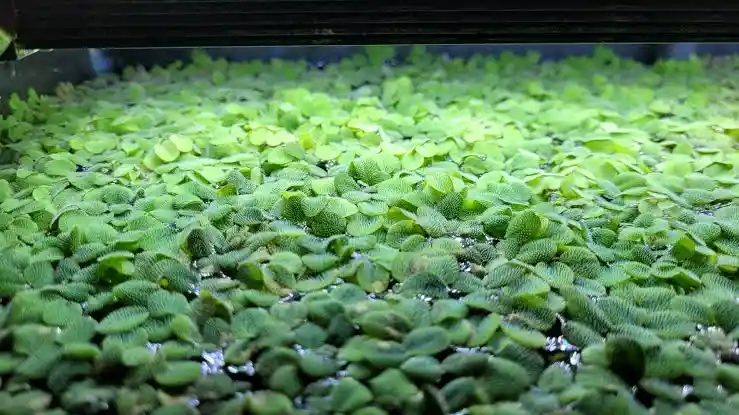
Salvinia minima is a small floating aquatic fern. It is also sold under the names water spangles, common salvinia and water fern.
The plant grows in groups of three leaves. Two oval leaves remain above the surface, while a divided third leaf hangs underwater. This underwater leaf looks like a root, but Salvinia minima does not have true roots.
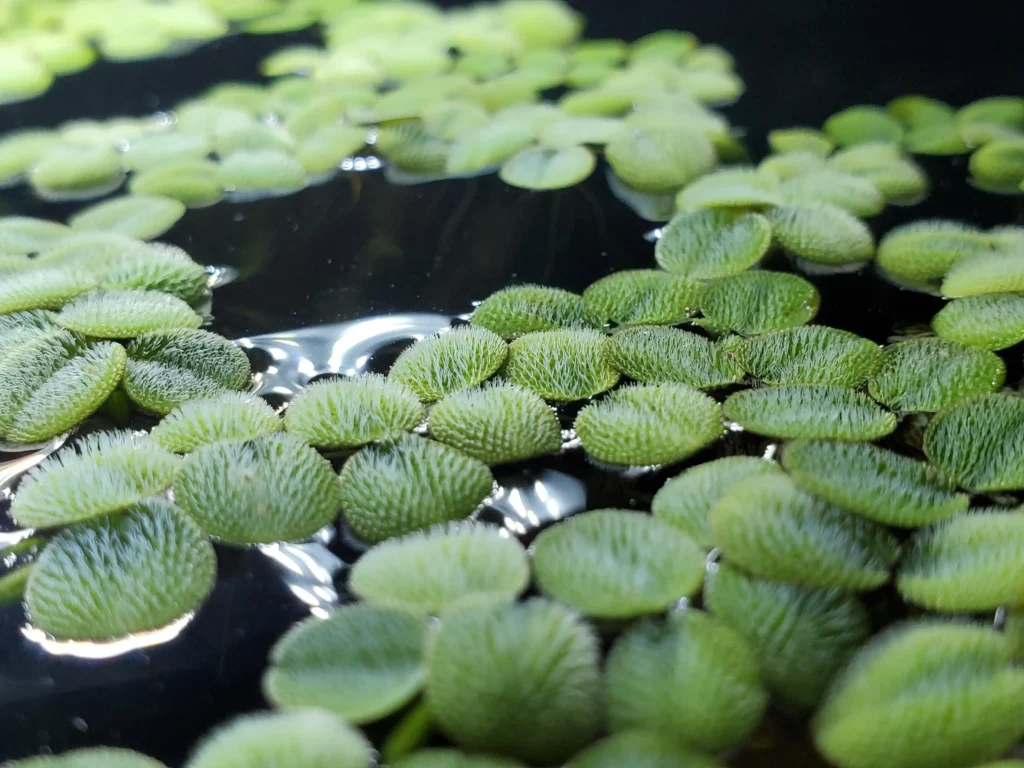
Fine hairs cover the upper leaves and help repel water. These hairs are one reason the plant struggles when it is repeatedly pushed underwater or splashed by a filter.
Salvinia minima does not need sand, gravel or aquasoil. It takes nutrients directly from the water while its upper leaves receive carbon dioxide from the air. You can learn more about this growth type in our complete aquarium plants guide.
How to Identify Salvinia Minima
Healthy Salvinia minima has small green oval leaves that float in connected groups. Younger leaves usually lie flat, while crowded mature leaves may fold slightly upward.
The fine hairs on Salvinia minima divide into separate tips. In giant salvinia, the hair tips join together and form a shape similar to a tiny egg beater. You may need a magnifying glass to see this difference.
Aquarium stores sometimes label several Salvinia species under the same common name. This matters because different species may be covered by local invasive-plant laws.
Salvinia Minima Light Requirements
Moderate aquarium lighting is the safest starting point for Salvinia minima. Begin with six to eight hours of light each day and use a timer to keep the schedule steady.
Because the plant sits directly below the aquarium light, it receives more light than plants growing near the substrate. A light that seems weak at the bottom of the tank may still be strong enough at the surface.
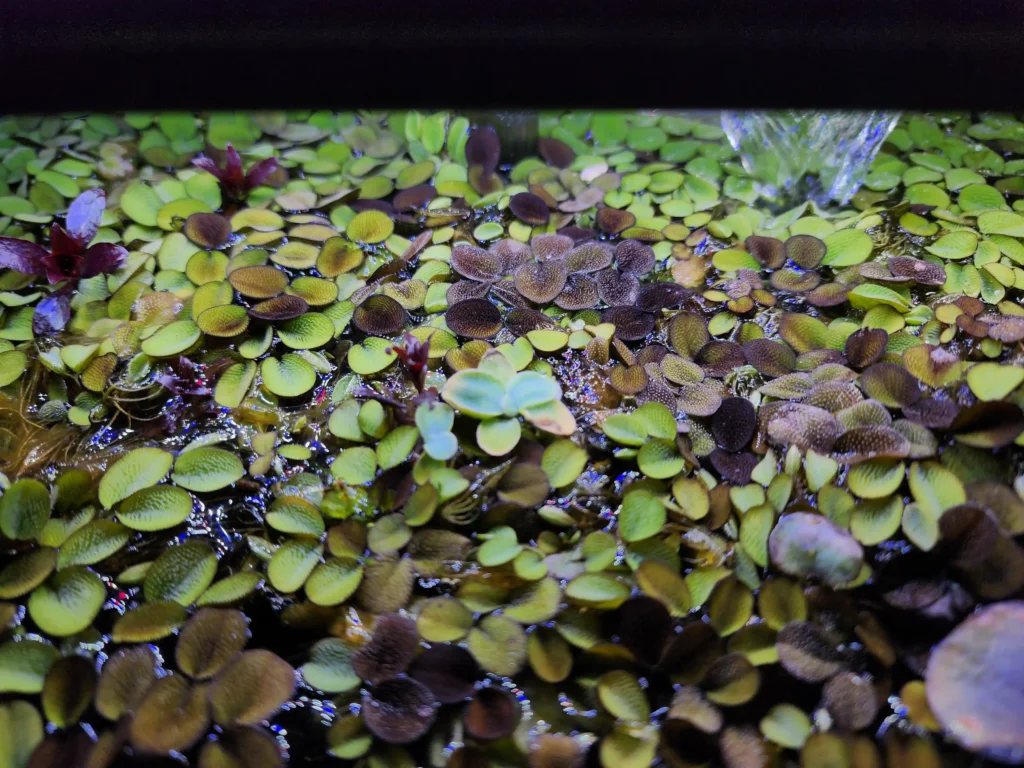
Under stronger light, Salvinia usually grows faster and forms tighter clusters. Strong light also means more frequent thinning. If the light is too weak, new leaves may become small or pale and growth may slow.
Do not assume that every pale leaf means the plant needs more fertilizer. Check the lighting schedule, surface flow and condition of the newest leaves first.
Very intense light can dry or burn leaves when the plant sits close to a hot fixture. Raise the light or reduce its intensity if leaf edges become dry while the tops remain free from water.
Temperature, pH and Water Hardness
Salvinia minima accepts a broad range of freshwater conditions. It can grow between 68 and 86°F, though a steady tropical range of 72 to 79°F works well in most aquariums.
Keep the pH between 6.0 and 8.0. The plant can adapt to soft, moderately hard or hard water, so there is usually no reason to change your tap water only for Salvinia.
Stable conditions matter more than reaching one exact number. A plant that has just arrived may lose a few leaves after moving from the seller’s water into your aquarium. Remove soft growth and watch for healthy new leaves before changing several parts of the setup.
Water Flow
Salvinia minima needs gentle surface flow. Strong current can push the leaves underwater, move them around the tank all day, or trap them near the filter.
The surface does not need to be completely still. Some movement is useful for gas exchange. The goal is to create a calm area where the plant can float without being constantly splashed.
Hang-on-back filters often cause problems because the falling water lands directly on the leaves. Try raising the aquarium water level, lowering the filter output, or directing the flow toward an open part of the surface.
A floating plant ring is another simple fix. You can make one from aquarium airline tubing and a connector. Place the Salvinia inside the ring or use the ring to keep an open feeding area.
If you use an air stone, position it away from the main Salvinia group. Bubbles that burst directly below the leaves may keep their upper surfaces wet.
Does Salvinia Minima Need CO₂?
Salvinia minima does not need injected CO₂. Its floating leaves have direct access to carbon dioxide in the air.
Adding a pressurized CO₂ system only for Salvinia would add cost without giving the plant much extra help. Lighting, nutrients and surface conditions have a much larger effect on its growth.
CO₂ may still be useful for demanding plants growing below the surface. Our CO₂ guide for planted aquariums explains when an injection system is worth using.
Fertilizer Requirements
Salvinia minima takes nutrients from the water column, so root tabs will not feed it. Root tabs remain buried in the substrate and are intended for rooted plants.
In an aquarium with fish, waste and leftover food may supply enough nitrogen and phosphorus. Micronutrients can still become limited, particularly when the tank contains many fast-growing plants.
Pale new leaves, smaller growth or a steady loss of color may mean the plant needs a complete liquid aquarium fertilizer. Use the product according to its label and start with a dose suited to the amount of plant growth in your tank.
Do not pour fertilizer directly onto the floating leaves. Add it to an area with water movement so it can spread through the aquarium.
If you keep shrimp, choose an aquarium fertilizer made for planted shrimp tanks and avoid guessing the dose. The trace amount of copper in a properly used aquarium fertilizer is different from adding an uncontrolled copper treatment.
Tank Size and Lids
Salvinia minima does not have a strict minimum tank size. It can grow in nano aquariums, but a tank of five gallons or larger is easier to manage.
Surface area matters more than water depth. A shallow, wide tank gives the plant more room than a tall tank with a narrow surface.
Covered aquariums can support Salvinia as long as the leaves are not touching the lid. Leave an air gap between the water and cover.
Watch for condensation dripping onto the same area throughout the day. If the leaves remain wet, lower the water level slightly or move the plant away from the dripping area.
How to Add Salvinia Minima to an Aquarium
Check new Salvinia carefully before placing it in your main tank. Remove brown, soft or badly damaged leaves. Rinse healthy portions gently with clean, dechlorinated water.
Look for pest snails, snail eggs, algae and other floating plants. Tiny pieces of duckweed can hide between Salvinia leaves and later spread through the aquarium.
If the seller cannot confirm that the plant is shrimp-safe, quarantine it in a separate container or aquarium. Newly purchased plants may carry pesticide residue that harms shrimp even when the plant itself is safe.
Avoid strong chemical dips unless you know the treatment is suitable for this plant. Salvinia leaves are delicate and can be damaged by harsh solutions.
Place the healthy clusters directly on the water. Spread them into one loose layer instead of piling them in a corner. Keep the first group small because it can multiply quickly after it adjusts.
Salvinia Minima Growth Rate
Salvinia minima is a fast-growing plant. Under moderate light with available nutrients, a small group can spread across a noticeable part of the aquarium within a few weeks.
The exact speed depends on light, temperature, nutrient levels and surface flow. Growth may slow after shipping while the plant adjusts to its new water.
Fast growth is useful because the plant takes up nutrients from the water. It also means Salvinia needs more maintenance than slow-growing plants such as Anubias or Java fern.
If you want more plants that establish quickly, see our list of fast-growing aquatic plants.
How to Propagate Salvinia Minima
Salvinia minima propagates on its own through branching and fragmentation. New growth develops from healthy sections and eventually separates from the parent plant.
You do not need to cut stems, bury roots or use special tools. Gently divide a healthy cluster and move part of it to another suitable aquarium.
Choose sections with firm green leaves and visible new growth. Avoid moving black, soft or badly melted pieces because they may decay before producing healthy leaves.
Even a small living section can continue growing. Check nets, buckets and aquarium tools before moving them between tanks if you do not want Salvinia spreading to every aquarium.
How to Stop Salvinia Minima From Taking Over
Remove excess Salvinia during regular water changes. Do not wait until the entire surface has formed a thick mat.
I prefer to keep about one-third to one-half of the surface open. This leaves room for feeding, filter movement and light to reach plants below. The exact amount can change depending on the fish and plants in the tank.
Bettas and gouramis need open access to breathe at the surface. Surface-feeding fish also need clear areas where they can see and reach their food.
Use a plant corral if you want Salvinia in one part of the aquarium. It can keep the plant away from the filter while creating a clear viewing and feeding area.
Never flush removed Salvinia down a toilet or drain. Do not release it into a pond, stream or outdoor water container. Let unwanted plants dry completely, seal them in a bag and dispose of them according to local rules.
Benefits of Salvinia Minima
Salvinia creates soft shade that can make shy fish feel more secure. Bettas, gouramis and many small community fish often prefer having some cover above them.
Its underwater modified leaves create small hiding and grazing areas. Shrimp may feed on biofilm growing around these surfaces, while newborn fish can use the plant as temporary cover.
Salvinia also takes up nitrate and other available nutrients as it grows. Removing part of the plant removes some of those stored nutrients from the aquarium.
This can support your normal maintenance routine, but it does not replace water changes or filtration. If nitrate remains high, follow a full plan for lowering aquarium nitrates safely.
Floating plants may also reduce some algae by taking up nutrients and shading the water below. They will not fix algae caused by overfeeding, long lighting periods or poor tank care.
Common Salvinia Minima Problems
| Problem | Likely Cause | What to Do |
| Pale or yellow leaves | Weak light or low nutrients | Check lighting first, then consider liquid fertilizer |
| Brown or black leaves | Wet leaves, strong flow or old growth | Reduce splashing and remove damaged leaves |
| Plant melting after purchase | Shipping stress or sudden water change | Keep conditions steady and save healthy sections |
| Very slow growth | Low light, cold water or limited nutrients | Check temperature, lighting and fertilizer |
| Plants pushed underwater | Strong filter output | Redirect flow or use a plant ring |
| Underwater leaves falling off | Strong current, fish damage or adjustment | Move the plant to a calmer area |
| Leaves folding upward | Crowded surface growth | Thin the group to create more space |
| Plants blocking the filter | Uncontrolled spreading | Remove excess growth and add a pre-filter sponge |
| Entire surface covered | Fast growth left unchecked | Thin weekly and maintain an open area |
Salvinia Minima Turning Brown
Brown leaves are often caused by water sitting on the upper surface. Check for filter spray, air bubbles, condensation or fish repeatedly pulling the plant underwater.
Remove soft brown leaves before they decay. Healthy green sections can recover once they are moved into a calmer, drier surface area.
Older leaves may also turn brown naturally. A few damaged leaves are not a reason to add more fertilizer when the newest growth remains green.
Salvinia Minima Turning Yellow
Yellow or pale new growth can point to weak lighting or low micronutrients. Check whether the plant is receiving enough light before adding fertilizer.
If lighting is already moderate and the plant continues producing pale leaves, use a complete liquid aquarium fertilizer at the labelled dose. Improvement will appear in new growth rather than damaged older leaves turning green again.
Salvinia Minima Melting
Some melting can happen after shipping. The plant may arrive wet, cold or compressed inside a bag.
Remove mushy pieces and keep the remaining healthy plants in gentle flow. Avoid changing the light, fertilizer and water conditions all at once. New green leaves are a better sign of recovery than the appearance of the damaged shipping leaves.
Best Tank Mates for Salvinia Minima
Salvinia minima works well with peaceful freshwater fish that enjoy gentle flow and some surface shade.
Bettas and gouramis often rest near floating plants. Keep a clear surface opening so these fish can use their labyrinth organ to breathe air.
Guppies, rasboras and small tetras can also live with Salvinia. Guppy fry may hide among the underwater leaves, though this cover cannot guarantee that every baby will avoid adult fish.
Freshwater shrimp can graze around the plant and use its hanging growth for cover. For other suitable choices, see our guide to the best plants for shrimp tanks.
Goldfish and large cichlids may eat, tear or repeatedly submerge Salvinia. It is also a poor match for aquariums that need strong surface current.
Salvinia Minima vs Other Floating Plants
| Plant | Growth Speed | Best Feature | Main Problem |
| Salvinia minima | Fast | Easy to remove by hand | Covers the surface quickly |
| Duckweed | Very fast | Small and easy to grow | Difficult to remove fully |
| Amazon frogbit | Fast | Long hanging roots | Leaves dislike splashing |
| Red root floater | Moderate | Can develop red leaves | Needs stronger light for red color |
For a beginner who wants a neat floating plant, I would choose Salvinia over duckweed. Duckweed grows easily, but its tiny leaves stick to equipment and are difficult to remove completely.
Choose Amazon frogbit if you want larger leaves and long hanging roots. Read the full Amazon frogbit care guide before deciding because it also dislikes wet upper leaves.
Red root floater is the better choice when color matters most. It may remain green under moderate light, while stronger light can produce red or pink tones.
Salvinia sits between these options. It grows quickly, stays compact and is easier to scoop out than duckweed.
Is Salvinia Minima Invasive or Illegal?
Salvinia minima can spread rapidly outside an aquarium. It may form dense mats in slow-moving outdoor water and crowd out native plants.
Laws differ by country, state and region. For example, Texas Parks and Wildlife lists all Salvinia species, including Salvinia minima, as prohibited aquatic plants.
Check your current local rules before buying, selling, owning or transporting it. Never assume that a plant is legal simply because an online seller offers it.
Do not release Salvinia outdoors. A small living fragment may grow into a new group when it reaches suitable water.
Frequently Asked Questions
Does Salvinia minima need to be planted?
No. Salvinia minima must float on the water surface. It does not need soil, sand, gravel or aquasoil.
Can Salvinia minima grow in low light?
It may survive under low light, but growth will usually be slower. Moderate light produces stronger and more reliable growth.
Does Salvinia minima need fertilizer?
It may grow without added fertilizer in a stocked aquarium. Use a complete liquid fertilizer if new growth remains pale or unusually small after lighting and flow have been checked.
Can Salvinia minima live in a covered tank?
Yes, provided there is an air gap and condensation does not keep the upper leaves wet. Do not let the plant press against the lid.
Is Salvinia minima safe for betta fish?
Yes. It creates shade and surface cover that many bettas enjoy. Keep part of the surface open so the betta can breathe and feed easily.
Is Salvinia minima safe for shrimp?
The plant itself is safe for freshwater shrimp. The larger risk is pesticide residue on newly purchased plants, so rinse and quarantine plants from unknown sources.
How fast does Salvinia minima grow?
It grows quickly when it has moderate light, available nutrients and gentle surface flow. In a healthy aquarium, weekly or biweekly thinning may be needed.
Does Salvinia minima reduce nitrate?
Salvinia uses nitrate and other nutrients while growing. Removing extra plant growth exports some of those nutrients, but the plant cannot replace water changes or proper stocking.
Does Salvinia minima have roots?
No. The structures hanging below the plant are divided underwater leaves that perform many of the same jobs as roots.
Is Salvinia Minima Right for Your Aquarium?
Salvinia minima is a good choice if you want an easy floating plant for a low-tech tank. It suits bettas, shrimp, guppy fry and peaceful community aquariums with gentle surface flow.
Choose another plant if your filter creates heavy splashing, the lid sits close to the water, or you do not want to remove extra growth regularly. You should also confirm that Salvinia is legal in your area before purchasing it.
For most beginners who want surface cover without the mess of duckweed, Salvinia minima is one of the better choices.
