
10 Types of Danios: Size, Tank Needs and Care

Danios are small schooling fish known for their speed, hardiness, and active behavior. Zebra danios are the best choice for most beginners, while Celestial Pearl Danios suit quiet planted tanks. Giant and Malabar Danios need much more swimming room.
The main mistake beginners make is assuming every danio needs the same setup. Some stay under one inch, while others may reach four inches or more. Some enjoy strong water movement, while smaller species prefer plants and gentle filtration.
In this guide, I’ll compare 10 popular types of danios so you can choose one that fits your tank.
What Is the Best Type of Danio?
For a first aquarium, I recommend the Zebra Danio. It is hardy, easy to feed, widely available, and comfortable in many water conditions.
Here are the best choices for different tanks:
- Best for beginners: Zebra Danio
- Best natural colors: Glowlight Danio
- Best for a planted nano tank: Celestial Pearl Danio
- Best uncommon small species: Gold Ring Danio
- Best for a large active aquarium: Giant Danio
- Best long-bodied species: Malabar Danio
A 20-gallon long aquarium is a better starting point than a 10-gallon tank for most fast-swimming danios.
Zebra Danio
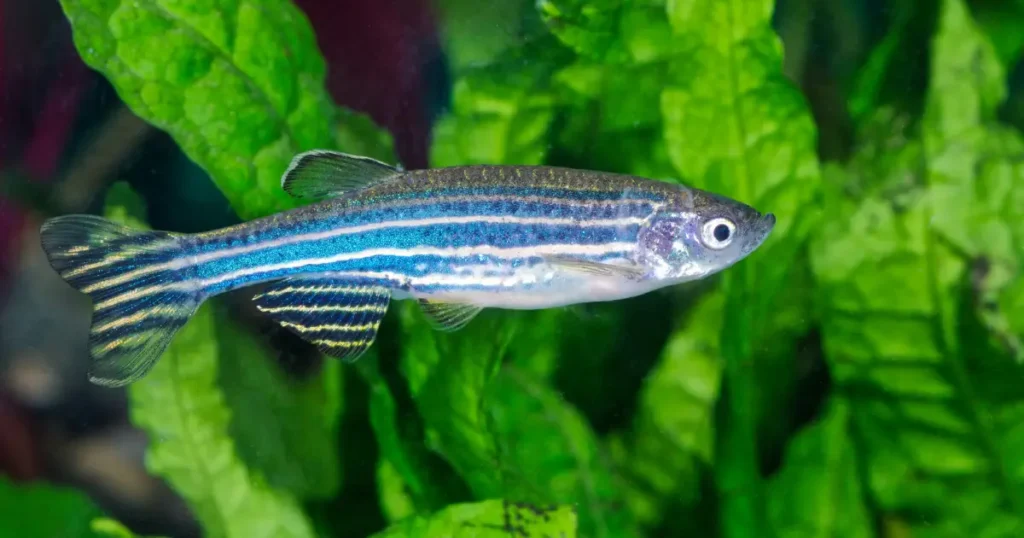
The Zebra Danio is the best-known member of this group. Its silver body has dark horizontal stripes that run from behind the gills to the tail.
This is my first choice for a beginner who wants an active schooling fish. Zebra danios accept flakes, pellets, frozen food, and small live foods. They are also more forgiving of minor changes in temperature than many tropical fish.
They may only grow to about two inches, but they need room to swim. I recommend a 20-gallon long tank for a group of eight or more. A 10-gallon aquarium is too cramped for their speed and constant movement.
Zebra danios are peaceful, but a small group may chase or nip each other. Keeping eight to ten spreads this behavior across the school.
Good tank mates include active tetras, small barbs, platies, Corydoras, and peaceful loaches. Avoid slow fish with large flowing fins.
Pearl Danio
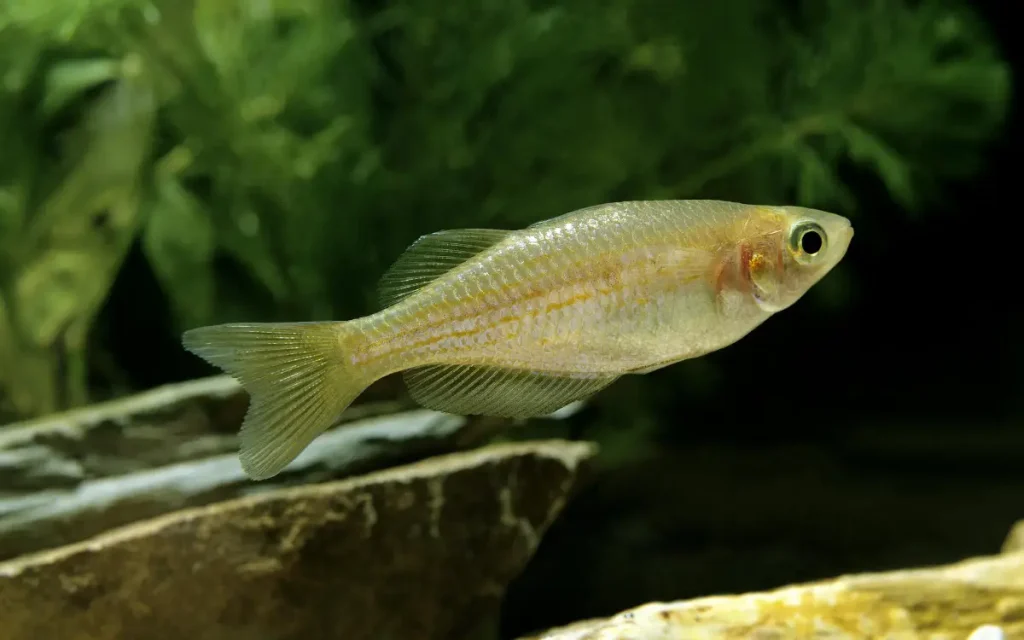
Pearl danios have a blue, pink, or violet shine that changes as they move under the aquarium light. They are not brightly patterned, but a healthy school has a clean and natural appearance.
They grow slightly larger and fuller-bodied than Zebra Danios. Because they swim constantly, give them a tank at least 36 inches long.
Pearl danios are hardy and peaceful. They work well for beginners who want something less common than a Zebra Danio without taking on a difficult species.
Keep at least eight together. A dark substrate, open swimming space, and plants around the back and sides help their color stand out.
Pearl danios can live in cooler tropical aquariums. Do not keep them at very warm temperatures throughout their lives simply because they are sold as tropical fish.
Glowlight Danio
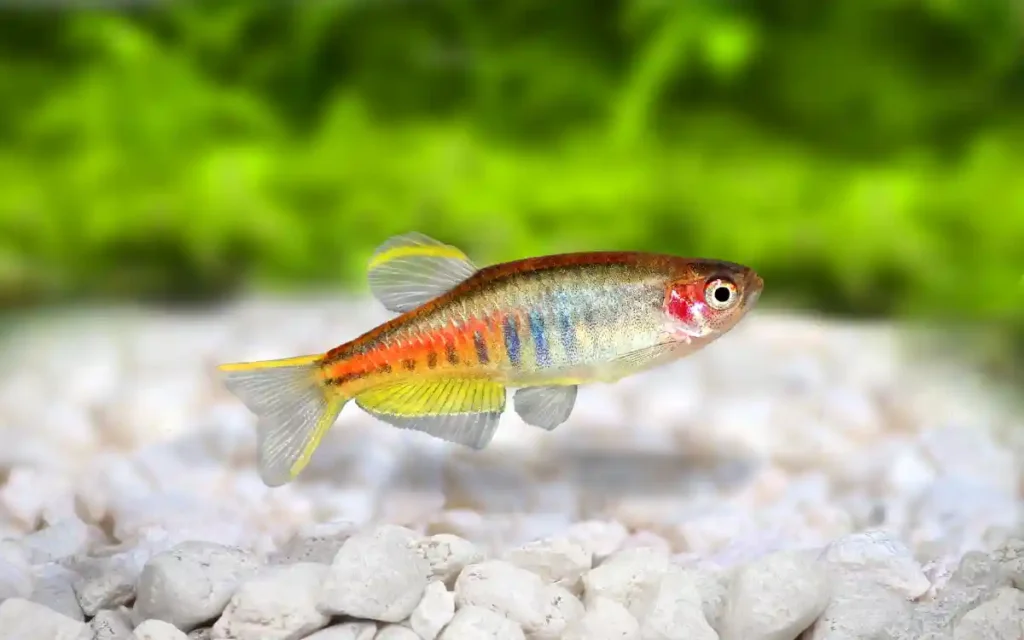
The Glowlight Danio is a natural species from Myanmar. It has an orange stripe, dark vertical markings, and yellow or orange fins.
Do not confuse it with a GloFish Danio. Glowlight danios have natural colors and are a separate species. GloFish danios are fluorescent varieties of the Zebra Danio.
Glowlight danios only reach about 1.2 inches, but they are very active. A tank around 30 inches long gives a group enough room to move.
Keep eight to ten together. Males may chase one another and develop a pecking order, but they normally leave unrelated tank mates alone.
A planted aquarium with a dark background brings out their orange color. Leave a clear area across the front or middle for swimming.
Blue Danio
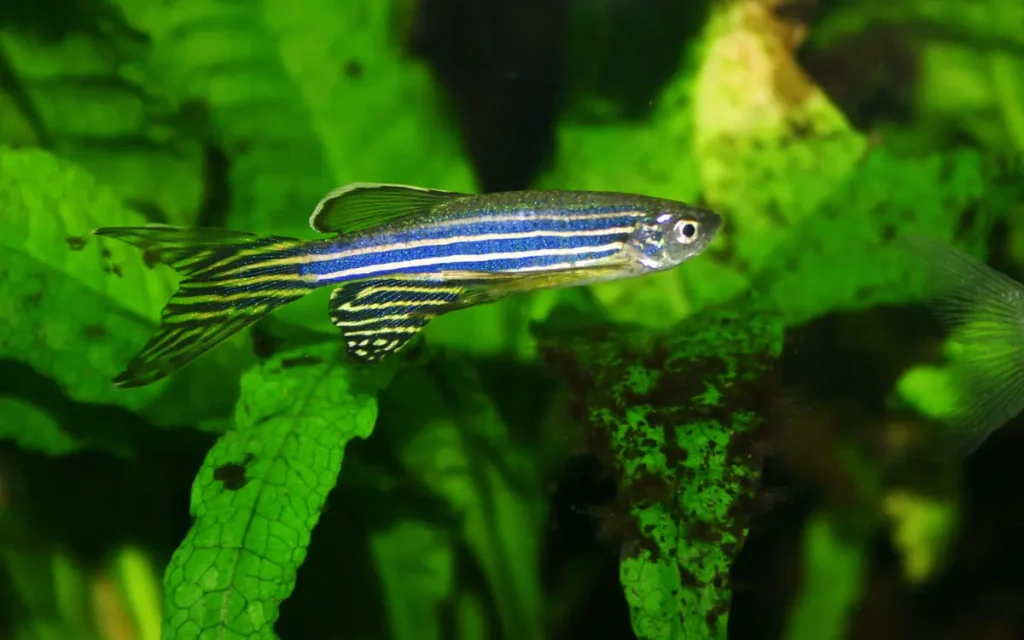
Scientific name: Danio kerri
The Blue Danio is also called Kerr’s Danio or Turquoise Danio. It has a powder-blue or blue-green body crossed by thin pinkish or golden horizontal lines.
This species grows to around 1.8 inches and needs a 20-gallon aquarium with a long swimming area. It is peaceful, active, and suitable for a community tank.
Blue danios are less common in local fish stores than Zebra or Pearl Danios. Check the scientific name when buying because shops sometimes use “blue danio” for dyed, fluorescent, or unrelated fish.
Keep at least eight. They look better and behave more naturally when they can swim with a proper group of their own species.
A darker tank background, clear water, and a varied diet help the blue coloring remain visible.
Gold Ring Danio
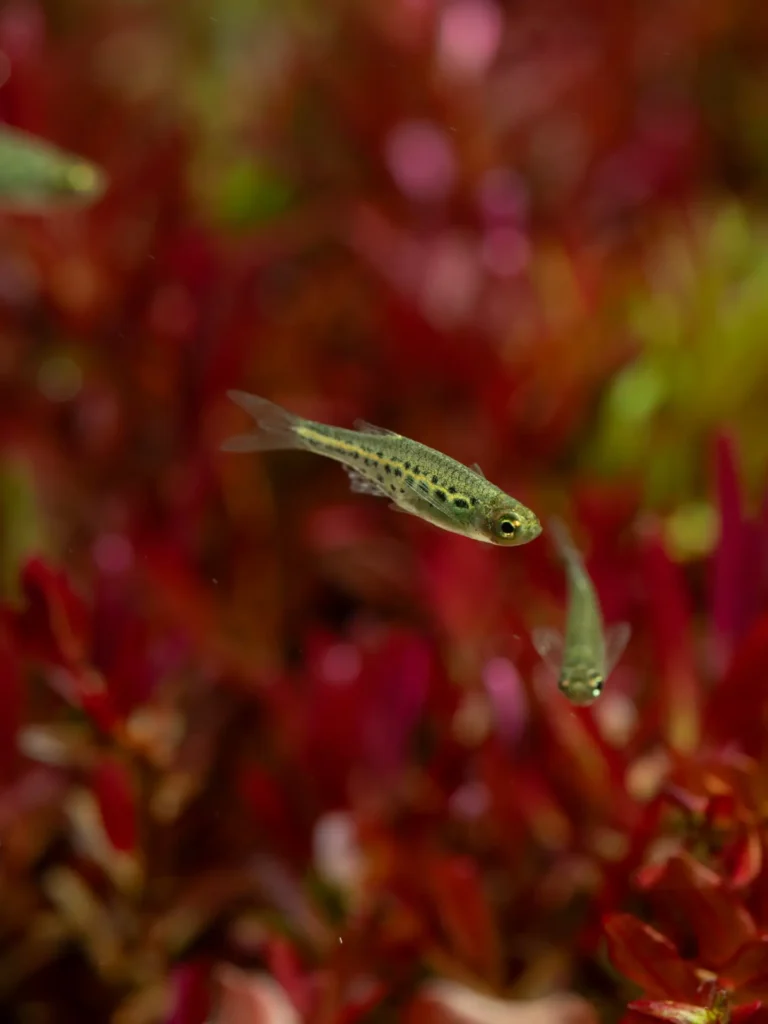
Gold Ring Danios are tiny fish covered with dark spots surrounded by golden coloring. They are sometimes sold as Burmese Spotted Danios.
Adults usually remain close to 1.2 inches. They can live in a 10 to 15-gallon tank, but the aquarium should still have a useful horizontal swimming area.
This species looks best in a planted tank with a darker substrate. It may appear pale in a bright, empty aquarium.
Keep eight to ten together. Although Gold Ring Danios are peaceful, their small size makes them a poor match for large tetras, aggressive barbs, cichlids, or any fish that may swallow them.
They come from softer water than many common Zebra Danios. Avoid sudden changes in hardness or pH when moving them into a new aquarium.
Dwarf Spotted Danio
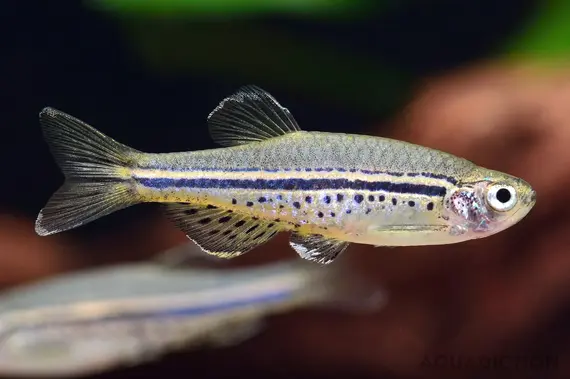
Dwarf Spotted Danios have rows of small dark spots and a faint horizontal line along the body. They resemble Leopard Danios, but they are a separate species rather than a Zebra Danio color variety.
They grow to around 1.5 inches and are calmer than standard Zebra Danios. A 15-gallon planted aquarium can house a small school, though more space makes care easier.
Keep at least eight together. Plants around the sides provide security, while an open area gives them somewhere to swim.
Choose peaceful tank mates of a similar size. Chili rasboras, small Corydoras, Ember Tetras, and other gentle nano fish may work when their water needs match.
Avoid confusing this species with the Leopard Danio. Check the scientific name before buying.
Orange Finned Danio
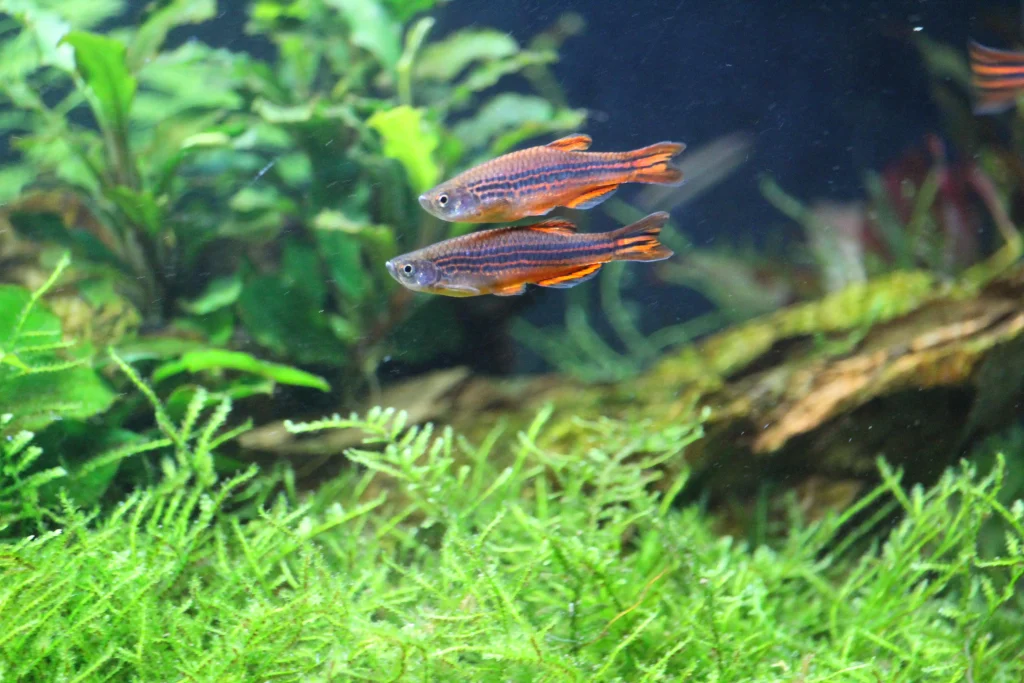
The Orange-Finned Danio has bright red-orange fins and either a striped or spotted body. Some stores sell it as the Orange-Finned Zebra Danio.
This is a separate species, not another Zebra Danio variety. It usually reaches around 1.8 inches.
Orange-Finned Danios are quick swimmers that need a 20-gallon long aquarium. Keep eight or more so they feel secure and direct most chasing toward their own group.
They look good in a stream-style aquarium with smooth stones, plants, clean water, and moderate flow. Keep a lid over every opening because they can jump.
This species may be harder to find, and similar-looking danios are sometimes sold under the same common name. Buying from a seller who provides the scientific name reduces confusion.
Celestial Pearl Danio
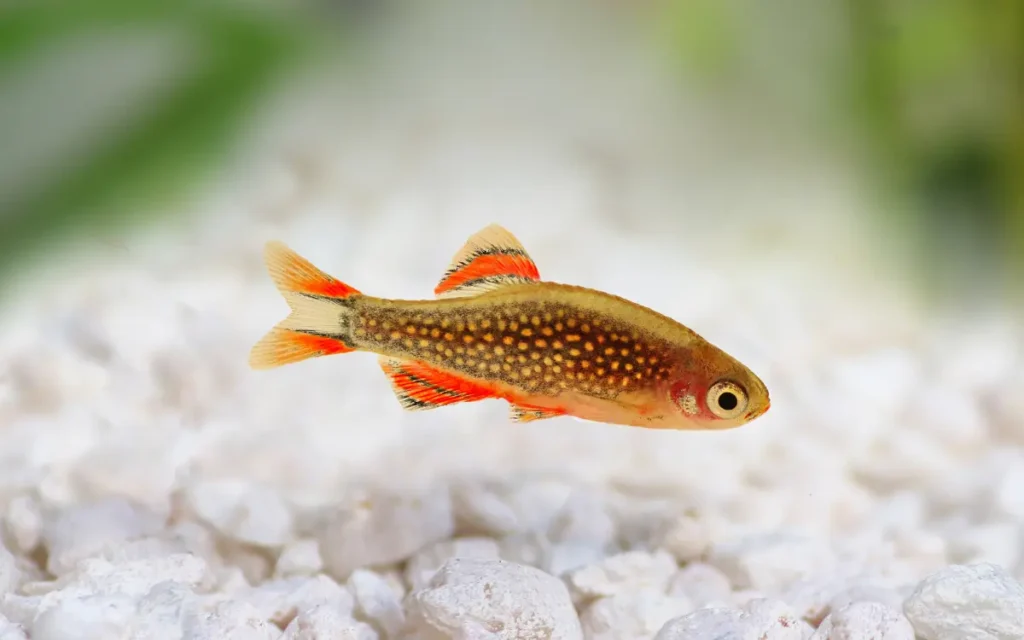
The Celestial Pearl Danio is one of the smallest and most colorful danios. Its dark blue body is covered with pale spots, while mature males develop red and black fins.
This fish behaves differently from Zebra Danios. It is shy, spends more time in the lower and middle parts of the tank, and prefers dense plant cover with gentle water movement.
A 10-gallon tank can hold a group, but 15 gallons gives males more room to avoid one another. Keep at least eight, with ten or more being better when space allows.
Dominant males may spar. Dense plants and broken lines of sight help weaker fish move away without leaving the group.
Celestial Pearl Danios should not be mixed with Giant Danios, Zebra Danios, or other fast feeders. They may hide and miss meals. Small sinking or slow-falling foods work better than large floating flakes.
Giant Danio
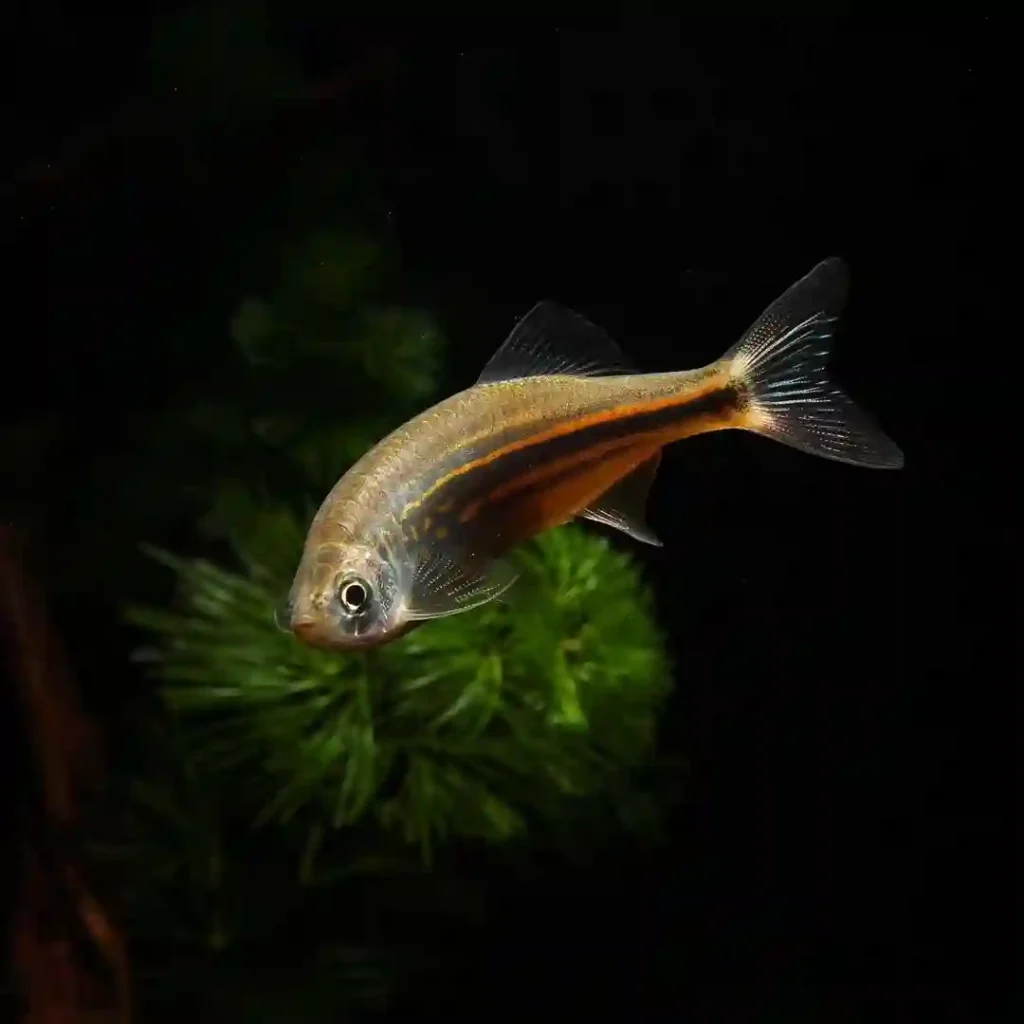
The Giant Danio is much larger and faster than the small danios commonly sold for community tanks. It has a blue-green body with yellow horizontal markings.
Adults may reach four to five inches, with some records showing even larger fish. A group needs a tank around four feet long. A 55-gallon aquarium should be treated as a starting point, not an oversized home.
Giant Danios are generally peaceful, but their speed can frighten slow or timid fish. Keep them with active, medium-sized species that cannot fit in their mouths.
They enjoy well-oxygenated water and moderate flow. Leave plenty of open swimming space and use a secure lid.
Keep at least six, though a larger group is better when the aquarium has enough room and filtration.
Malabar Danio
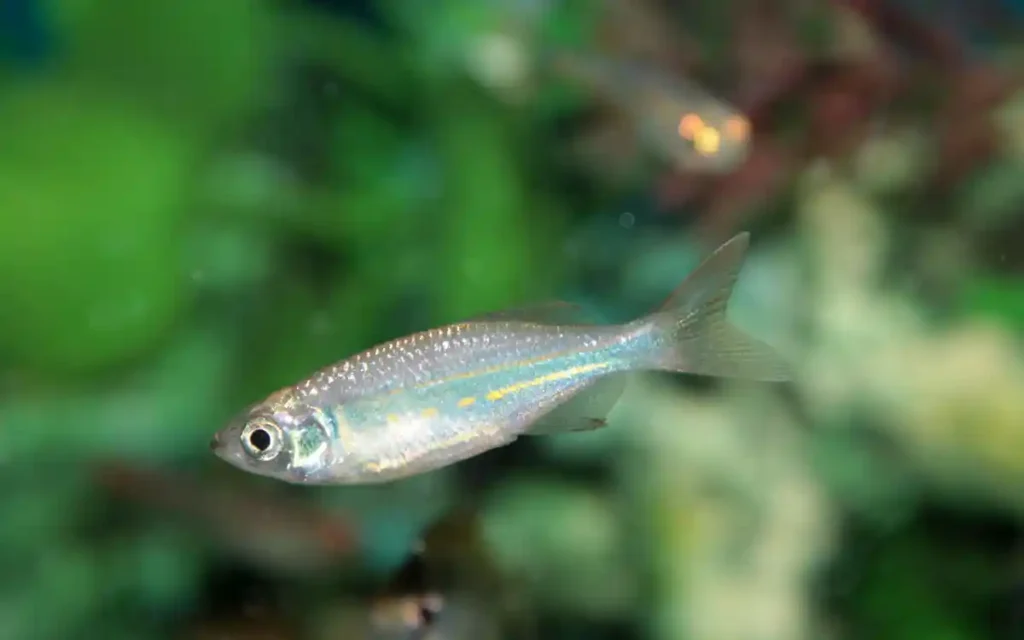
The Malabar Danio is another large species suited to long aquariums. It has a silver body crossed by blue and yellow stripes.
Malabar Danios commonly reach around three to four inches. They are slightly smaller than the largest Giant Danios, but they still need a tank close to four feet long.
A 60 to 65-gallon aquarium is a safer minimum for a proper group. Keep six or more and choose active tank mates that can handle their fast swimming and eager feeding.
This fish does well in clean, well-oxygenated water with moderate movement. Smooth rocks, wood, and hardy plants can create a natural-looking setup, but keep the center open.
Malabar and Giant Danios are often confused in the aquarium trade. Use the scientific name when checking a store label.
Popular Zebra Danio Varieties
Leopard, Longfin, Golden, and GloFish Danios are commonly called different types of danios. They look different, but they all come from the Zebra Danio species.
Leopard Danio
The Leopard Danio has dark spots instead of horizontal stripes. Its accepted aquarium classification is generally treated as a spotted form of Danio rerio.
It needs the same group size, food, swimming room, and water conditions as a standard Zebra Danio.
Longfin Leopard Danio
The Longfin Leopard Danio combines a spotted body with longer fins. It swims a little less efficiently than short-finned Zebra Danios.
Do not house it with known fin-nipping fish. Make sure it can reach food before faster tank mates eat everything.
GloFish Danio
The GloFish Danio is a fluorescent Zebra Danio. It is available in several bright colors and fluoresces strongly under blue aquarium lighting.
Its color does not change its care requirements. It still needs a school, a long swimming area, clean water, and a covered aquarium.
Golden Zebra Danio
Golden Zebra Danios have reduced dark pigment, giving them a pale gold or yellow appearance. They are not a separate species.
Standard, Golden, Leopard, Longfin, and GloFish Zebra Danios recognize each other as the same general kind of fish and can usually school together.
Can Different Types of Danios Live Together?
Some types can live in the same aquarium, but one fish from several species does not make a proper school.
For example, one Pearl Danio, one Glowlight Danio, and one Zebra Danio should not be treated as a group of three. Keep at least six to eight of each species unless you are mixing Zebra Danio varieties.
Zebra, Leopard, Golden, Longfin, and GloFish Danios can usually form one mixed group because they are all varieties of Danio rerio.
Do not mix Celestial Pearl Danios with Giant or Malabar Danios. The size, feeding speed, water movement, and behavior are too different.
Before combining fish, compare:
- Adult size
- Preferred temperature
- Swimming speed
- Group size
- Feeding behavior
- Water flow
- Aggression level
What Tank Size Do Danios Need?
Most small danios need more swimming room than their body size suggests.
A 10-gallon tank may hold Gold Ring, Dwarf Spotted, or Celestial Pearl Danios when carefully stocked. Fast species such as Zebra, Pearl, Glowlight, Blue, and Orange-Finned Danios are better in a 20-gallon long tank or larger.
Giant and Malabar Danios need aquariums close to four feet long.
If you are choosing fish for a standard aquarium, compare them with the other options in the best fish for a 20-gallon tank guide.
Tank length matters more than height. Danios swim across the aquarium rather than moving up and down in one area.
How Many Danios Should Be Kept Together?
Keep at least six danios of the same species, but eight to ten is better for most small types.
A larger group helps nervous fish feel safer. It also spreads chasing between more individuals instead of allowing one weak fish to receive all the attention.
Celestial Pearl Danios do well in groups of ten or more when the tank contains dense plants. Giant and Malabar Danios need at least six, but the aquarium must be large enough to handle the group.
Never keep one danio alone. A single fish may hide, pace along the glass, chase tank mates, or become unusually nippy.
Are Danios Aggressive?
Most danios are peaceful, but they are not calm fish. Chasing is common within the group, especially when males compete or the school forms a pecking order.
Fin nipping becomes more likely when:
- The group is too small
- The tank is too short
- There are no visual barriers
- Slow long-finned fish share the tank
- Food is limited to one small area
If one fish is constantly hiding or has damaged fins, check the group size and tank space before assuming it has a disease.
Best Tank Setup for Danios
Start with a fully cycled aquarium. Ammonia and nitrite must remain at 0 ppm, while nitrate should be kept low through regular water changes.
If the aquarium is new, follow this fish tank cycling guide before adding a full school.
Choose a long aquarium with a lid. Leave the middle and front open for swimming, then place plants around the back and sides.
Moderate filtration works for most species. Giant and Malabar Danios appreciate more oxygen and water movement. Celestial Pearl Danios need a calmer planted setup with gentle filtration.
A safe general arrangement includes:
- A filter sized for the aquarium
- A secure lid
- Open swimming room
- Plants near the sides and back
- A heater when the room temperature is unstable
- Smooth gravel or sand
- A regular light schedule
- Weekly water changes
Do not create a powerful current for every species. Smaller danios often use calmer edges of streams rather than fighting the strongest flow all day.
What Do Danios Eat?
Danios are easy to feed. Use a good flake or small pellet as the main food, then add frozen or live foods several times a week.
Good choices include:
- Daphnia
- Baby brine shrimp
- Adult brine shrimp
- Mosquito larvae
- Small bloodworms
- Crushed flakes
- Micro pellets
Feed once or twice a day. Only provide an amount the group can finish in about one or two minutes.
Use smaller food for Celestial Pearl, Gold Ring, Dwarf Spotted, and Glowlight Danios. Large flakes may remain at the surface while shy fish go hungry lower in the tank.
Best Tank Mates for Danios
The best tank mates are peaceful fish that share the same temperature range and can handle the danios’ activity.
Possible tank mates for small, active danios include:
- Peaceful barbs
- Active tetras
- White Cloud Mountain Minnows
- Platies
- Corydoras
- Small loaches
- Peaceful rainbowfish
Celestial Pearl Danios need smaller and calmer companions. Giant and Malabar Danios need stronger, medium-sized community fish.
Avoid combining fast Zebra or Giant Danios with fancy guppies, slow bettas, or other fish with long fins. Constant movement and food competition can cause stress even when no direct attack occurs.
Use the community fish guide to compare more peaceful freshwater species.
Common Mistakes When Keeping Danios
Choosing a Tank Based Only on Fish Length
A two-inch Zebra Danio still needs a long tank because it spends much of the day swimming.
Keeping Only Two or Three
Small groups often produce more chasing and fin damage. Start with a proper school.
Mixing Fast and Shy Species
Celestial Pearl Danios cannot compete well with Giant or Zebra Danios. Match fish by behavior, not only by name.
Leaving the Tank Uncovered
Danios can jump through small openings around filters, cables, and feeding gaps.
Counting Every Variety as a Separate Species
Leopard, Longfin, Golden, and GloFish Danios are Zebra Danio varieties. Their colors and fins differ, but their basic care is the same.
Using the Same Temperature for Every Danio
The word “danio” covers fish from different habitats. Check the temperature range of the exact species before buying it.
Which Danio Should You Choose?
Choose Zebra Danios if you are a beginner with a 20-gallon long aquarium. They are affordable, hardy, and easy to feed.
Choose Glowlight or Blue Danios if you want a small, active school with natural color. Gold Ring and Dwarf Spotted Danios work better for smaller planted tanks.
Choose Celestial Pearl Danios for a calm, heavily planted aquarium. They are beautiful, but they are not the best choice for a busy community tank.
Choose Giant or Malabar Danios only when you have a long aquarium of at least 55 to 65 gallons.
Do not buy a mixed collection of single danios. Pick one suitable species, build a proper group, and give it enough horizontal swimming space.
Frequently Asked Questions
Are danios good for beginners?
Zebra, Pearl, and Blue Danios are good beginner fish. Celestial Pearl Danios need more careful tank mate and feeding choices, while Giant Danios require a large aquarium.
Can danios live in a 10-gallon tank?
Small species such as Gold Ring and Celestial Pearl Danios may live in a well-planned 10-gallon tank. Zebra Danios are too active for this size and should have a 20-gallon long tank.
Do danios need a heater?
A heater may not be necessary when the room stays within the chosen species’ temperature range. Use one when the water temperature drops or changes sharply between day and night.
Can Zebra and Leopard Danios school together?
Yes. Leopard Danios are a spotted variety of the Zebra Danio and can normally join the same school.
Can GloFish Danios live with regular Zebra Danios?
Yes. GloFish Danios have the same basic care and social needs as regular Zebra Danios.
Do danios need strong water flow?
Many active danios enjoy moderate flow and well-oxygenated water. Celestial Pearl Danios prefer gentler filtration with dense plants.
How long do danios live?
Many small danios live for around three to five years with clean water and proper care. Lifespan varies by species, genetics, diet, and aquarium conditions.
Why are my danios chasing each other?
Danios chase during courtship and while forming a pecking order. Constant attacks, torn fins, or one fish hiding may point to a small group, limited swimming space, or poor tank mate choices.
Are Roseline Sharks a type of danio?
No. Roseline Sharks are also called Denison Barbs and belong to a different genus. They should not be included in a list of danio species.
