
35 Best Community Fish for a Peaceful Freshwater Tank

A community tank can look peaceful in the fish store and become stressful within a week. The problem is often poor matching. Even peaceful fish can need different temperatures, water hardness, group sizes, and swimming space.
If you are choosing community fish for the first time, start with species that suit your aquarium. Guppies and platies prefer harder water. Cardinal and rummynose tetras do better in softer water. White cloud minnows like cooler conditions, while German blue rams need much warmer water. They may all be peaceful, but they do not belong in the same tank.
This guide covers 35 of the best community fish for freshwater aquariums. Each profile includes adult size, tank size, temperature, pH, group size, suitable tank mates, and fish to avoid. Use these details to build one compatible community instead of buying attractive fish and hoping they get along.
Guppy
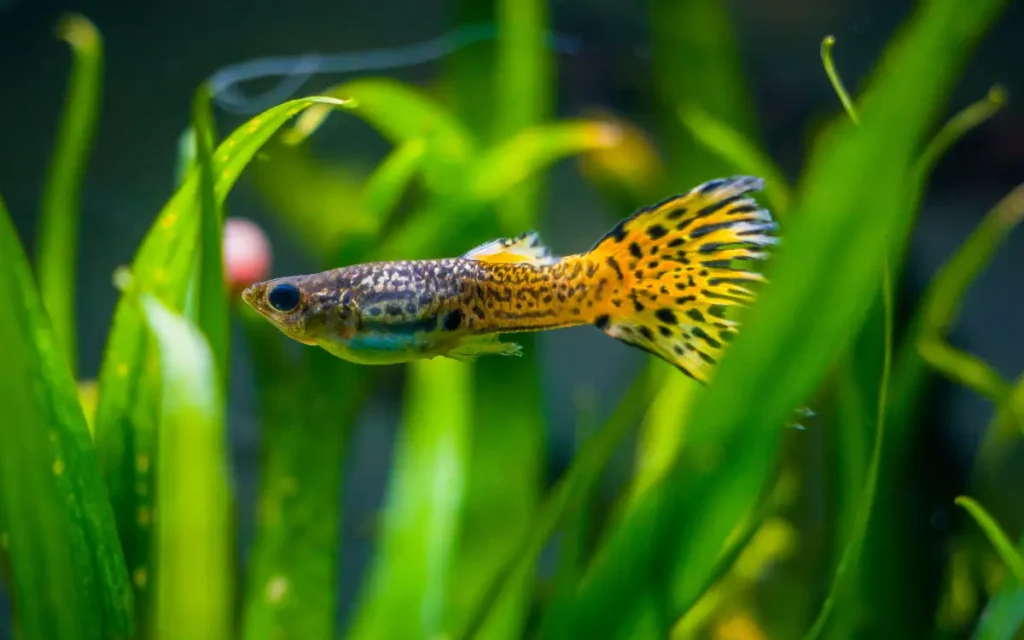
Guppies are one of the best community fish for beginners, especially when your tap water is naturally hard and slightly alkaline. They are colorful, active, easy to feed, and spend most of their time near the top and middle of the aquarium.
I recommend at least a 20-gallon tank when adding guppies to a mixed community. Although they can live in a 10-gallon aquarium, the larger tank gives them more swimming room and helps prevent overcrowding.
Male guppies have bright colors and long tails. These fins can attract unwanted attention from tiger barbs, serpae tetras, and other fin-nipping fish. Keep them with calm species that will not chase or bite them.
You can keep an all-male group if you do not want baby fish. When keeping both sexes, use one male for every two or three females. Guppies breed quickly, so a few adults can produce many fry within several months.
Quick care
- Adult size: Males 1.5 to 2 inches; females 2 to 2.5 inches
- Community tank size: 20 gallons or larger
- Temperature: 72°F to 82°F
- pH: 7.0 to 8.2
- Water preference: Moderately hard to hard
- Tank level: Top to middle
- Care level: Beginner
- Temperament: Peaceful and active
- Group: Five or more males, or one male for every two to three females
Best tank mates: Platies, Mollies, Swordtails, peaceful Corydoras, Bristlenose Plecos, and other fish that accept harder water.
Avoid: Fin nippers, large predatory fish, aggressive Bettas, and soft-water species that require a much lower pH.
Guppies are easy community fish only when their water needs match the rest of the tank. Before mixing them with other species, check this complete Guppy care guide and compare the safest Guppy tank mates.
Platy
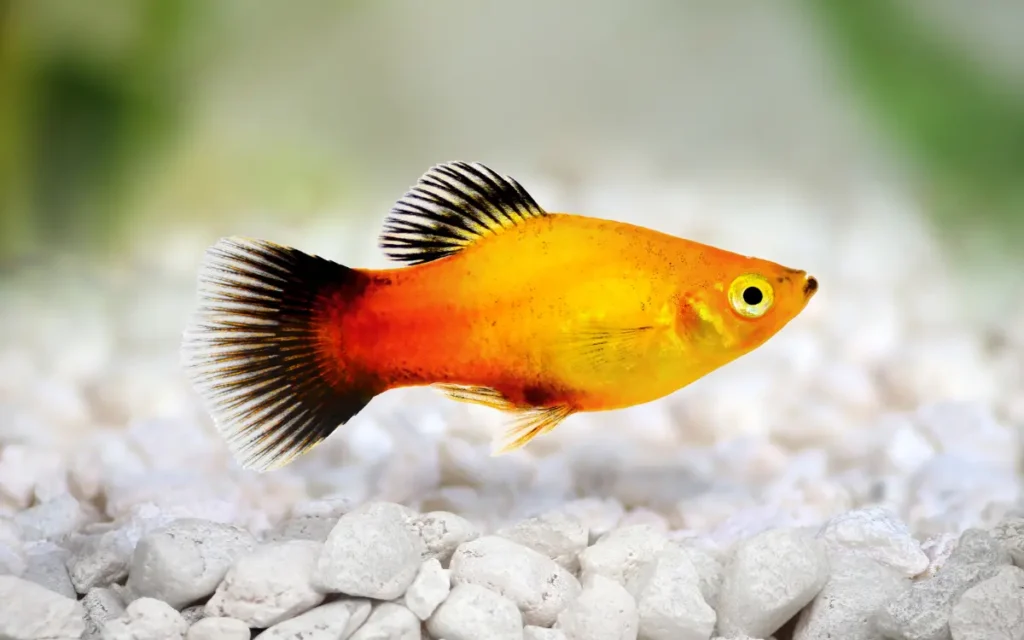
Platies are colorful, active, and forgiving of small beginner mistakes. They do best in mineral-rich water and are a strong choice for community tanks with other peaceful livebearers.
Like guppies, platies breed easily. Keep only females if you do not want fry. If keeping both sexes, provide at least two or three females for every male so one female is not chased constantly.
Quick care
- Adult size: 2-3 inches
- Community tank size: 20 gallons or larger
- Temperature: 70-78°F
- pH: 7.0-8.2
- Water preference: Moderately hard to hard
- Tank level: Middle and upper levels
- Care level: Beginner
- Temperament: Peaceful and active
- Group: All females or one male with two to three females
Best tank mates: Guppies, swordtails, mollies, bronze corydoras, and bristlenose plecos.
Avoid: Aggressive fish, persistent fin nippers, and species that require very soft acidic water.
Learn more in the complete Platy Care Guide.
Zebra Danio
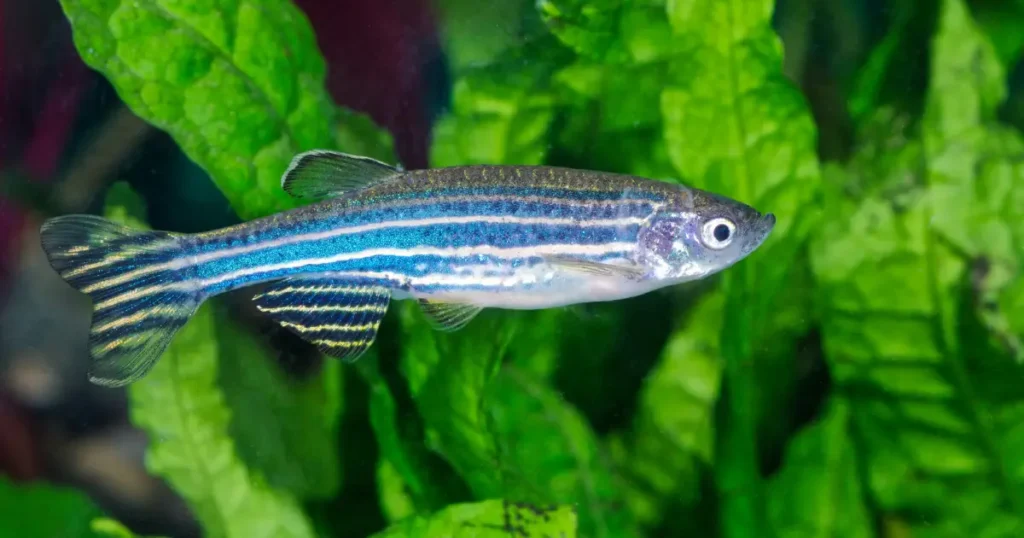
Zebra danios are energetic schooling fish that spend most of their time racing around the upper half of the aquarium. Their speed, hardiness, and strong appetite make them suitable for beginners.
Keep at least eight together. A larger group spreads out chasing and helps prevent one fish from becoming the target. A long tank is better than a tall tank because zebra danios need open swimming space.
Quick care
- Adult size: About 2 inches
- Community tank size: 20-gallon long or larger
- Temperature: 64-77°F
- pH: 6.0-8.0
- Water preference: Moderate to hard
- Tank level: Middle and upper levels
- Care level: Beginner
- Temperament: Peaceful but very active
- Group: Eight or more
Best tank mates: White cloud mountain minnows, cherry barbs, bronze corydoras, and other active fish that enjoy similar temperatures.
Avoid: Bettas, fancy guppies, slow long-finned fish, and warm-water species.
See the full Zebra Danio Care Guide.
Bronze Corydoras
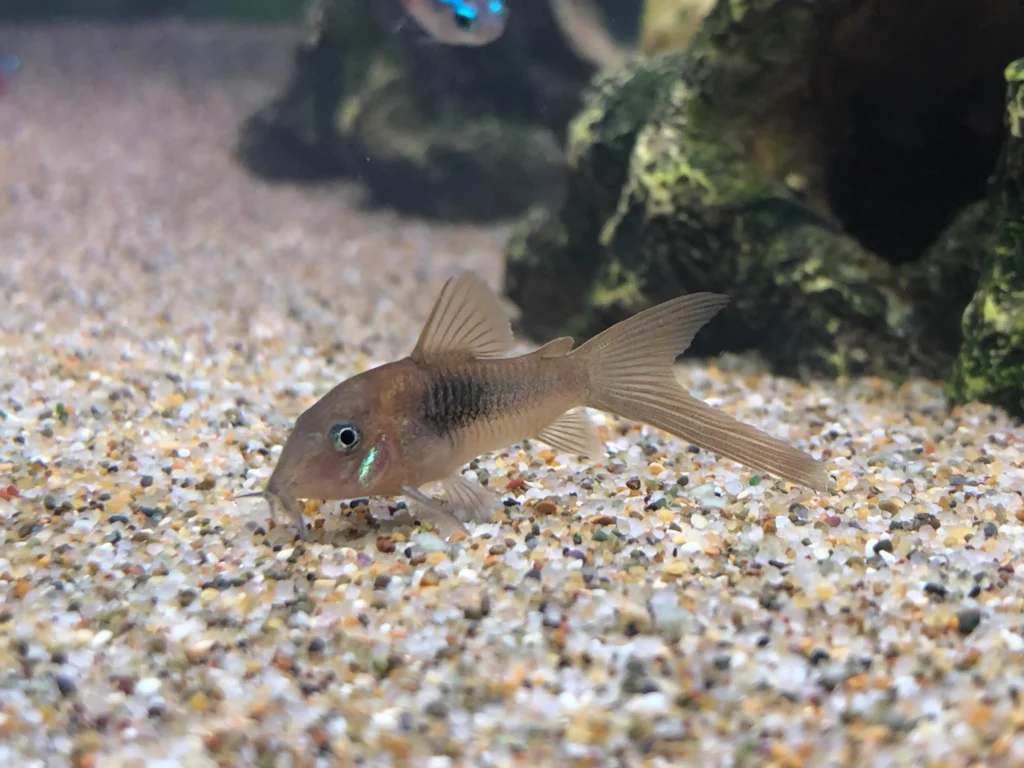
Bronze corydoras are peaceful bottom dwellers with a friendly, busy personality. They search the substrate for food but should never be expected to survive on leftovers alone.
Provide sinking pellets, wafers, and frozen foods. Sand or smooth fine gravel protects their sensitive barbels. Keep at least six because lone corydoras often become nervous and inactive.
Quick care
- Adult size: 2.5-3 inches
- Community tank size: 20 gallons or larger
- Temperature: 72-79°F
- pH: 6.0-8.0
- Water preference: Soft to moderately hard
- Tank level: Bottom
- Care level: Beginner
- Temperament: Very peaceful
- Group: Six or more
Best tank mates: Platies, peaceful tetras, rasboras, honey gouramis, and other small corydoras.
Avoid: Aggressive bottom dwellers, sharp gravel, and fish large enough to swallow them.
Read the complete Bronze Cory Care Guide.
Neon Tetra
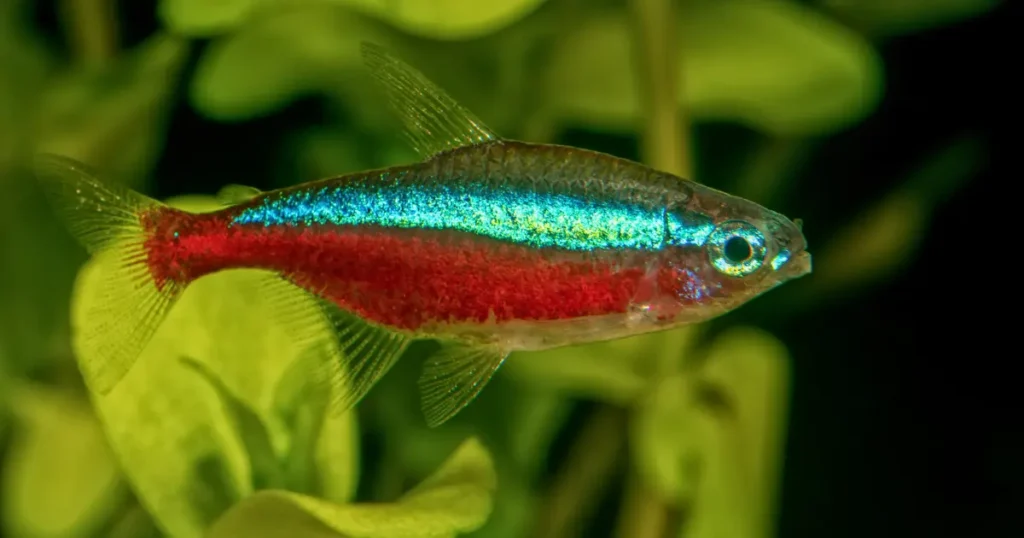
Neon tetras add a bright blue and red line of color to a planted community aquarium. They feel safer and display better schooling behavior when kept in a group of at least eight.
Although commonly sold as beginner fish, neons should enter a fully cycled aquarium. Choose fish with straight bodies, clear colors, and full bellies. Avoid individuals that appear pale, thin, bent, or separated from the school.
Quick care
- Adult size: About 1.5 inches
- Community tank size: 15-20 gallons or larger
- Temperature: 70-77°F
- pH: 5.0-7.5
- Water preference: Soft to moderately hard
- Tank level: Middle
- Care level: Beginner in a stable tank
- Temperament: Peaceful
- Group: Eight to ten or more
Best tank mates: Harlequin rasboras, honey gouramis, small corydoras, and kuhli loaches.
Avoid: Large fish, aggressive species, very warm tanks, and hard-water livebearer setups.
Learn how to keep them healthy in the Neon Tetra Care Guide.
Harlequin Rasbora
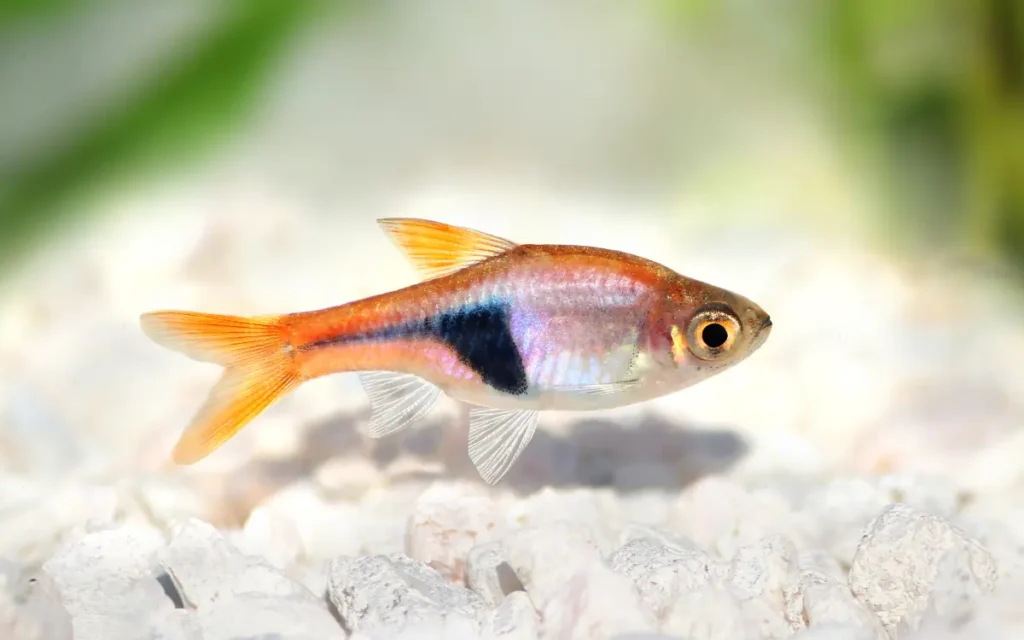
Harlequin rasboras are dependable community fish with copper-colored bodies and distinctive black markings. They school closely, eat readily, and usually ignore their tank mates.
Keep at least eight, although ten or more creates a more confident and attractive school. Plants around the sides provide shelter while an open middle area gives them room to swim.
Quick care
- Adult size: 1.75-2 inches
- Community tank size: 20 gallons or larger
- Temperature: 72-80°F
- pH: 5.5-7.5
- Water preference: Soft to moderately hard
- Tank level: Middle
- Care level: Beginner
- Temperament: Peaceful
- Group: Eight to ten or more
Best tank mates: Honey gouramis, peaceful tetras, corydoras, kuhli loaches, and small plecos.
Avoid: Large predators, aggressive barbs, and fish that need hard alkaline water.
Find feeding, water, and tank setup advice in the Harlequin Rasbora Care Guide.
Panda Corydoras
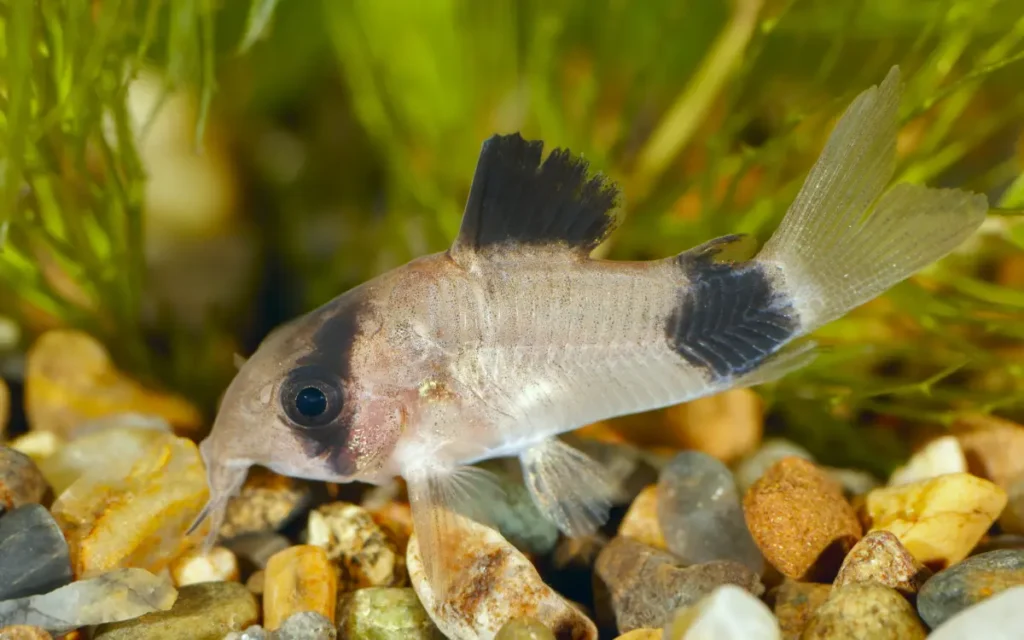
Panda corydoras have bold black-and-white markings and a playful social nature. They prefer slightly cooler water than many tropical bottom dwellers, so temperature should be checked before choosing tank mates.
Use sand or smooth gravel and keep the water well oxygenated. Feed sinking food after faster fish have eaten so the pandas receive a full meal.
Quick care
- Adult size: About 2 inches
- Community tank size: 20-gallon long or larger
- Temperature: 68-77°F
- pH: 6.0-7.5
- Water preference: Soft to moderately hard
- Tank level: Bottom
- Care level: Beginner to intermediate
- Temperament: Very peaceful
- Group: Six to eight or more
Best tank mates: Neon tetras, white cloud mountain minnows, small rasboras, and other peaceful corydoras.
Avoid: German blue rams, very warm aquariums, aggressive bottom fish, and sharp substrate.
Read the Panda Cory Care Guide before planning their tank.
Ember Tetra
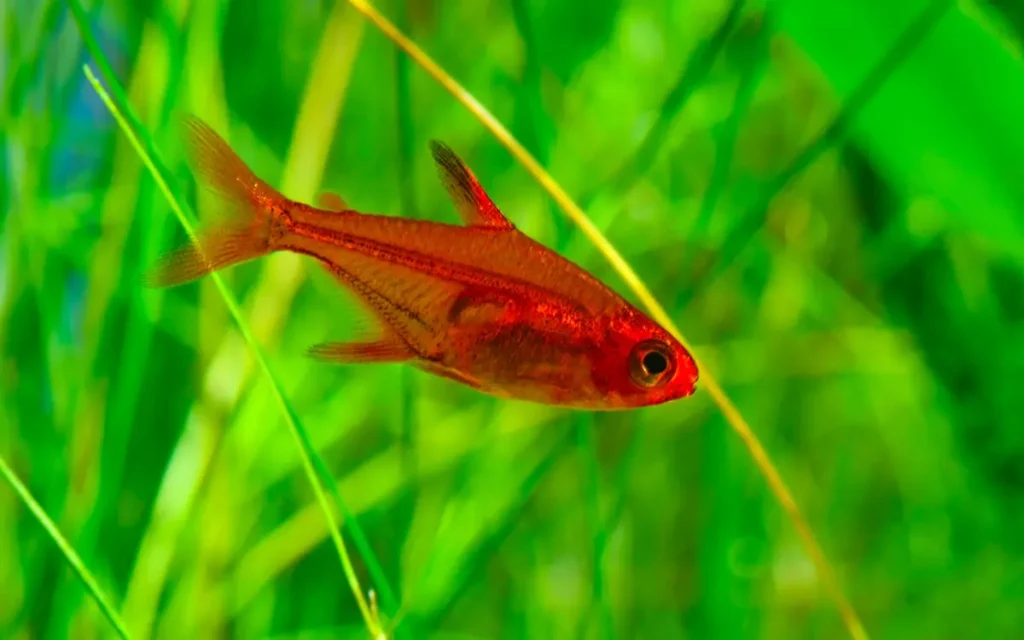
Ember tetras are tiny orange fish that look especially attractive against green plants and dark substrate. Their small size makes them suitable for compact aquariums, but it also means they can be frightened by larger or faster fish.
A group of ten or more helps them feel secure. Feed crushed flakes, micro pellets, baby brine shrimp, and other foods small enough to fit their mouths.
Quick care
- Adult size: About 0.8 inch
- Community tank size: 10 gallons or larger
- Temperature: 72-82°F
- pH: 5.5-7.5
- Water preference: Soft to moderately hard
- Tank level: Middle
- Care level: Beginner in a stable tank
- Temperament: Gentle and peaceful
- Group: Ten or more
Best tank mates: Pygmy corydoras, chili rasboras, sparkling gouramis, otocinclus, and peaceful shrimp.
Avoid: Large fish, fast feeders, strong currents, and aggressive tank mates.
The Ember Tetra Care Guide explains how to feed and house this tiny species.
Cardinal Tetra
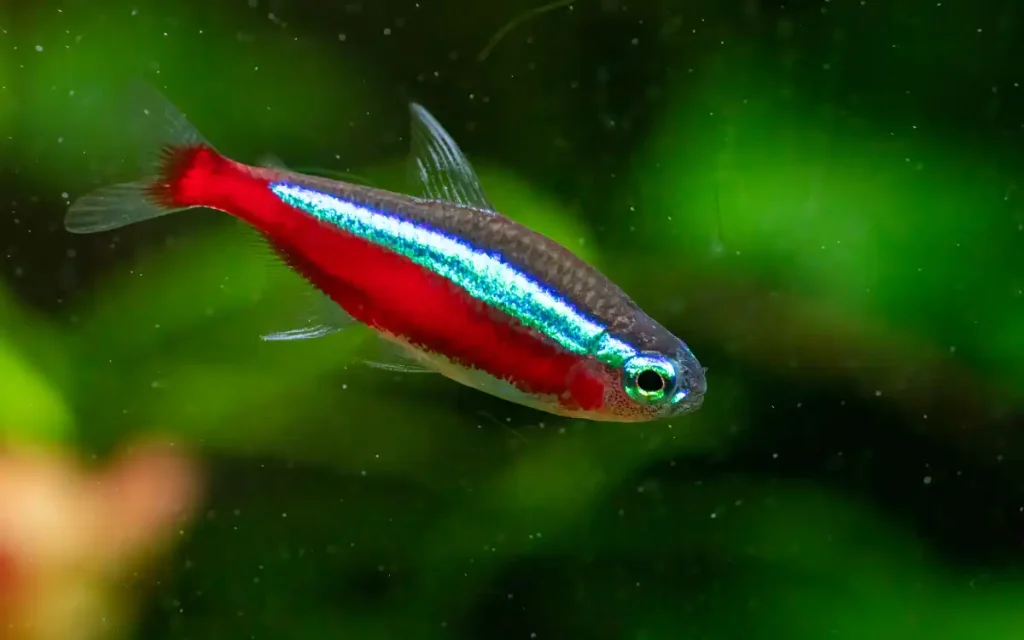
Cardinal tetras resemble neon tetras, but their red stripe extends almost the full length of the body. They prefer warmer, softer water and look best in a large school inside a mature planted aquarium.
Cardinals can react poorly to sudden changes in temperature or water chemistry. Acclimate them carefully and keep nitrates under control with regular partial water changes.
Quick care
- Adult size: 1.5-2 inches
- Community tank size: 15-20 gallons or larger
- Temperature: 73-84°F
- pH: 5.0-7.5
- Water preference: Soft
- Tank level: Middle
- Care level: Intermediate
- Temperament: Peaceful
- Group: Ten or more
Best tank mates: Rummynose tetras, peaceful warm-water corydoras, German blue rams, and other gentle soft-water fish.
Avoid: Cool-water danios, hard-water livebearers, aggressive fish, and new uncycled aquariums.
See the Cardinal Tetra Care Guide for a complete setup.
Rummynose Tetra
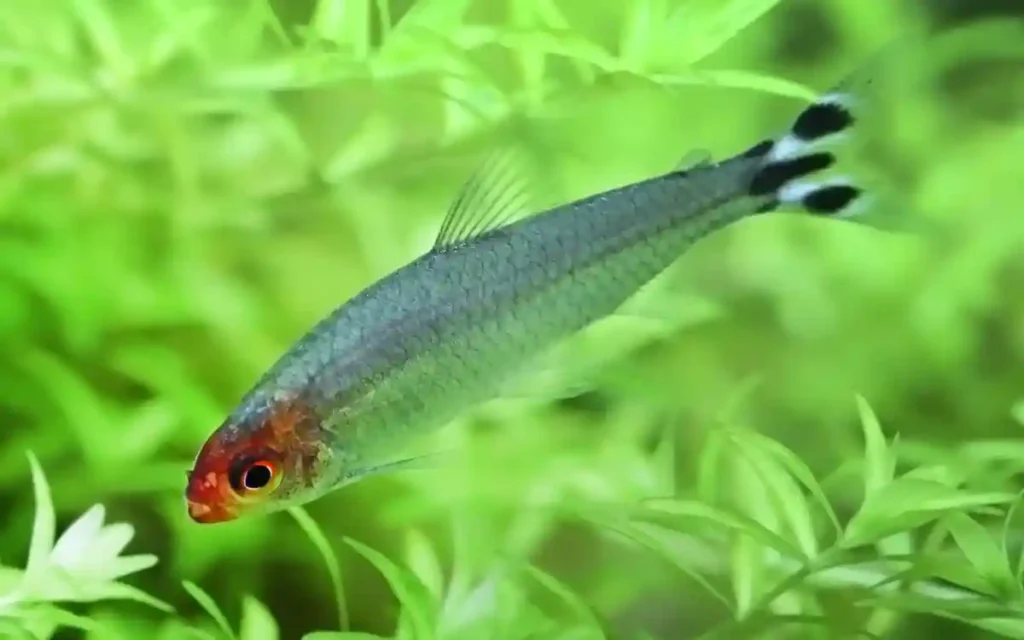
Rummynose tetras are known for their bright red faces and tightly coordinated swimming. Several similar species are sold under the same common name, but their basic care is comparable.
These fish need clean, stable water. A faded red nose can be an early warning of stress, although lighting and recent transport can also affect their color. Keep at least ten in a long tank with room to school.
Quick care
- Adult size: About 2 inches
- Community tank size: 20-gallon long or larger
- Temperature: 75-82°F
- pH: 5.0-7.0
- Water preference: Soft
- Tank level: Middle
- Care level: Intermediate
- Temperament: Peaceful and active
- Group: Ten or more
Best tank mates: Cardinal tetras, peaceful warm-water corydoras, German blue rams, and small soft-water catfish.
Avoid: New tanks, hard alkaline water, aggressive fish, and species that prefer cool water.
Use the Rummy Nose Tetra Care Guide to plan their aquarium.
Celestial Pearl Danio
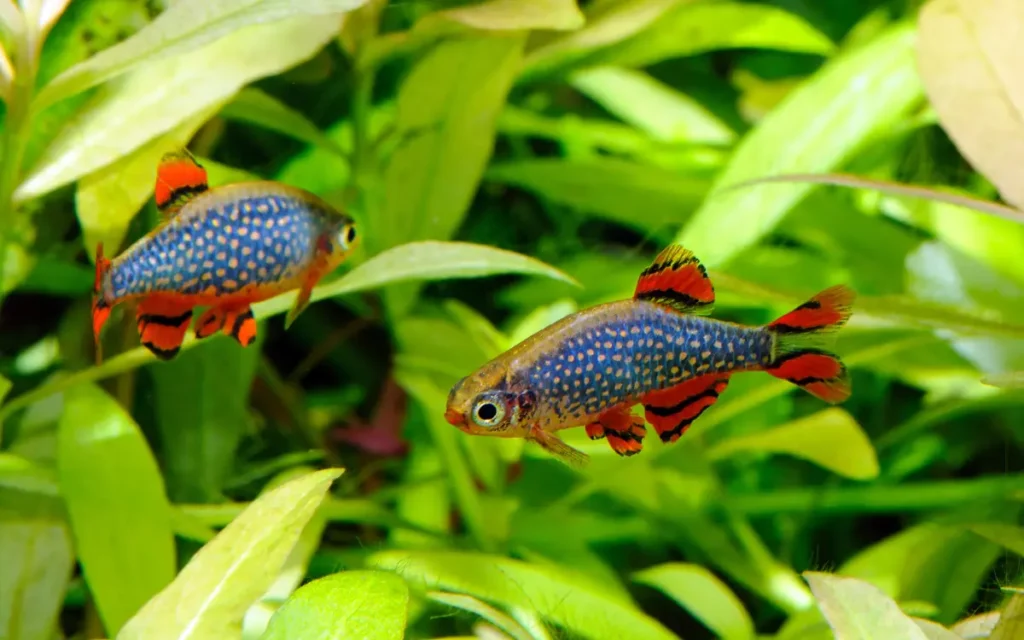
Celestial pearl danios are tiny spotted fish with red fins and a shy personality. They spend more time exploring plants than racing through open water like zebra danios.
Keep them in a densely planted aquarium with gentle flow. Males may display and chase one another, but serious problems are less likely when the group has enough females, plants, and hiding places.
Quick care
- Adult size: 0.8-1 inch
- Community tank size: 10-15 gallons or larger
- Temperature: 68-79°F
- pH: 6.5-7.5
- Water preference: Moderately soft to moderately hard
- Tank level: Middle and lower levels
- Care level: Beginner to intermediate
- Temperament: Peaceful but shy
- Group: Ten or more
Best tank mates: Pygmy corydoras, small rasboras, ember tetras, peaceful shrimp, and snails.
Avoid: Zebra danios, large fish, aggressive species, and fast feeders that take all the food.
Read the complete Celestial Pearl Danio Guide.
Honey Gourami
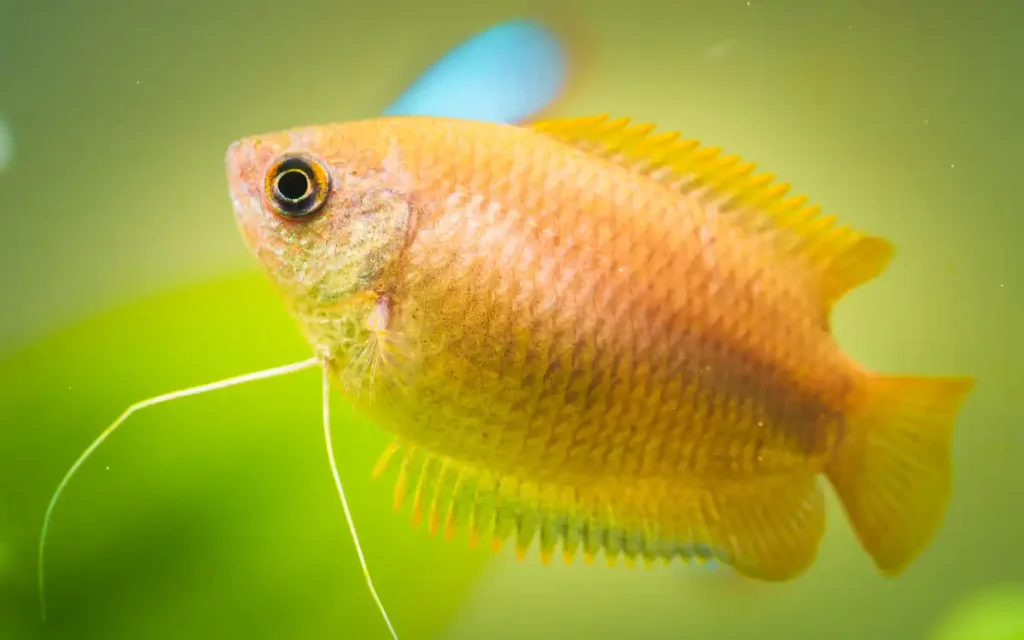
Honey gouramis are among the gentlest gouramis available. Their calm behavior and warm yellow coloring make them a good centerpiece for a quiet community aquarium.
Provide floating plants, sheltered areas, and gentle water movement. One honey gourami can live comfortably alone. In larger planted tanks, one male may be kept with two females if each fish has room to retreat.
Quick care
- Adult size: 2-2.5 inches
- Community tank size: 20 gallons or larger
- Temperature: 72-82°F
- pH: 6.0-7.5
- Water preference: Soft to moderately hard
- Tank level: Middle and upper levels
- Care level: Beginner
- Temperament: Peaceful and sometimes shy
- Group: One fish or a carefully planned group
Best tank mates: Harlequin rasboras, ember tetras, corydoras, kuhli loaches, and peaceful small catfish.
Avoid: Fin nippers, aggressive gouramis, bettas, and boisterous fish that dominate feeding time.
See the Honey Gourami Care Guide for setup and feeding advice.
Kuhli Loach
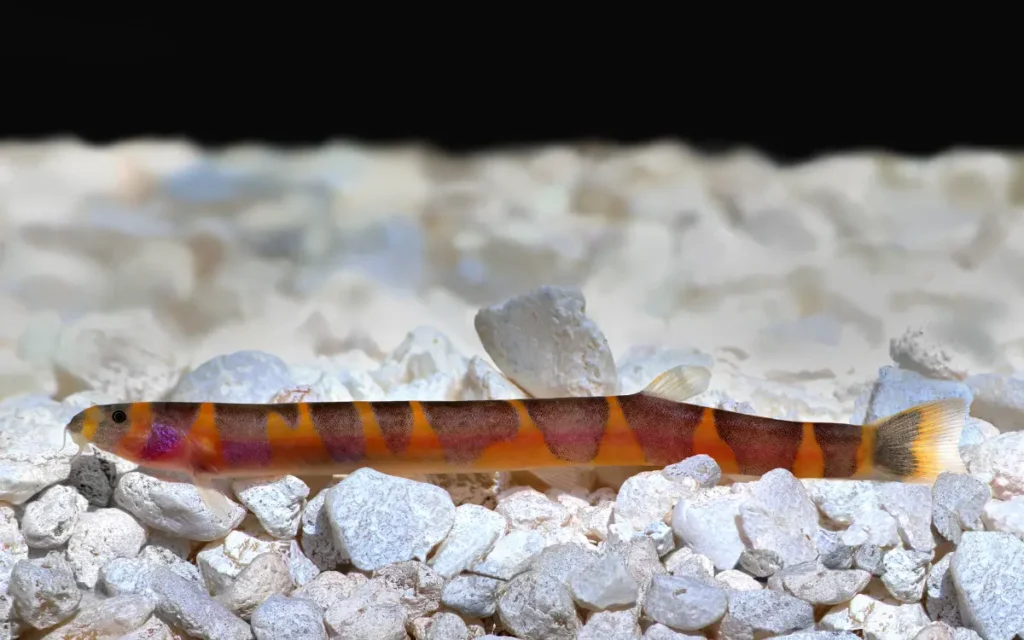
Kuhli loaches are slender nocturnal fish that hide under wood and plants during the day. When kept in a proper group, they become more confident and may appear regularly at feeding time.
Use fine sand, smooth decorations, and several tight hiding places. Cover filter openings and close every gap around the lid because kuhli loaches can squeeze into surprisingly small spaces.
Quick care
- Adult size: 3-4 inches
- Community tank size: 20-gallon long or larger
- Temperature: 75-82°F
- pH: 5.5-7.0
- Water preference: Soft
- Tank level: Bottom
- Care level: Beginner to intermediate
- Temperament: Very peaceful
- Group: Six or more
Best tank mates: Harlequin rasboras, peaceful tetras, honey gouramis, and small peaceful catfish.
Avoid: Aggressive bottom dwellers, sharp gravel, uncovered filter intakes, and fish that require hard alkaline water.
The Kuhli Loach Care Guide covers hiding places, feeding, and tank safety.
Otocinclus Catfish
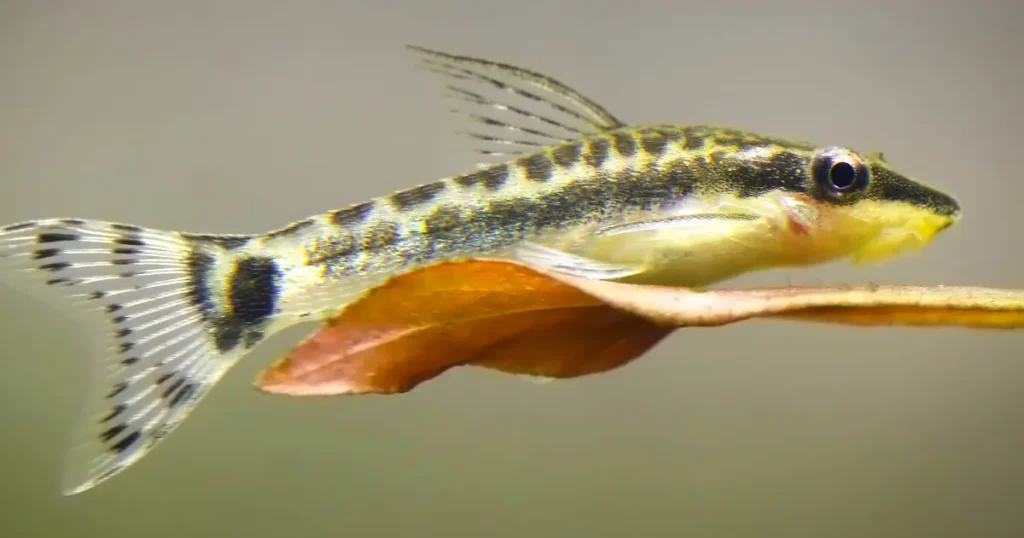
Otocinclus are small algae-grazing catfish, but they are not suitable for a newly established aquarium. They need a mature tank containing natural biofilm, algae, plants, and stable water.
Many newly purchased otocinclus arrive thin and stressed. Choose active fish with rounded bellies. Offer algae wafers, softened vegetables, gel food, and other suitable foods instead of expecting tank algae to feed them forever.
Quick care
- Adult size: 1.5-2 inches
- Community tank size: 20-gallon mature aquarium
- Temperature: 72-79°F
- pH: 6.0-7.5
- Water preference: Soft to moderately hard
- Tank level: Bottom, plants, glass, and decorations
- Care level: Intermediate
- Temperament: Very peaceful
- Group: Six or more
Best tank mates: Ember tetras, small rasboras, pygmy corydoras, peaceful shrimp, and gentle gouramis.
Avoid: New tanks, aggressive fish, large cichlids, and aquariums without enough food.
Read the Otocinclus Catfish Care Guide before bringing a group home.
Molly
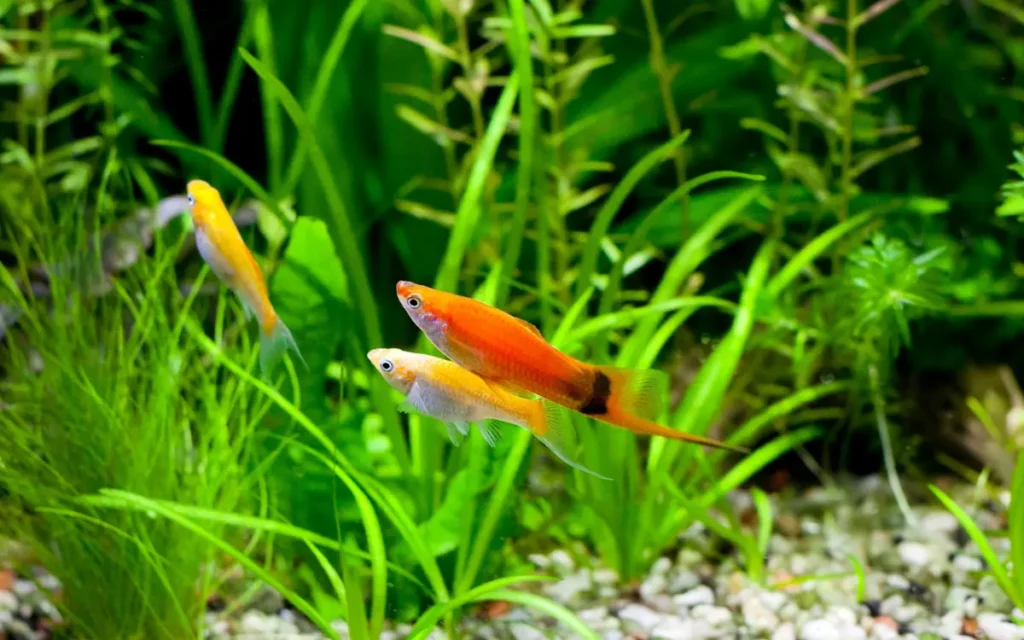
Mollies are active livebearers that prefer warm, mineral-rich water. Depending on the variety, adults may become much larger and produce more waste than beginners expect.
Freshwater mollies do not automatically need aquarium salt. Stable hard water with enough calcium and magnesium is more important. Keep one male with at least three females, or choose an all-female group if you want less chasing.
Quick care
- Adult size: 3-5 inches, depending on variety
- Community tank size: 29-30 gallons or larger
- Temperature: 74-82°F
- pH: 7.2-8.5
- Water preference: Hard and mineral-rich
- Tank level: Middle and upper levels
- Care level: Beginner to intermediate
- Temperament: Peaceful but active
- Group: One male with three females or an all-female group
Best tank mates: Platies, swordtails, guppies, and peaceful fish that enjoy hard water.
Avoid: Soft-water tetras, timid fish, cramped tanks, and mixing males and females unless you are prepared for fry.
See the complete Molly Fish Care Guide.
Swordtail
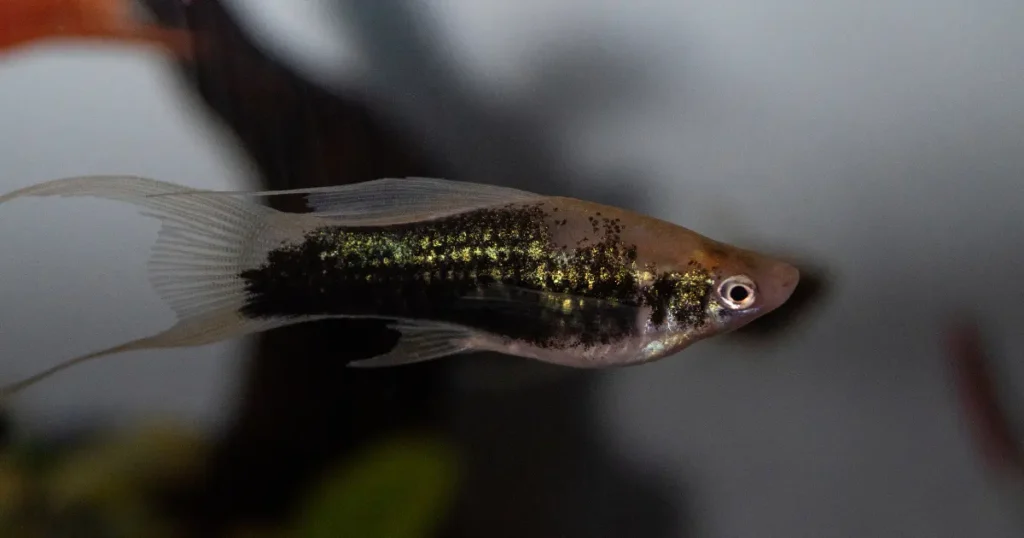
Swordtails are active livebearers named for the long lower tail extension seen on mature males. They need more swimming room than platies or guppies and may jump when startled.
Males can chase females and challenge other males. A group with one male and at least three females usually works better than a pair. A secure lid and long swimming area are essential.
Quick care
- Adult size: 4-5 inches, including the male’s sword
- Community tank size: 29-30 gallons or larger
- Temperature: 72-82°F
- pH: 7.0-8.3
- Water preference: Moderately hard to hard
- Tank level: Middle and upper levels
- Care level: Beginner
- Temperament: Peaceful but active
- Group: One male with three females or an all-female group
Best tank mates: Platies, mollies, bronze corydoras, bristlenose plecos, and other robust community fish.
Avoid: Tiny shy fish, slow long-finned species, small tanks, and several males without enough space.
Read the Swordtail Fish Care Guide for group and breeding advice.
Dwarf Gourami
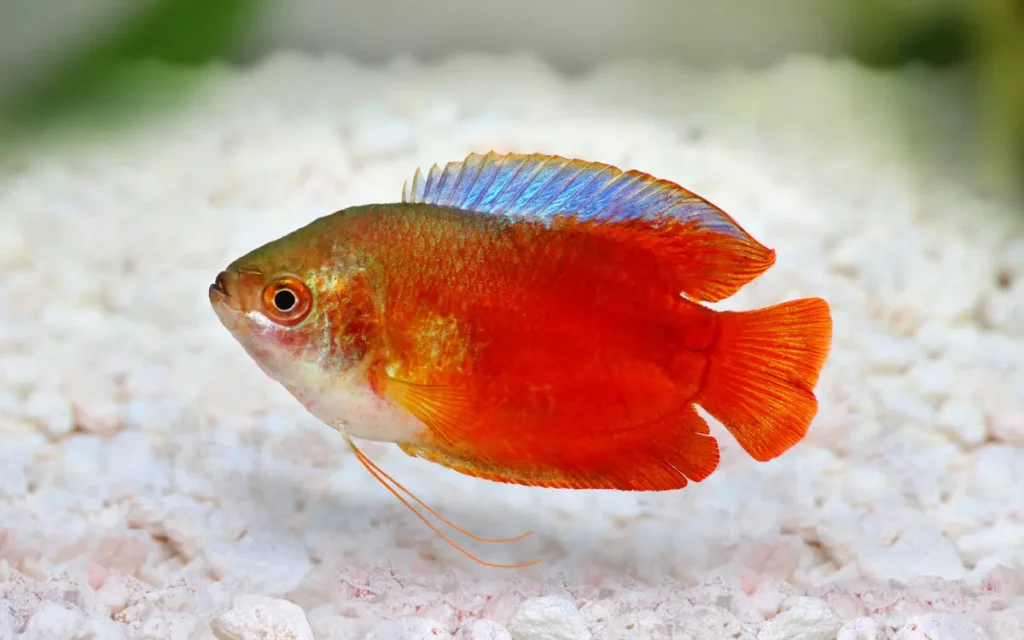
Dwarf gouramis are colorful centerpiece fish, but they are not as dependable as honey gouramis. Males can become territorial, and poorly bred stock may arrive with health problems.
Choose an alert fish with clear eyes, smooth scales, and normal breathing. Keep one male in a peaceful community aquarium unless the tank is large and carefully arranged. Floating plants and gentle flow help the fish feel secure.
Quick care
- Adult size: 3-3.5 inches
- Community tank size: 20 gallons or larger
- Temperature: 75-82°F
- pH: 6.0-7.5
- Water preference: Soft to moderately hard
- Tank level: Middle and upper levels
- Care level: Intermediate
- Temperament: Usually peaceful but territorial
- Group: One male is safest for beginners
Best tank mates: Peaceful rasboras, corydoras, kuhli loaches, and calm tetras.
Avoid: Other male gouramis, bettas, fin-nipping barbs, and aggressive cichlids.
The Dwarf Gourami Care Guide explains health checks and tank setup.
Pearl Gourami
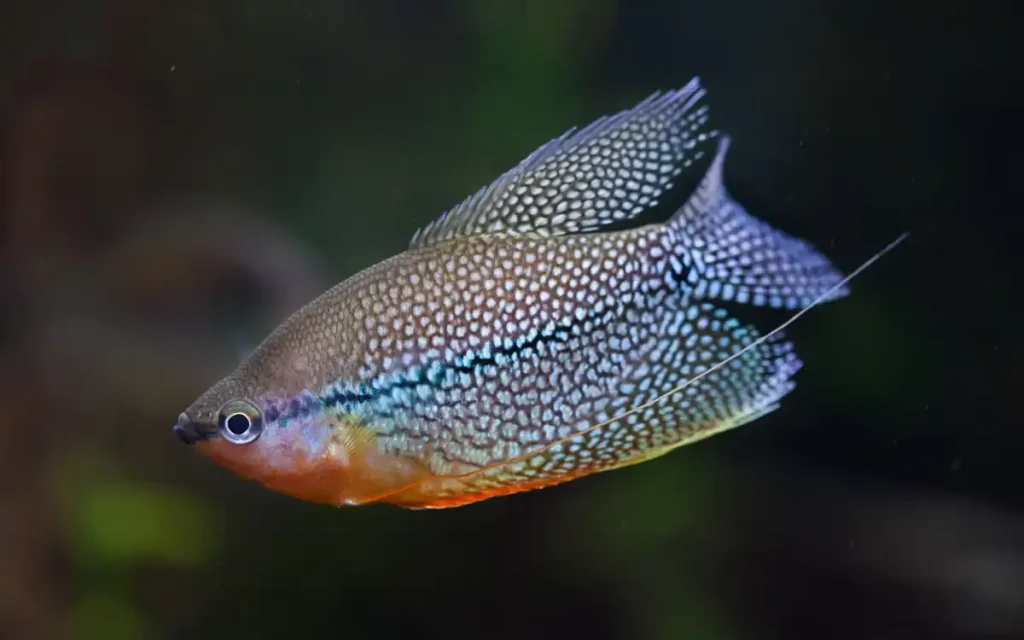
Pearl gouramis are larger than honey and dwarf gouramis but are usually calm when given enough space. Their spotted bodies and long feeler-like pelvic fins make them an impressive centerpiece.
A planted 40-gallon aquarium provides room for adults and their tank mates. Keep the current gentle and leave some open access to the surface because gouramis breathe atmospheric air.
Quick care
- Adult size: 4-5 inches
- Community tank size: 40 gallons or larger
- Temperature: 75-82°F
- pH: 5.5-7.5
- Water preference: Soft to moderately hard
- Tank level: Middle and upper levels
- Care level: Beginner to intermediate
- Temperament: Peaceful, although males may become territorial
- Group: One fish or one male with two females in a larger tank
Best tank mates: Medium peaceful tetras, harlequin rasboras, corydoras, kuhli loaches, and small plecos.
Avoid: Fin nippers, aggressive gouramis, rough cichlids, and very fast fish that cause constant stress.
Plan their aquarium with the Pearl Gourami Care Guide.
Bolivian Ram (Mikrogeophagus altispinosus)
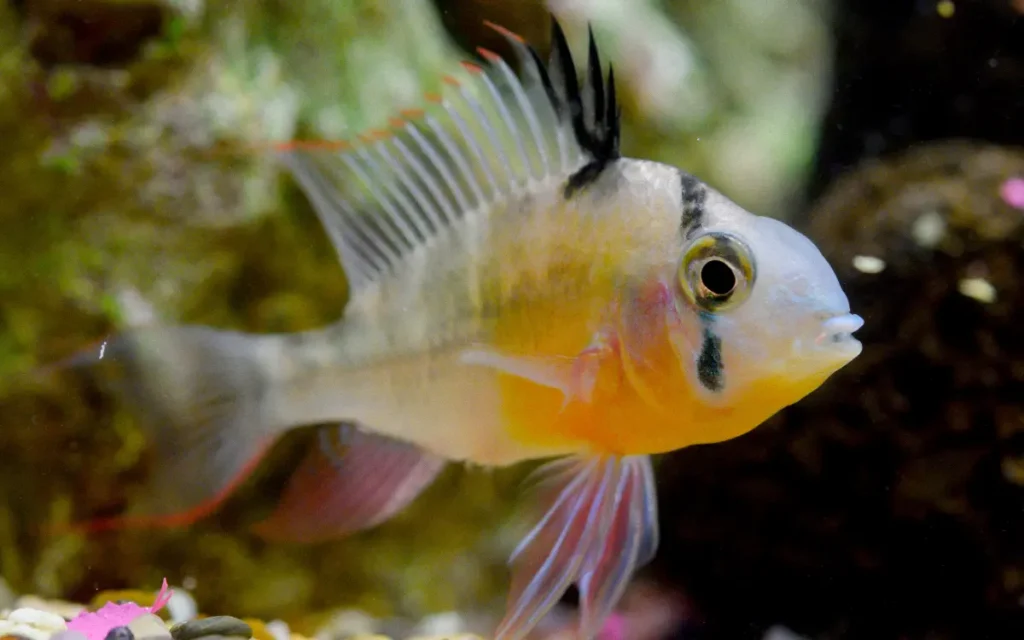
Bolivian rams are small cichlids with more forgiving temperature requirements than German blue rams. They are generally calm, but they still defend a chosen area, especially when breeding.
Provide sand, smooth stones, wood, and visual barriers. A single fish or compatible pair can work in a community tank. Avoid forcing two random fish to live as a pair if they show continued aggression.
Quick care
- Adult size: 3-4 inches
- Community tank size: 30 gallons for a community or pair
- Temperature: 72-79°F
- pH: 6.0-7.5
- Water preference: Soft to moderately hard
- Tank level: Lower and middle levels
- Care level: Beginner to intermediate
- Temperament: Peaceful for a cichlid
- Group: One fish or a compatible pair
Best tank mates: Medium peaceful tetras, rasboras, corydoras in spacious tanks, and bristlenose plecos.
Avoid: Aggressive cichlids, tiny shrimp, cramped tanks, and delicate bottom fish during breeding.
Learn more in the Bolivian Ram Cichlid Guide.
German Blue Ram
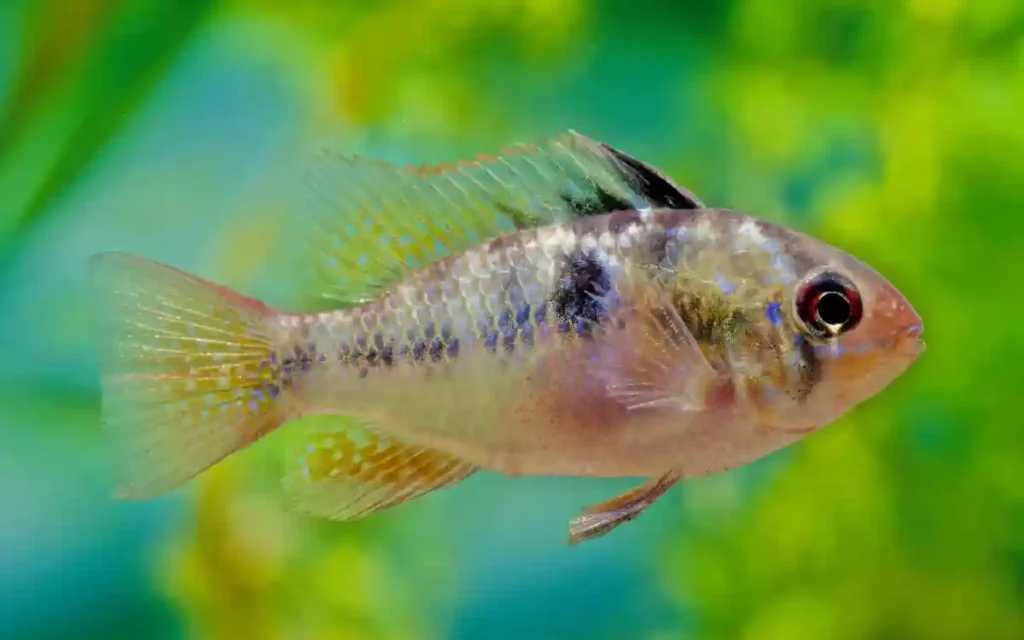
German blue rams are beautiful, but they are not ideal first fish. They require consistently warm water, low waste levels, and a mature aquarium with stable chemistry.
Their high temperature requirement greatly reduces the number of suitable tank mates. A fish that survives at 82°F is not automatically comfortable there, so choose species that naturally prefer warm water.
Quick care
- Adult size: 2.5-3 inches
- Community tank size: 20 gallons for a compatible pair
- Temperature: 80-86°F
- pH: 5.0-7.0
- Water preference: Soft
- Tank level: Lower and middle levels
- Care level: Experienced
- Temperament: Peaceful but territorial when breeding
- Group: One fish or a compatible pair
Best tank mates: Cardinal tetras, rummynose tetras, warm-water corydoras, and other calm soft-water species.
Avoid: Panda corydoras, white clouds, zebra danios, hard-water livebearers, and unstable new tanks.
The Ram Cichlid Care Guide explains their demanding water and temperature needs.
Dwarf Neon Rainbowfish
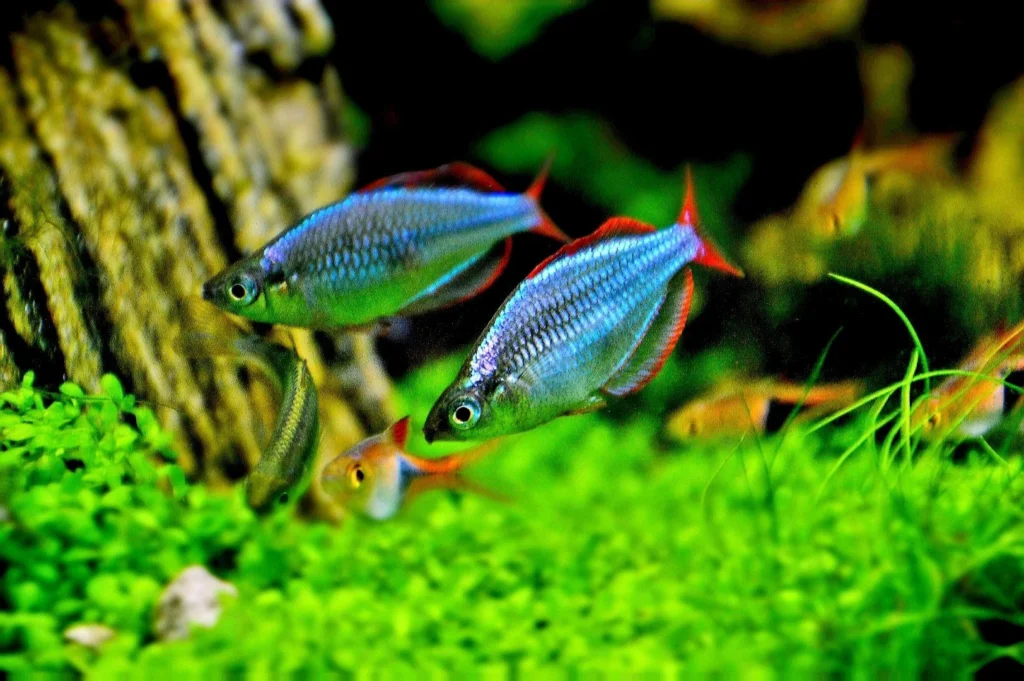
Dwarf neon rainbowfish have metallic blue bodies and bright red or yellow fins. They are smaller than many rainbowfish, but they remain strong, active swimmers that need a long aquarium.
Keep at least six, with eight or more preferred. A mixed group containing more females than males helps spread out courtship behavior. Feed a varied diet to maintain their color and body condition.
Quick care
- Adult size: 2.5-3 inches
- Community tank size: 30-gallon long or larger
- Temperature: 74-82°F
- pH: 6.5-8.0
- Water preference: Moderately hard
- Tank level: Middle and upper levels
- Care level: Beginner to intermediate
- Temperament: Peaceful and highly active
- Group: Six to eight or more
Best tank mates: Robust tetras, peaceful barbs, corydoras, and bristlenose plecos.
Avoid: Shy nano fish, slow long-finned species, and aquariums without open swimming space.
Use the Rainbowfish Care Guide to plan their school.
Threadfin Rainbowfish
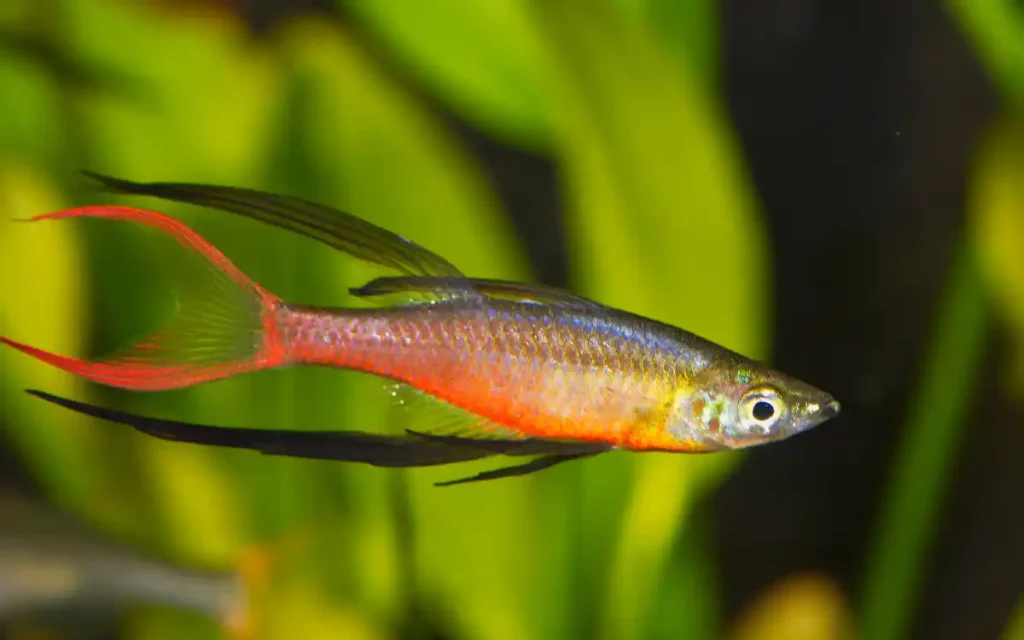
Threadfin rainbowfish are delicate schooling fish with long decorative fins. Males display to one another without usually causing serious injuries, making a mixed group interesting to watch.
They are slow feeders and can lose weight when housed with zebra danios, barbs, or other fast fish. Use gentle filtration and offer small floating or slowly sinking foods several times in modest amounts.
Quick care
- Adult size: 1.5-2 inches
- Community tank size: 20-gallon long or larger
- Temperature: 75-82°F
- pH: 5.5-7.5
- Water preference: Soft to moderately hard
- Tank level: Middle and upper levels
- Care level: Intermediate
- Temperament: Gentle and peaceful
- Group: Eight or more
Best tank mates: Small rasboras, ember tetras, pygmy corydoras, kuhli loaches, and other calm fish.
Avoid: Zebra danios, fin-nipping barbs, large fish, and aggressive feeders.
Our general Rainbowfish Care Guide provides additional family-wide care information.
Clown Pleco
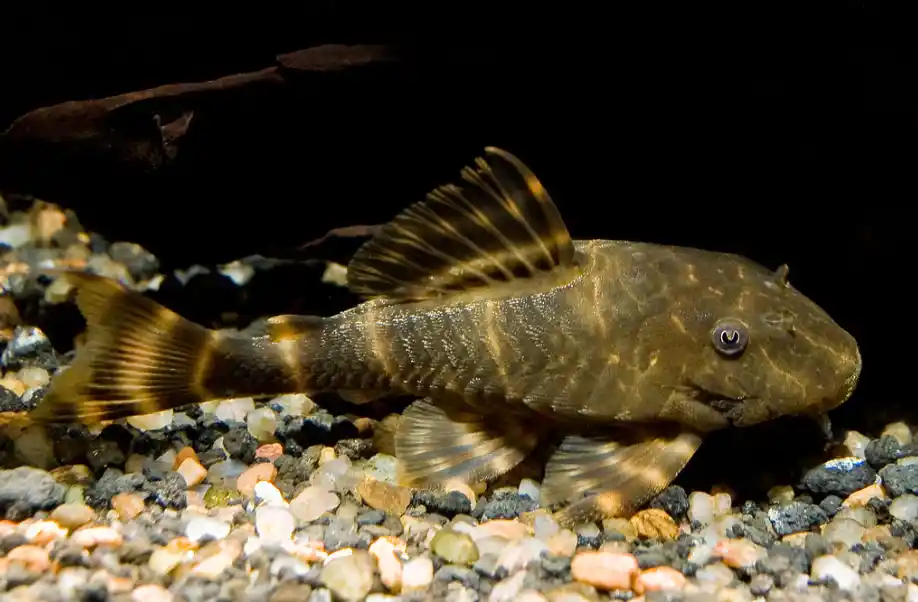
Clown plecos are small patterned catfish that spend much of the day resting under wood. Their compact size makes them easier to house than common plecos, but they still produce waste and need regular maintenance.
Natural driftwood should always be available. Feed algae wafers, vegetable-based foods, occasional protein, and suitable fresh vegetables. A clown pleco is not a replacement for cleaning the aquarium.
Quick care
- Adult size: About 3.5 inches
- Community tank size: 20-30 gallons or larger
- Temperature: 73-82°F
- pH: 6.5-7.5
- Water preference: Soft to moderately hard
- Tank level: Bottom
- Care level: Intermediate
- Temperament: Peaceful but territorial with similar plecos
- Group: One is safest in a smaller community tank
Best tank mates: Peaceful tetras, rasboras, gouramis, corydoras, and other nonaggressive community fish.
Avoid: Multiple plecos in cramped tanks, aggressive cichlids, and tanks without driftwood or hiding places.
Compare this species with others in our guide to the Different Types of Plecos.
Marbled Hatchetfish
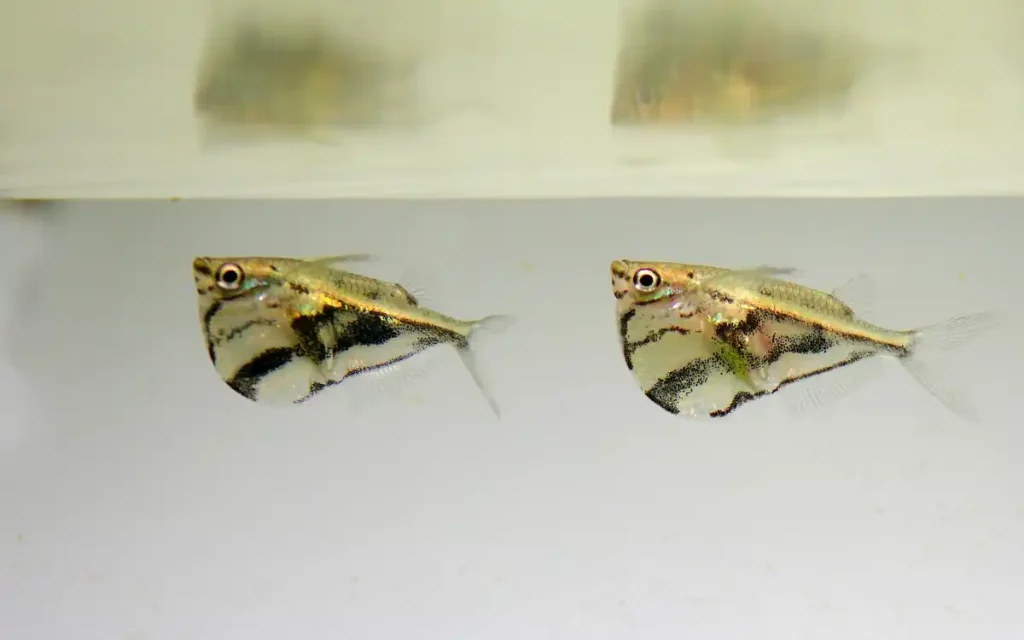
Marbled hatchetfish spend almost all their time near the water’s surface. Their unusual body shape and marbled pattern make them stand out, but they require a calm, secure aquarium.
These fish are skilled jumpers. Use a tight lid and cover gaps around cables, filters, and airline tubing. Floating plants provide security, but leave open spaces where the group can feed.
Quick care
- Adult size: About 1.5 inches
- Community tank size: 20 gallons or larger
- Temperature: 74-82°F
- pH: 5.0-7.0
- Water preference: Soft
- Tank level: Surface
- Care level: Intermediate
- Temperament: Peaceful and shy
- Group: Eight or more
Best tank mates: Cardinal tetras, rummynose tetras, peaceful corydoras, otocinclus, and other calm soft-water fish.
Avoid: Open-top tanks, boisterous surface feeders, hard-water fish, and aggressive species.
Offer floating micro pellets, flakes, and small frozen or live foods that remain near the surface long enough for them to eat.
Peacock Gudgeon
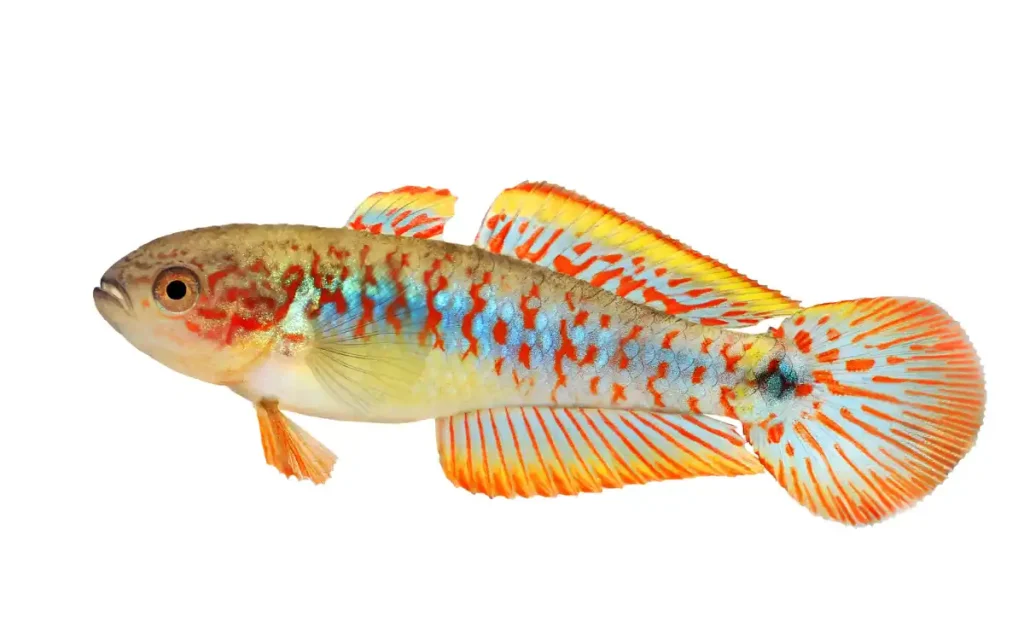
Peacock gudgeons are small colorful fish with spotted fins and bright blue-edged bodies. They usually live peacefully in community tanks, although males may guard caves and chase rivals during breeding.
Provide plants, wood, and several separate caves. These fish can be slow or cautious at feeding time, so watch that they receive enough frozen, live, or high-quality prepared food.
Quick care
- Adult size: 2.5-3 inches
- Community tank size: 20 gallons or larger
- Temperature: 72-79°F
- pH: 6.5-7.5
- Water preference: Soft to moderately hard
- Tank level: Middle and lower levels
- Care level: Intermediate
- Temperament: Peaceful with mild territorial behavior
- Group: A pair or small group with enough cover
Best tank mates: Peaceful rasboras, small tetras, corydoras, and calm gouramis.
Avoid: Aggressive cichlids, fast feeders, fin nippers, and tanks with only one breeding cave.
See our guide to Peacock Gudgeon Tank Mates before building the community.
White Cloud Mountain Minnow
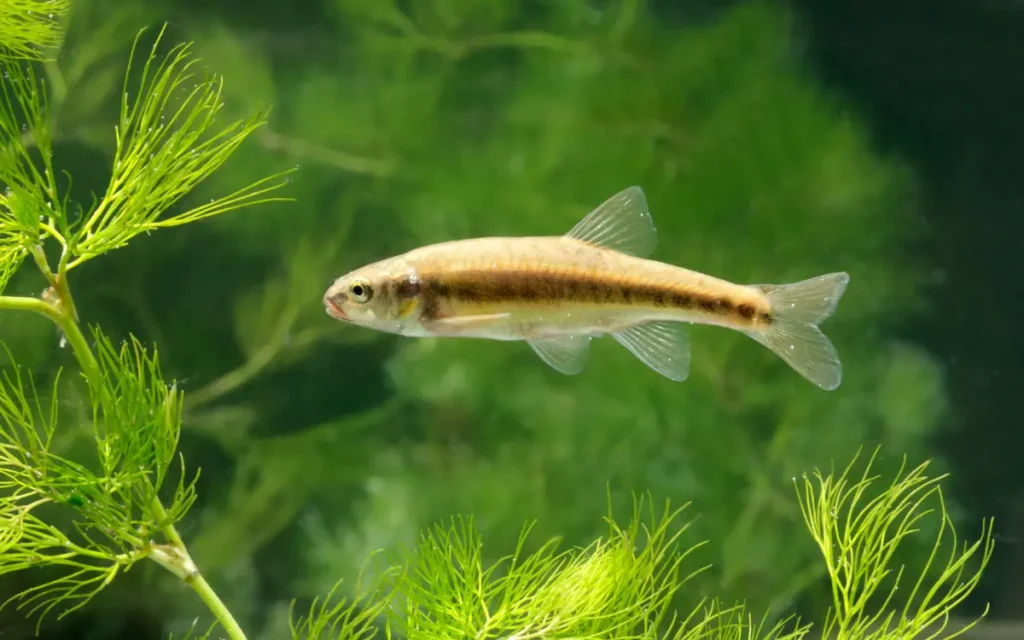
White cloud mountain minnows are hardy schooling fish that prefer cooler water than most tropical species. Their red fins and active behavior make them excellent fish for an unheated indoor aquarium when room temperatures remain suitable.
Keep at least eight, with ten or more preferred. Do not permanently maintain them at high tropical temperatures simply because they can survive short warm periods.
Quick care
- Adult size: About 1.5 inches
- Community tank size: 20-gallon long or larger
- Temperature: 64-72°F
- pH: 6.0-8.0
- Water preference: Moderately soft to moderately hard
- Tank level: Middle and upper levels
- Care level: Beginner
- Temperament: Peaceful and active
- Group: Eight to ten or more
Best tank mates: Zebra danios, other white clouds, and peaceful cool-water bottom dwellers.
Avoid: German blue rams, discus, warm-water gouramis, large goldfish, and tropical tanks kept above their preferred range.
Read the White Cloud Mountain Minnow Care Guide for a complete cool-water setup.
Cherry Barb
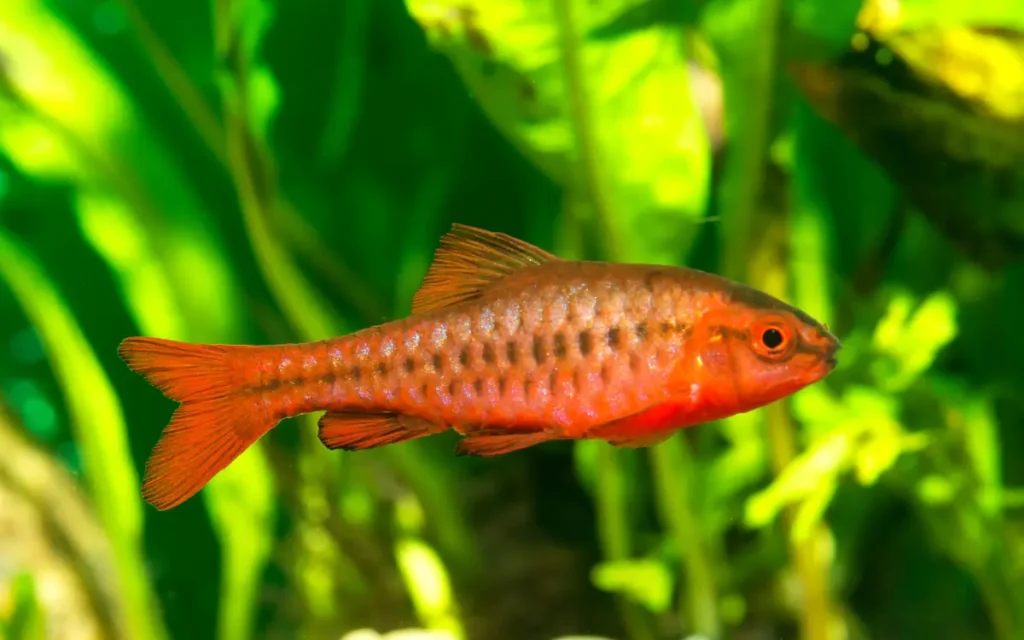
Cherry barbs are calmer than many other barbs. Mature males develop a rich red color, while females tend to be lighter with a visible side stripe.
Keep at least eight so they feel secure and display natural social behavior. A group containing more females than males can reduce persistent courtship. Plants and shaded areas bring out their color.
Quick care
- Adult size: About 2 inches
- Community tank size: 20 gallons or larger
- Temperature: 73-81°F
- pH: 6.0-8.0
- Water preference: Soft to moderately hard
- Tank level: Middle and lower levels
- Care level: Beginner
- Temperament: Peaceful and active
- Group: Eight to ten or more
Best tank mates: Harlequin rasboras, corydoras, honey gouramis, black neon tetras, and kuhli loaches.
Avoid: Large predators, aggressive barbs, and keeping only one or two cherry barbs.
The Cherry Barb Care Guide explains group size, feeding, and breeding behavior.
Chili Rasbora
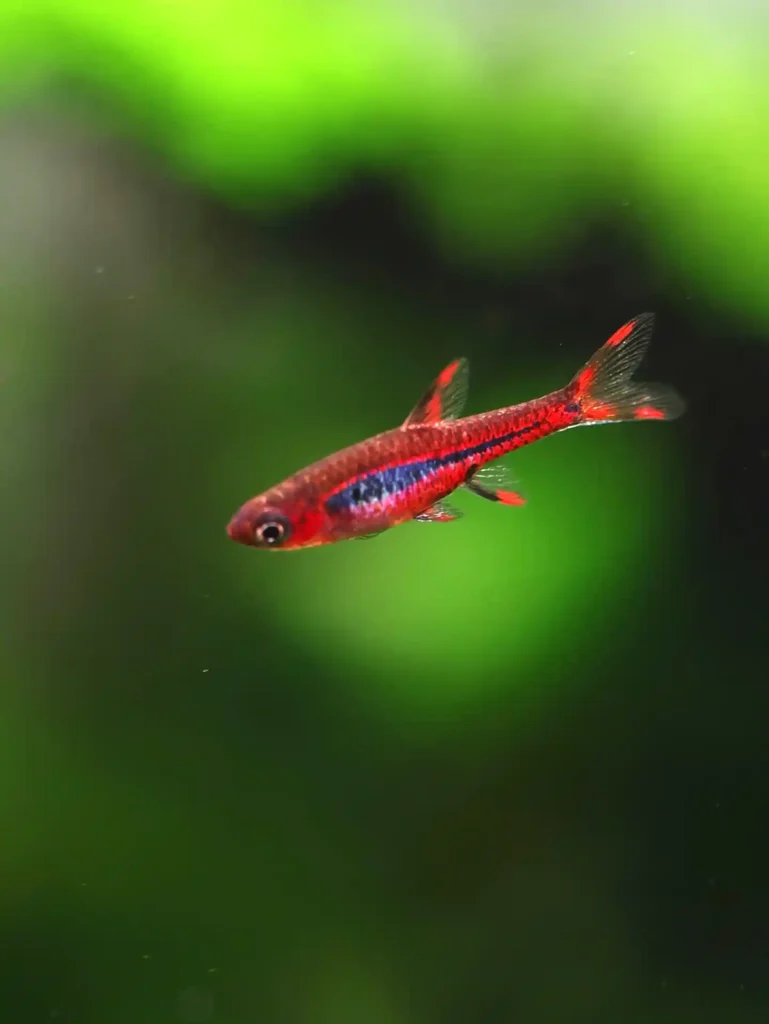
Chili rasboras are tiny red fish designed for peaceful nano communities. Their size makes them vulnerable to larger tank mates and strong filter currents.
A mature planted aquarium with gentle flow, subdued light, and a group of at least ten helps them feel secure. Feed powdered flakes, micro pellets, and tiny frozen or live foods.
Quick care
- Adult size: 0.7-0.8 inch
- Community tank size: 10 gallons or larger
- Temperature: 72-82°F
- pH: 4.0-7.0
- Water preference: Very soft to soft
- Tank level: Middle
- Care level: Intermediate
- Temperament: Very peaceful and shy
- Group: Ten to twelve or more
Best tank mates: Pygmy corydoras, sparkling gouramis, ember tetras, small shrimp, and other gentle nano fish.
Avoid: Danios, barbs, large tetras, livebearers, and any fish capable of swallowing them.
Build a safe nano aquarium with the Chili Rasbora Care Guide.
Glowlight Tetra
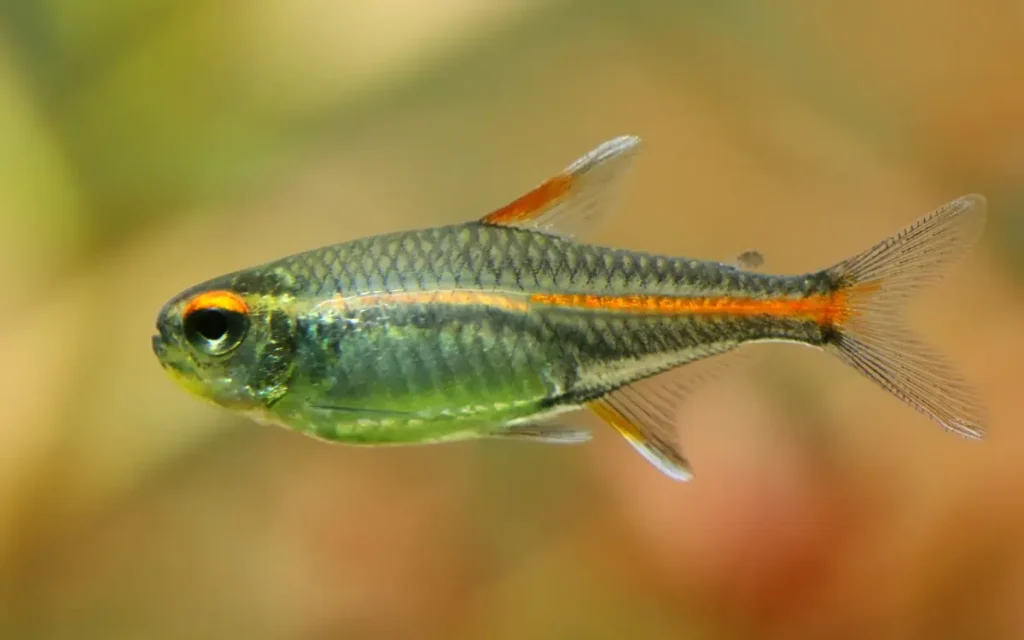
Glowlight tetras have a bright orange stripe that appears to shine under aquarium lighting. They are peaceful, adaptable, and less delicate than some other small tetras.
Keep at least eight, although a group of ten or more creates better schooling behavior. Dark substrate, plants, and moderate lighting help their stripe stand out.
Quick care
- Adult size: 1.5-1.8 inches
- Community tank size: 15-20 gallons or larger
- Temperature: 74-82°F
- pH: 5.5-7.5
- Water preference: Soft to moderately hard
- Tank level: Middle
- Care level: Beginner
- Temperament: Peaceful
- Group: Eight to ten or more
Best tank mates: Harlequin rasboras, corydoras, honey gouramis, kuhli loaches, and other peaceful tetras.
Avoid: Large fish, aggressive barbs, and species requiring hard alkaline water.
Read the Glowlight Tetra Care Guide for feeding and aquarium setup advice.
Black Neon Tetra
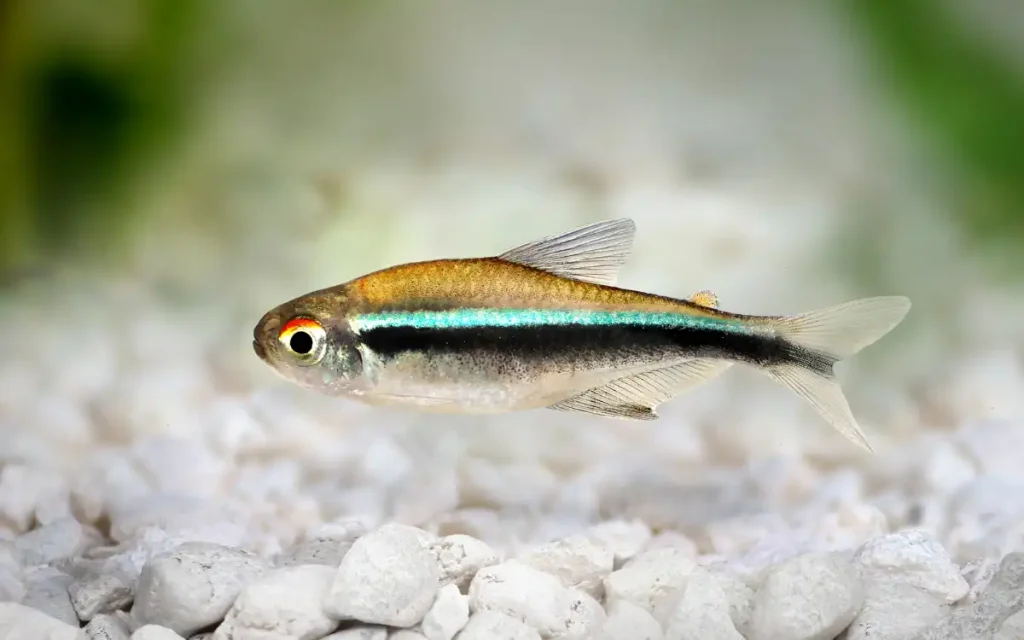
Black neon tetras have a bright silver stripe above a dark horizontal band. They are hardy, active, and often more visible in a community aquarium than shy nano species.
Keep at least eight to reduce nervous behavior and occasional chasing. They appreciate plants around the tank edges with open swimming space through the middle.
Quick care
- Adult size: About 1.5 inches
- Community tank size: 20 gallons or larger
- Temperature: 72-82°F
- pH: 5.5-7.5
- Water preference: Soft to moderately hard
- Tank level: Middle
- Care level: Beginner
- Temperament: Peaceful and active
- Group: Eight to ten or more
Best tank mates: Corydoras, harlequin rasboras, honey gouramis, cherry barbs, and peaceful bottom dwellers.
Avoid: Large predators, aggressive cichlids, and keeping them in pairs or very small groups.
See the complete Black Neon Tetra Care Guide.
Diamond Tetra
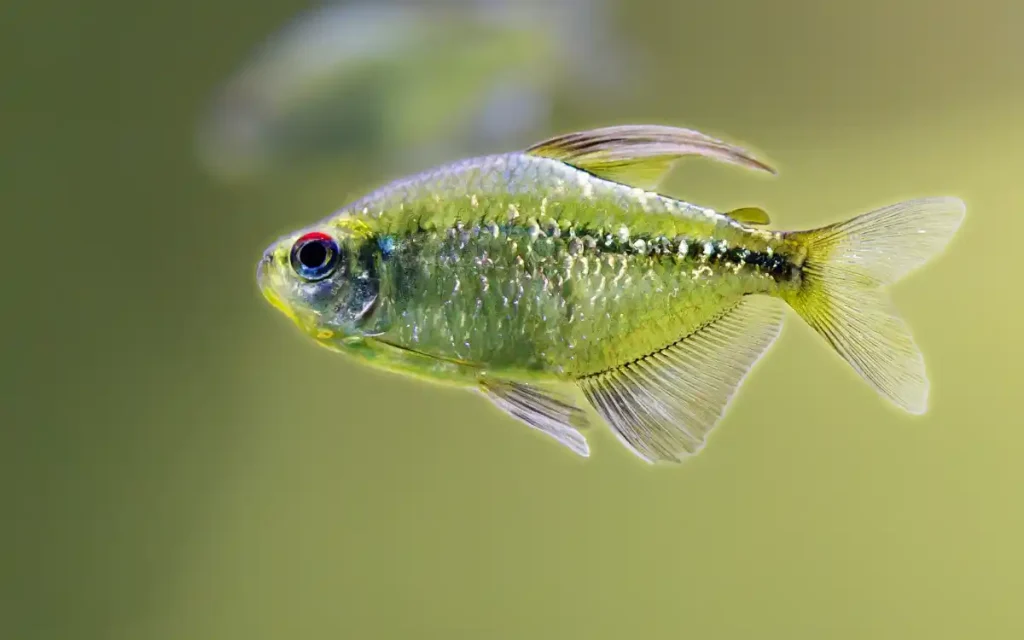
Diamond tetras develop reflective scales and flowing fins as they mature. Young fish in store tanks may look plain, but healthy adults become impressive when kept in good water and fed a varied diet.
Males may display and spar without causing serious harm. Keep at least eight so social attention is spread across the group. A larger aquarium is helpful because adults are deeper-bodied than neon tetras.
Quick care
- Adult size: 2-2.5 inches
- Community tank size: 20-29 gallons or larger
- Temperature: 75-82°F
- pH: 5.5-7.5
- Water preference: Soft to moderately hard
- Tank level: Middle
- Care level: Beginner to intermediate
- Temperament: Peaceful with social sparring
- Group: Eight or more
Best tank mates: Corydoras, pearl gouramis, harlequin rasboras, bristlenose plecos, and similar medium community fish.
Avoid: Large predators, aggressive fin nippers, and tanks without enough room for the complete school.
Good food, clean water, and moderate lighting help adult diamond tetras show their best color.
Pygmy Corydoras
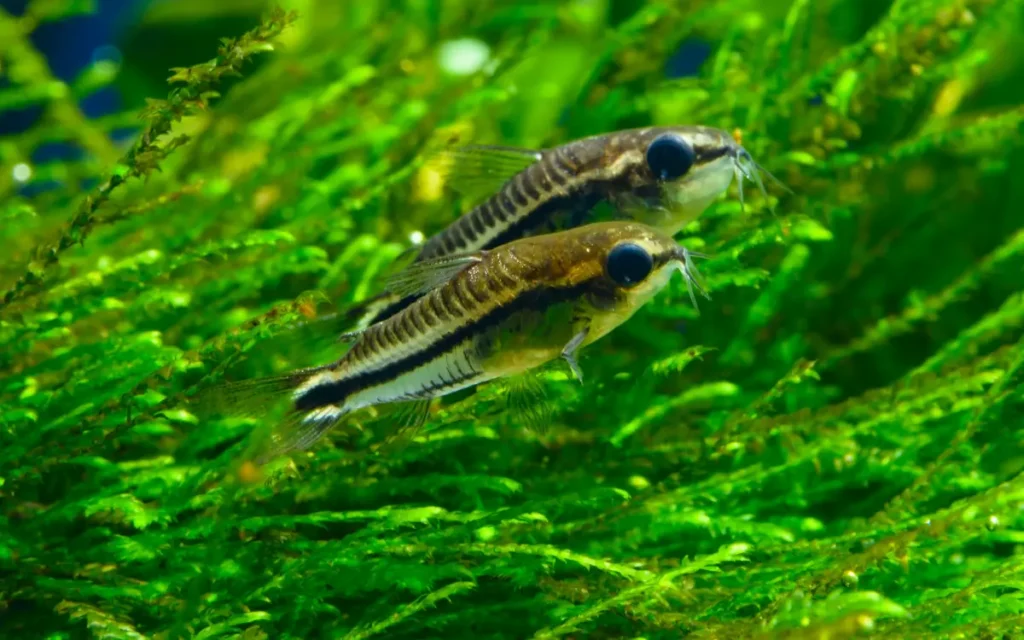
Pygmy corydoras are tiny social catfish that swim through the middle of the aquarium as well as resting on the bottom. This makes them more visible than many larger corydoras species.
Keep at least eight, although ten or more is even better. Use sand or smooth substrate and feed tiny sinking pellets, wafers, baby brine shrimp, and other appropriately sized foods.
Quick care
- Adult size: About 1 inch
- Community tank size: 10 gallons or larger
- Temperature: 72-79°F
- pH: 6.4-7.4
- Water preference: Soft to moderately hard
- Tank level: Bottom and middle levels
- Care level: Beginner in a stable tank
- Temperament: Very peaceful
- Group: Eight to ten or more
Best tank mates: Chili rasboras, ember tetras, celestial pearl danios, otocinclus, shrimp, and snails.
Avoid: Large fish, aggressive bottom dwellers, sharp gravel, and fast tank mates that take all the food.
Read the Pygmy Cory Care Guide for feeding and group advice.
Bristlenose Pleco
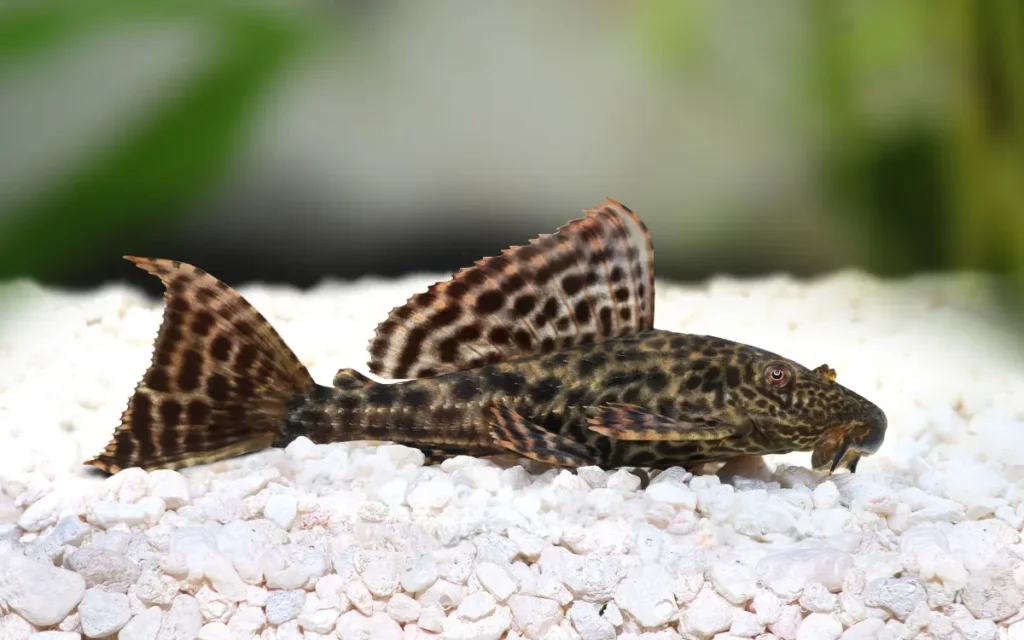
Bristlenose plecos stay much smaller than common plecos, but they still need a roomy aquarium, strong filtration, and regular maintenance. Adults are easy to recognize by the soft facial bristles, which are usually more developed on males.
Provide driftwood, caves, algae wafers, vegetables, and occasional protein-rich food. They eat some algae, but they cannot keep an aquarium clean by themselves.
Quick care
- Adult size: 4-5 inches
- Community tank size: 30 gallons or larger
- Temperature: 72-80°F
- pH: 6.5-7.5
- Water preference: Soft to moderately hard
- Tank level: Bottom
- Care level: Beginner to intermediate
- Temperament: Peaceful but territorial with other plecos
- Group: One adult in an average community tank
Best tank mates: Medium tetras, rasboras, livebearers with compatible water, gouramis, and corydoras in spacious tanks.
Avoid: Multiple adult males in small tanks, aggressive cichlids, and aquariums without wood or shelter.
Compare bristlenoses with other species in our Types of Plecos Guide.
Sparkling Gourami
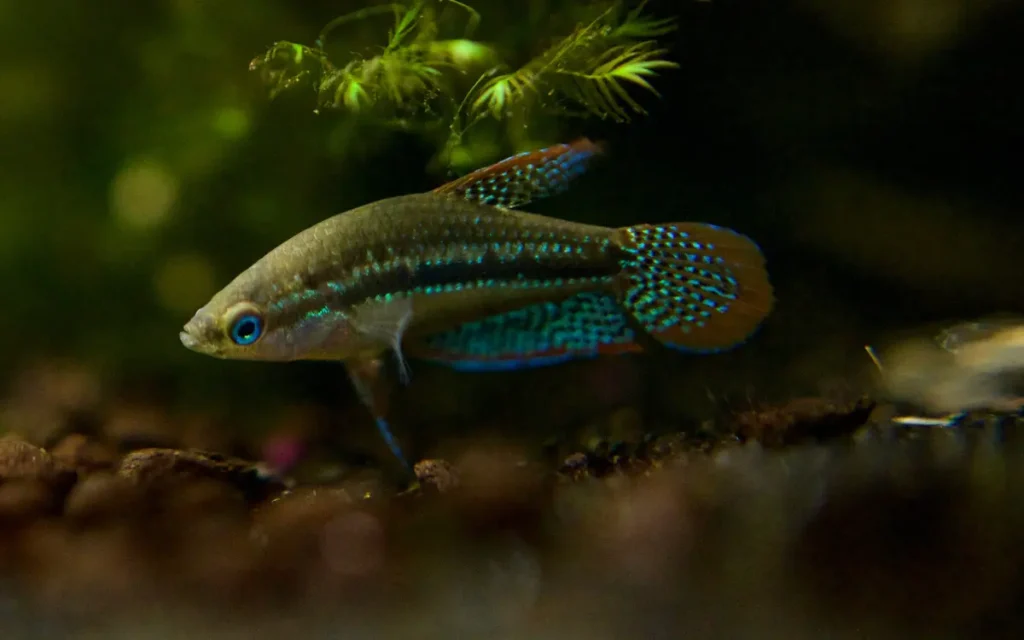
Sparkling gouramis are tiny labyrinth fish known for producing quiet croaking sounds. They are attractive and interesting, but their shy behavior makes tank-mate selection important.
Use dense plants, floating cover, wood, and gentle filtration. Males may defend small territories, so provide several sheltered areas if keeping more than one fish.
Quick care
- Adult size: About 1.5 inches
- Community tank size: 15 gallons or larger
- Temperature: 75-82°F
- pH: 5.5-7.5
- Water preference: Soft to moderately hard
- Tank level: Middle and upper levels
- Care level: Intermediate
- Temperament: Peaceful, shy, and mildly territorial
- Group: A pair or small group in a heavily planted tank
Best tank mates: Chili rasboras, ember tetras, pygmy corydoras, kuhli loaches, and peaceful shrimp.
Avoid: Zebra danios, aggressive barbs, larger gouramis, bettas, and fast feeders.
The Sparkling Gourami Care Guide explains how to create a quiet planted setup.
Glass Catfish
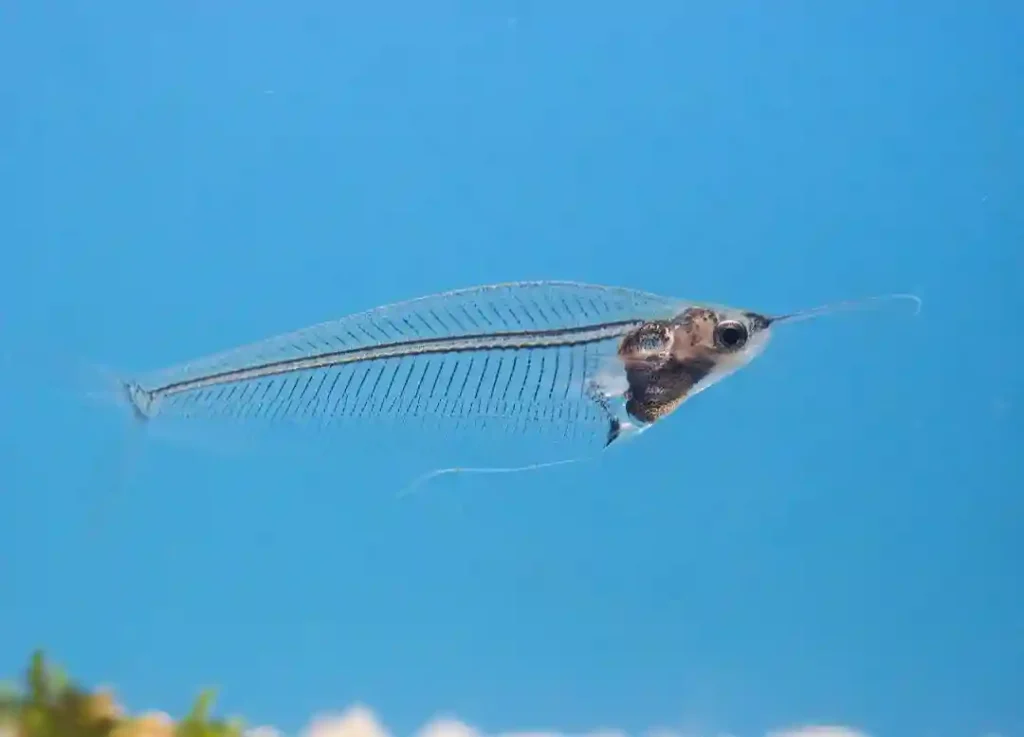
Glass catfish have nearly transparent bodies and a gentle schooling nature. They are sensitive to unstable water, so they should be added only after the aquarium is fully cycled and established.
Keep at least eight. A small group may hide constantly and refuse food. Plants, shaded areas, and gentle water movement help them settle, while an open middle section gives the school room to swim.
Quick care
- Adult size: 3-4 inches
- Community tank size: 30-gallon long or larger
- Temperature: 75-80°F
- pH: 6.0-7.5
- Water preference: Soft to moderately hard
- Tank level: Middle
- Care level: Intermediate
- Temperament: Peaceful and shy
- Group: Eight or more
Best tank mates: Harlequin rasboras, peaceful tetras, corydoras, kuhli loaches, and calm gouramis.
Avoid: Aggressive barbs, large cichlids, fast feeders, bright uncovered tanks, and unstable new aquariums.
Glass catfish are a beautiful choice for experienced beginners who can maintain consistent water conditions and provide a peaceful environment.
