
Red Root Floater Care Guide: Light, Red Color, and Growth

Red root floaters grow best on a calm freshwater surface with moderate to strong light, a temperature of 70–82°F (21–28°C), and a pH between 6.0 and 8.0. They do not need substrate or injected CO2. Their two biggest problems are strong surface movement and leaves that stay wet.
The plant can remain green under moderate light and still be healthy. Stronger light produces the red or pink color most fishkeepers want. Balanced nutrients also matter, but starving the plant or forcing nitrate to zero can stop growth rather than improve its color.
I recommend red root floaters for planted display tanks, betta tanks, guppy tanks, and shrimp tanks with gentle flow. They are not the best choice for a tank with heavy splashing, a dripping lid, or fish that constantly disturb the surface.
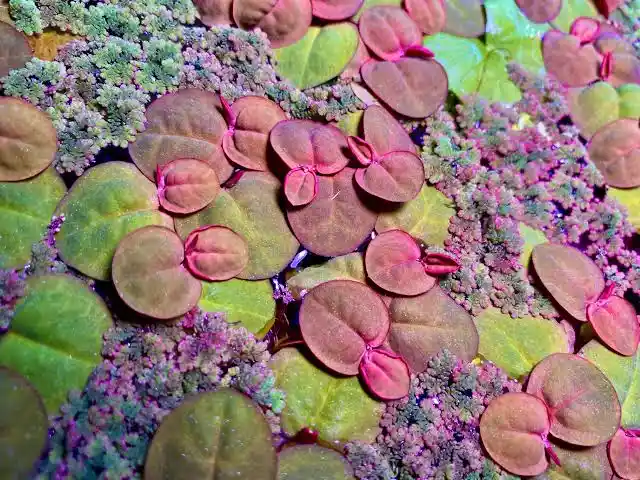
Red Root Floater Care at a Glance
| Care need | Recommended conditions |
| Scientific name | Phyllanthus fluitans |
| Care level | Easy to moderate |
| Growth rate | Moderate to fast |
| Light | Moderate for growth; strong for deeper red color |
| Temperature | 70–82°F (21–28°C) |
| pH | 6.0–8.0 |
| Water hardness | Soft to moderately hard |
| Water flow | Gentle, with a calm surface area |
| CO2 | Not required |
| Fertilizer | Liquid fertilizer when needed |
| Placement | Water surface only |
| Propagation | Natural branching and division |
| Best for | Planted tanks, bettas, guppies, shrimp, and fry |
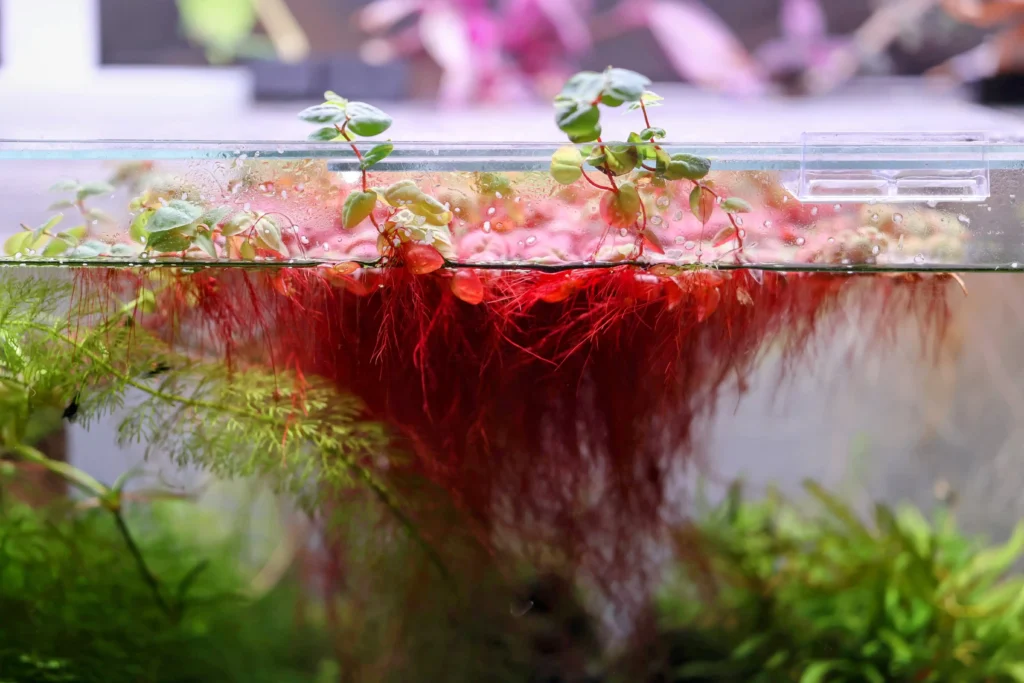
What Is a Red Root Floater?
Red root floater is a small floating plant native to tropical parts of the Americas. Its scientific name is Phyllanthus fluitans. It grows round or slightly heart-shaped leaves at the surface, while clusters of fine roots hang below the water.
New or shaded leaves are often green. With stronger light, the upper leaves can become orange, pink, or deep red, and the roots may develop a brighter red tone. Healthy plants may also produce tiny white flowers, although flowering is not needed for propagation.
Unlike Amazon frogbit, red root floater stays fairly compact. Its leaves are also much easier to remove than duckweed. That makes it a good decorative choice when you want surface cover without a plant made of hundreds of tiny loose pieces.
It is one of the more colorful choices in this guide to floating aquarium plants. It is slightly less forgiving than Salvinia or frogbit because the leaves react badly to constant splashing.
Is Red Root Floater Easy to Grow?
Red root floater is easy to moderate rather than completely effortless. It does not require aquasoil, root tabs, or a pressurized CO2 system. Place it on the surface, give it suitable light, and keep it away from rough water.
Most failures come from the tank layout rather than difficult water chemistry. A hang-on-back filter may push the plants under its outflow. An air stone may keep the leaves wet. Condensation from a tight lid may drip on the same area all day.
If you can provide one calm, well-lit section of the surface, the plant usually grows well. I would choose a different floater for a turbulent aquarium where the surface cannot be kept quiet.
How Much Light Do Red Root Floaters Need?
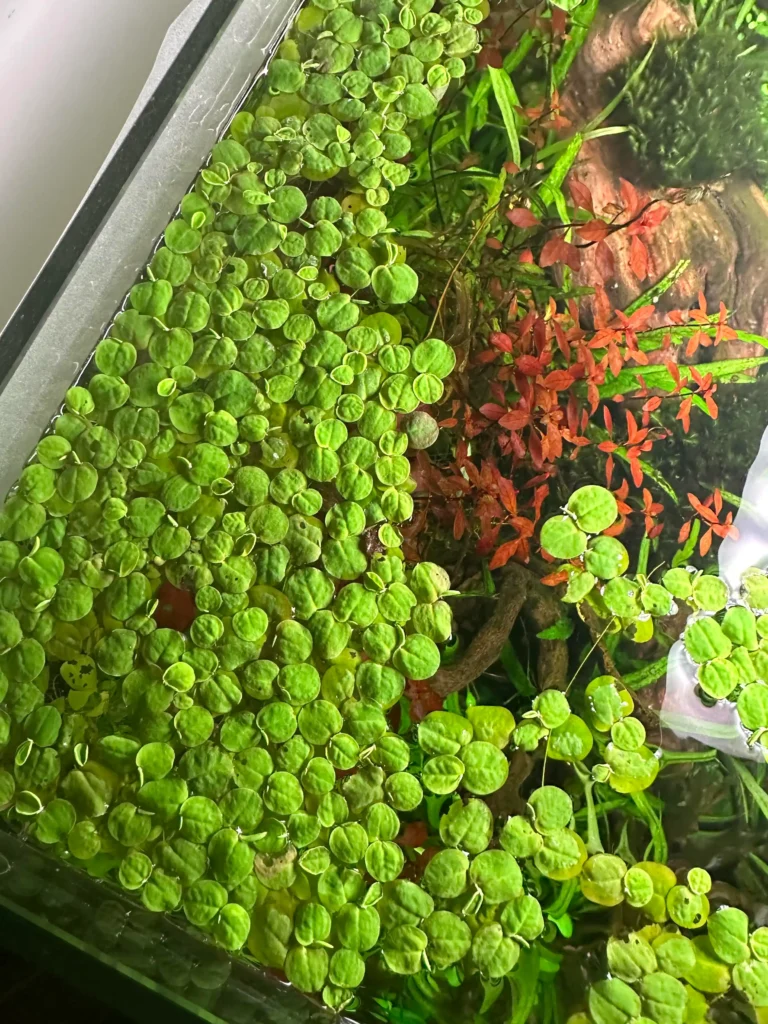
Red root floaters need moderate light for steady growth and stronger light for red leaves. Under weaker lighting, the plant may remain green, grow slowly, or produce smaller clusters. Green leaves do not automatically mean something is wrong.
Start with six to eight hours of light each day. A planted-tank LED that spreads light evenly is better than one intense beam over a small section. Watch both the plant and the rest of the aquarium before increasing brightness or extending the schedule.
More light can deepen the color, but it can also cause algae when nutrients and maintenance are out of balance. If algae starts coating the roots or leaf edges, do not keep extending the lighting period. Return to a steady schedule and deal with excess food, waste, or fertilizer first.
If your aquarium only has a weak light, red root floater may stay green. That is harmless, but another species from this list of low-light aquarium plants may be a better match if you want easier growth.
How to Make Red Root Floaters Turn Red
Strong, steady light is the main factor behind red coloration. Position the plants where they receive direct light rather than under a shaded lid edge or behind taller floating plants. Thin the colony before older leaves begin covering new growth.
The plant also needs enough nutrients to keep producing healthy leaves. A complete liquid aquarium fertilizer can supply nitrogen, potassium, iron, and trace elements when fish waste is not enough. Use the label as your limit and make small changes instead of adding several extra doses at once.
Some fishkeepers try to make the plant redder by driving nitrate extremely low. I do not recommend that approach. Red root floaters need nitrogen to grow, and a true shortage can cause pale leaves, weak roots, and stalled propagation. Strong light with balanced nutrition is safer than starving the plant for color.
Give new plants time to adjust. Shipping stress may leave the first leaves green, damaged, or pale. Judge the tank by the color and shape of new growth after the plant has settled, not by the leaves that arrived in the package.
Best Water Conditions
Keep red root floaters between 70 and 82°F (21 and 28°C). They can tolerate a wider range for short periods, but steady tropical temperatures support better growth. Avoid placing them under a light that heats the surface far above the rest of the aquarium.
A pH from 6.0 to 8.0 works for most home setups. Soft to moderately hard water is suitable, and many plants also grow in harder livebearer tanks. Stability matters more than adjusting the pH to one exact number.
Ammonia and nitrite should remain at zero in a stocked, cycled aquarium. Red root floaters use nitrogen as they grow, but they cannot make an uncycled tank safe for fish.
Water Flow and Filter Placement
Gentle flow is one of the most useful parts of red root floater care. The roots can hang in moving water, but the leaves should not be repeatedly pushed underwater or carried beneath a filter outflow.
A sponge filter is usually an easy match. If you use a hang-on-back or canister filter, create a calm corner with a floating plant corral. A loop of clean airline tubing can hold the plants away from the strongest current while leaving the rest of the surface open.
Do not remove all surface movement just for the plant. Fish still need suitable oxygen and gas exchange. The goal is to keep one section calm, not make the entire aquarium motionless.
Can Red Root Floaters Grow Under a Lid?
They can grow in a covered aquarium, but the leaves should not stay wet from condensation. A close-fitting lid may collect water and drip over the plants. Constant moisture on top of the leaves can lead to dark patches, soft tissue, and melting.
Check the underside of the lid in the morning and after the light has been running. If water is dripping heavily, improve the air gap where possible or keep the plants inside a corral away from the wettest section.
An open-top aquarium is often easier, but it is not required. Fish that jump still need a secure cover. Never remove a necessary lid just to grow a floating plant.
Does Red Root Floater Need CO2 or Fertilizer?
Red root floater does not need injected CO2. Its leaves sit at the surface and can use carbon dioxide from the air, which is one reason floating plants can grow quickly without a high-tech setup.
The plant takes its mineral nutrients directly from the water. Root tabs and nutrient-rich substrate will not feed it. A complete liquid aquarium fertilizer is the correct option when the tank cannot supply enough through fish waste and feeding.
Do not add fertilizer automatically because one old leaf changes color. First check the light, surface flow, wet leaves, temperature, and new growth. Several problems can cause similar damage, and adding more nutrients will not fix a plant being pushed beneath the filter.
How to Add Red Root Floaters to an Aquarium
Inspect the plants before adding them. Remove brown, crushed, or slimy leaves and look for pest snails, snail eggs, algae, and other hitchhikers. Rinse the roots gently in conditioned water without soaking or rubbing the upper leaves.
Do not pour shipping or store water into the aquarium. Transfer only the inspected plants. If the seller cannot confirm that they are free from pesticides and safe for invertebrates, quarantine them before placing them with shrimp.
Set a small group on the surface with the leaves facing upward and the roots in the water. There is nothing to plant, bury, tie, or glue. Place the group in a calm, lit area and avoid moving it repeatedly during the first few days.
How Fast Do Red Root Floaters Grow?
Growth ranges from moderate to fast. A settled colony with good light and available nutrients can spread across open surface space quickly. New plants may grow slowly at first while they adjust to different water and lighting.
Growth is not always even. Plants near the center of the light may become red and compact, while those at the edge remain greener. Crowded sections can also slow down when older leaves shade the young ones.
Thin the colony before it covers the full surface. I prefer checking it during every water change rather than waiting for a thick mat to form.
How to Propagate Red Root Floater
Red root floater propagates on its own by producing new growth along its branching stems. Small connected clusters develop beside the parent plant and gradually become large enough to live separately.
You can leave the sections attached or gently divide a healthy cluster when it has several leaves and roots. Use clean scissors if the connection does not separate easily. Avoid pulling on the roots because they can break away from the plant.
Place the new section in a calm, well-lit area. No rooting hormone, substrate, or separate propagation tank is needed.
How to Trim and Control It
Red root floater does not need traditional pruning like a stem plant. Control it by removing complete plants or healthy outer sections. Keep enough open water for feeding, surface movement, and light to reach plants below.
Lift unwanted plants into a white container before disposal. Tiny shrimp, fry, and snails may be hidden among the roots. Return any animals to the aquarium before removing the plant material.
Never release red root floaters into a pond, stream, drain, or natural waterway. The plant can form dense surface cover outside its native range. Seal unwanted plants in a bag or dry them fully before disposal according to local rules.
Benefits in a Freshwater Aquarium
Healthy red root floaters use nitrogen and other dissolved nutrients while growing. Removing excess plants takes some of those nutrients out of the aquarium. This can support water management, but it does not replace testing, filtration, or water changes.
If nitrate stays high, look at feeding, stocking, trapped waste, and source water rather than expecting floaters to solve it alone. The full process is covered in this guide to lowering nitrate safely.
The hanging roots create cover for small fish, fry, and shrimp. The leaves also soften bright overhead light, which can make shy surface fish feel less exposed. Biofilm may grow around the roots and provide another grazing surface for shrimp.
Surface shade has a tradeoff. A solid mat can block too much light from rooted plants and leave little room for surface-feeding fish. Thin the plant so it supports the tank without controlling the entire surface.
Red Root Floaters for Bettas, Guppies, and Shrimp
Red root floaters work well with bettas because both prefer a calm surface. The plant creates light shade and cover around the top of the aquarium. Always leave clear openings where a betta can breathe and take food. You can compare other safe choices in this guide to plants for betta fish.
Guppies also use the hanging roots as light cover, and newborn fry may hide beneath a larger colony. Red root floaters also appear in this guide to plants for guppies, but they should not cover all the open swimming and feeding space.
Shrimp graze on the roots and plant surfaces. Baby shrimp may hide inside the root mass, although a floating plant does not provide as much dense underwater shelter as Java moss or guppy grass. For a mixed setup, compare more plants for shrimp tanks.
Avoid fish that eat, tear, or repeatedly pull floating plants underwater. Goldfish and some large cichlids may damage the colony. Fish that require strong surface current are also a poor match because the plant needs calmer water.
Common Red Root Floater Problems
Leaves Staying Green
Green leaves most often mean the light is not strong enough to produce red color. The plant may still be healthy. Move it out of shade, prevent crowding, and make sure the light reaches the surface evenly.
Do not lower nitrate to zero or overdose iron just to force a color change. Improve the light first and keep nutrition balanced.
Leaves Melting or Turning Brown
Melting often follows shipping, a sudden change in water conditions, wet leaf tops, or rough surface movement. Remove soft leaves and keep the remaining plants in a calm area. Look for firm new growth before discarding the entire colony.
If the damage occurs only below the filter or under a dripping lid, fix that local problem rather than changing the water chemistry.
Yellow or Pale New Leaves
Pale new growth can come from weak light or a shortage of available nutrients. Check whether the tank is lightly stocked, whether other plants are pale, and whether fertilizer is already being used.
A small label-directed dose of complete liquid fertilizer may help a nutrient-poor tank. Give the plant time to respond instead of adding extra fertilizer every day.
Roots Falling Off
Roots may break after shipping, during handling, or when fish pull at them. Strong flow can also tangle the colony and damage the roots. Move the plants to calmer water and judge recovery by new root growth.
Some root loss is not fatal when the leaves and stems remain firm. Remove loose decaying pieces before they enter the filter.
Plants Collecting Around the Filter
The filter outflow may push every plant into one corner or pull roots toward the intake. Use a floating ring or airline-tubing corral to keep them in a stable section. A prefilter sponge can protect loose roots and small animals near the intake.
Algae Growing on the Roots
Fine roots can catch hair algae and debris. Reduce an overly long lighting schedule, remove trapped waste, and avoid overfeeding. If only a few plants are badly affected, removing them is easier than trying to clean every root.
Red Root Floater vs. Amazon Frogbit
Red root floater is smaller and can develop red leaves under strong light. Amazon frogbit stays green and usually grows much longer hanging roots. Frogbit is often easier for beginners, while red root floater is better when color is the main goal.
Both plants dislike wet leaf tops and strong surface disturbance. Both also need regular thinning. Read the Amazon frogbit care guide if you want a larger, greener floater with a more dramatic root system.
Red Root Floater vs. Duckweed
Red root floater is much easier to remove and control than duckweed. Its plants are large enough to pick up by hand, while tiny duckweed pieces stick to equipment and spread between tanks.
Duckweed usually grows faster and accepts a wider range of conditions. Red root floater needs better lighting and calmer water, but it gives a cleaner appearance. The duckweed care guide explains the maintenance needed before adding it.
Frequently Asked Questions
Can red root floaters live in low light?
They may survive and grow slowly under lower light, but the leaves will usually stay green. Moderate light is better for growth, while stronger light produces deeper red color.
Do red root floaters need a substrate?
No. They float on the surface and take nutrients from the water. Sand, gravel, aquasoil, and root tabs do not feed them directly.
Why are my red root floater roots green or brown?
Root color can change with light, age, nutrients, and adjustment. Healthy new growth matters more than one exact root color. Soft or decaying roots should be removed.
Can red root floaters grow in a covered tank?
Yes, if the lid does not keep dripping water on the leaves. Check for condensation and leave a safe air gap where the tank design allows it.
Do red root floaters need a filter?
The plant itself does not need a filter, but a stocked aquarium usually does. Choose gentle flow and keep the colony away from the intake and outflow.
Are red root floaters safe for shrimp?
Yes, aquarium-grown red root floaters are safe for shrimp when they have not been treated with harmful pesticides. Shrimp may graze on biofilm around the roots.
Can red root floaters cover the whole tank?
They can spread across most of the surface when light and nutrients are available. Remove extra plants regularly so fish can feed and breathe at the surface and lower plants still receive light.
Should You Add Red Root Floaters?
Choose red root floaters if you want a compact floating plant with pink or red color, hanging roots, and natural surface cover. They grow without substrate or injected CO2 and fit many peaceful freshwater aquariums.
Choose a different plant if your tank has strong surface flow, heavy splashing, or constant condensation. Amazon frogbit and Salvinia are often more forgiving, while low-light attached plants are better for covered tanks with little surface light.
You can compare more species and care methods in the OceanBitez aquarium plant guide.
